Skip to content

Sports & outdoors · ecommerce growth

Sports equipment marketing agency

Two buyers share this catalog and they behave nothing alike. A parent buys one bat before tryouts and needs to know which certification stamp the league accepts. A coach or equipment manager buys forty jerseys with names and numbers, on a purchase order, against a season that starts on a fixed date. We build stores that serve both: certification and sizing answered where the parent is standing, a team ordering path with deadlines and decoration handled properly, and a campaign calendar that follows registration rather than the retail year.

The buyer, in brief

Consideration
Days for a parent working from a coach's equipment list, weeks for a club comparing quotes and decoration options
Purchase frequency
Once or twice per season for individuals, annually and in volume for clubs, with consumables and replacements throughout
Seasonality
Registration windows drive everything, so demand arrives weeks before each season opens and collapses once play begins, with a second wave of replacements mid-season
Price band
Wide, from a mouthguard to a full team kit, with the same store serving a first-year parent and a club with a budget
Return risk
Fit driven on individual items and effectively zero on decorated team orders, which cannot be resold once a name is on them
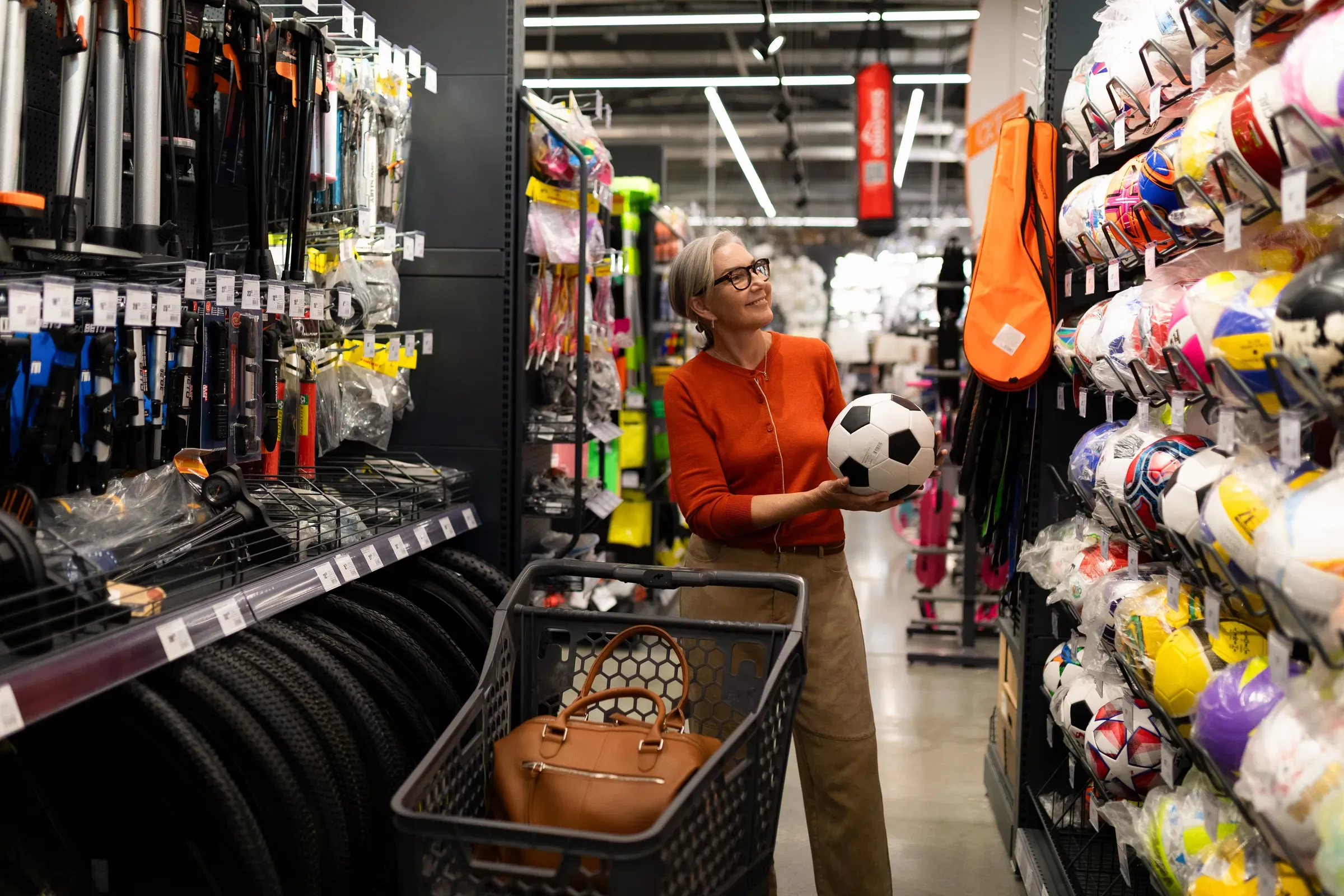
Shopping experience of a modern woman in a retail store while choosing sports equipment and accessories, team sports equipment ecommerce
Team sports equipmentParents buying for a child who has just made a team and who need to know which certification a league requires and what size fits a growing player, alongside coaches, equipment managers and club administrators buying in bulk on a deadline, often with a purchase order and a decoration list attached.

How team sports equipment makes money

Four levers, and what limits each one here

Revenue is traffic times conversion rate times order value times purchase frequency. In this niche each lever has its own ceiling.

Traffic

Traffic: the certification stamp, the age group and the equipment list

Parents search for what the league told them to buy, usually badly remembered. They search for a certification stamp they were shown on a form, for the equipment a specific age division requires, or simply for the list a coach handed out. Those searches are highly specific, low competition and almost entirely unserved by large retailers, who list a bat by brand and length and say nothing about which leagues accept it. A store that publishes a page for each certification, each age division and each sport's starting kit collects the parent at the moment of confusion, which is the moment they are most willing to buy everything in one place.

Conversion

Conversion: is it legal for the league, and will it fit next season

The parent's first question is not about quality. It is whether the item will be allowed on the field, because being turned away at a first game is the outcome they are trying to avoid. State the certification exactly as it appears on the product, name the governing bodies that accept it, and say plainly where the store is not the authority on a local rule. The second question is growth, since equipment bought for a child in March may not fit by August. Sizing guidance that talks about growing room, and a clear exchange window that runs into the season rather than ending in two weeks, both convert better than a discount.

Order value

Order value: the equipment list, the team order and the decoration

Individual order value rises when the store publishes the whole list rather than the item. A parent arriving for a helmet is usually also required to buy a mouthguard, a bag and protective gear, and a page that presents the division's full requirement as a package saves them a second trip and doubles the basket honestly. Team orders are a different scale entirely: one club order is worth many retail sales, and decoration, numbering and coordinated accessories multiply it further. The work that makes it happen is a proper ordering portal with a roster upload, size collection per player and a visible deadline, rather than a spreadsheet emailed back and forth.

Frequency

Frequency: the season repeats and the child keeps growing

This is one of the most predictable repeat cycles in retail and most stores treat every season as a fresh acquisition. A household that bought for a nine-year-old in one sport will buy again next season, in a larger size, and probably for a second sport as well. Recording the sport, the division and the season a customer bought for turns next year's campaign into a targeted reminder rather than a broadcast. Clubs are even more predictable, since they reorder annually against the same roster shape, and a store that arrives with a quote before the club goes looking usually keeps the account for years.

Search visibility

Search: certification pages, division equipment lists and the team ordering hub

Build a page for every certification standard the catalog touches, written to explain rather than to sell. What the stamp means, which governing bodies accept it, how to find it on a product, and which items in the range carry it. These pages capture parents who have been handed a rule they do not understand, they age well because standards change slowly, and they are almost never built by larger competitors.

The second build is the equipment list by sport and age division. Write it as the coach would write it, with required items separated from recommended ones, and link every item to a product. This single page format outperforms almost anything else a store in this category can publish, because it answers the exact question a new sports parent has and because it converts into a multi-item order rather than a single purchase.

The third is the team ordering hub, which needs to be indexable and to rank for the searches clubs actually run, usually a sport plus uniforms or team gear plus a region. Set out decoration options, minimum quantities, lead times and how the roster process works. Technically, the catalog is size heavy and seasonal, so sizes belong to one product, decorated items need their own handling as made-to-order goods, and out-of-season pages should stay live rather than being unpublished each year and rebuilt from nothing.

Queries that matter

  • bat certification stamp for little league
  • u13 soccer equipment list
  • youth football helmet certification
  • custom team jerseys with numbers canada
  • what size hockey stick for a 12 year old
  • mouthguard required for youth lacrosse
  • team uniform order minimum quantity

Certification explanations, equipment lists by sport and age division, and a team ordering hub with real lead times and minimums rank here. A Sports collection organized by brand, with no mention of what any league accepts, does not.

AI answers

AI answers: what the league allows and what size a growing player needs

The questions put to assistants here are rule questions and sizing questions, and both have answers that a store can state accurately without overreaching. Which certification a given league requires. What a stamp on a bat or a helmet means. What length stick or size glove suits a player of a certain age and height. Stores get cited by writing those answers plainly, naming the governing bodies rather than paraphrasing them, and being explicit that local leagues can add their own rules and should be checked. That last qualification reads as expertise rather than hedging, and it keeps the store out of trouble when a division does something unexpected.

Which bat certification does my child's league require?
What size hockey stick suits a twelve year old?
Does youth football require a specific helmet certification?
How much growing room should I allow when buying skates?
What is the minimum order for custom team jerseys?

Questions shoppers put to assistants. A store gets named when its pages answer them in plain text.

Google Shopping and Merchant Center

Shopping for a catalog split between retail and team orders

The first job is keeping the two catalogs apart. Decorated and made-to-order team products should not sit in the retail feed alongside stock items, because their pricing depends on quantity, their lead times are long and their availability is not a simple number. Custom labels separating stock retail, decorated goods and clearance make it possible to bid each one sensibly instead of averaging them into nonsense.

On the retail side, the attributes that matter are the ones a parent filters by. Age group and gender for youth apparel and protective gear, size with a size system that matches the page, and product_detail carrying the certification and the age division the item suits. Certification in particular belongs in structured data rather than buried in a paragraph, because it is the deciding factor and because it lets the listing serve the searches that name it.

Seasonality has to be reflected in availability and in bidding. Stock sells out at predictable points before each season opens, and a feed that lags real inventory during registration week produces both wasted spend and availability mismatches. Where an item is legal in some leagues and not others, the description should say so factually rather than claiming universal approval, since an overstated claim here fails a parent at the field rather than merely disappointing them.

Feed attributes that decide eligibility

  • product_detail for certification stamps and accepted age divisions
  • age_group and gender on youth apparel and protective gear
  • size with a size_system matching the sizing chart
  • item_group_id across sizes and colorways
  • gtin for branded equipment
  • custom_label separating stock retail, decorated goods and clearance

Disapprovals we see in this niche

  • Certification claimed more broadly than the product actually carries
  • Decorated made-to-order items submitted with stock availability
  • Size-level availability mismatch during registration week
  • Missing age_group and gender on youth protective apparel

Meta and social ads

Meta and social: the equipment bag, the fitting and the team reveal

Creative in this category works when it is useful to a parent who feels out of their depth. A bag unpacked item by item for a first season, with each piece named and its purpose explained, is more effective than any product shot. A fitting demonstration for skates, helmets or pads answers the sizing anxiety directly. And the team reveal, a club seeing its new kit for the first time, is content the club will share themselves, which reaches exactly the households you want.

The policy points are about children and about claims. Any creative featuring young athletes needs written permission from a parent or guardian, and clubs need to have agreed to their name and crest appearing. Protective equipment cannot be described as preventing injury, only as meeting the certification it holds, because safety promises in youth sport are both a policy problem and an ethical one. Avoid copy that addresses the viewer as a parent of a particular child, since personal attribute rules apply here as they do elsewhere.

  • A first season equipment bag unpacked item by item with each piece named
  • A skate or helmet fitting shown step by step with the measurement points
  • A club seeing its new kit for the first time, filmed with permission
  • The certification stamp found on a product and explained in ten seconds
  • A coach explaining what a division actually requires versus what is optional

Policy line

Written permission from a parent or guardian for any creative featuring young athletes, club consent for names and crests, protective equipment described by its certification rather than as preventing injury, and no copy addressing the viewer by family role.

Conversion and the store

The store: the rule, the size and a deadline the club can see

On the retail side, put the certification and the age division the product suits directly beside the price, and add a line saying that local leagues can impose additional rules and should be checked. Then handle growth honestly, with sizing guidance that talks about a season rather than a moment and an exchange window long enough to cover a child growing between purchase and first game. Bundle the division's required items so a parent leaves with everything rather than returning for the piece they missed.

The team path needs to be a different experience entirely. A roster upload or a per-player size collection form, decoration options with proofs the coach can approve, a visible production lead time and a hard order deadline shown as a date rather than a duration. Quote requests should reach a person quickly, because clubs compare and the fastest respondent frequently wins. Make clear up front that decorated goods cannot be returned, alongside the size sample process that makes that fair.

Objections the page must answer

  • “Is this allowed under my child's league rules”
  • “What size do I buy for a child who will grow this season”
  • “Can I exchange it if the coach says it is wrong”
  • “How long does decoration take and what is the deadline”
  • “What happens if a player's size is wrong on a team order”

Email, SMS and retention

Email and SMS: the season list, the growth check and the club quote

The most valuable field this store can collect is the sport, division and season a customer bought for. With that, the following year's message can arrive before registration with the right list, the right size step and the right deadline, instead of a generic seasonal promotion sent to everyone. Parents genuinely welcome it, because remembering what a child needs for a new season is a chore they would happily delegate.

Mid-season messaging is about replacement, since equipment breaks, gets lost and gets outgrown between openers. Clubs run on their own cycle, and the message that matters is a quote reminder timed several weeks before the point at which they will need to order to have kit in hand for the first game. Decoration deadlines are the one place SMS earns a place, because a missed cutoff means a team plays in the wrong shirts and everybody hears about it. Post-season is the moment to ask what worked and to capture the next division.

  1. Sport and division capture

    In the first post-purchase email

  2. Season list reminder

    Four to six weeks before registration opens, by sport

  3. Growth check

    Ten months after a youth equipment purchase

  4. Mid-season replacement

    Six weeks into the playing season

  5. Club quote reminder

    Timed backward from the first game, allowing for decoration

  6. Decoration deadline

    Ten days and two days before the production cutoff

Where revenue leaks

The leaks we find in team sports equipment stores

The Growth Analysis ranks these against your own numbers and says which to close first.

Get a Growth Analysis for your sports equipment store
  • Certification mentioned nowhere

    The one fact that decides whether a bat or a helmet can be used is missing from the page, so the anxious parent buys from a store that states it and never comes back.

  • Team orders run on emailed spreadsheets

    Sizes are collected by hand, names get transposed, the deadline slips and the club spends a season telling other clubs about it. A portal with a roster upload removes all of that.

  • A return window shorter than the wait for the season

    Equipment is bought in spring for a fall season and the exchange window closes in June, so the first-game size problem becomes a complaint instead of a swap.

  • Seasonal pages taken down every year

    The division and season pages are unpublished at the end of each cycle and rebuilt from scratch, so they never accumulate any search history and every year starts at zero.

  • No record of the sport a household plays

    The store knows what was bought but not who it was for, so next season's message goes out to everyone about everything, which is the same as sending it to nobody.

Platform notes

Where the platform changes the work

Shopify

Team ordering usually needs a separate B2B catalog with quantity pricing and its own payment terms, since clubs pay on invoice rather than by card. Decorated goods should be modelled as made-to-order products with real production lead times, and certification data belongs in metafields so it reaches the page, the structured data and the feed together.

WooCommerce

Global attributes for sport, age division and certification power the filters and the archive pages that become the division lists. Role-based pricing handles clubs and schools, and a product add-on extension collects decoration details, names and numbers as line item data that reaches the production floor intact.

BigCommerce

Customer groups suit school boards and clubs with negotiated pricing, price lists handle volume tiers, and quote workflows fit a buyer who needs approval before ordering. Product option rules keep decoration charges accurate without duplicating the underlying product.

Questions

Team sports equipment owners ask us

By CartKernel · Last reviewed

How should equipment certification be presented on product pages?

As a stated fact next to the price, naming the standard exactly as it appears on the product and the bodies that accept it, with a line noting that individual leagues can add their own rules. Being precise protects the parent from being turned away at a first game, and it protects the store from a claim it cannot support if a local division decides differently.

Should team orders run through the same store as retail?

The same store, a different path. Clubs need per-player size collection, decoration proofs, quantity pricing, invoicing and a visible production deadline, none of which belong in a standard cart. Keeping them in one platform means shared inventory and one customer record, while keeping the experiences separate means neither buyer is forced through the other's process.

How do you handle sizing for children who are still growing?

By talking about the season rather than the day. Publish growing room guidance for each category, be honest about where extra room is unsafe such as with helmets and skates, and extend the exchange window so a purchase made in spring can still be swapped when the season starts. Most sizing complaints in youth sport are timing problems rather than measurement problems.

What does the registration calendar mean for advertising?

It means the budget should be a series of spikes rather than a flat monthly spend. Each sport and region has its own registration and season start dates, and demand concentrates in the four to six weeks before each. Mapping those dates once, then pacing spend against them, typically improves results more than any change to bidding or creative.

Can decorated team products be advertised in Shopping?

It is usually better to keep them out of the retail feed. Their price depends on quantity, their availability is a production schedule rather than a stock number and their lead times are long, all of which produce mismatches. Advertise the team ordering service through search and lead campaigns instead, with the feed reserved for stock items that behave normally.

How do you keep a club account year after year?

By reaching them before they go looking. Clubs order annually against a similar roster, so a quote that arrives several weeks before they would need to order, with last year's sizes and decoration already on file, is very hard to beat. Speed of response to quote requests is the other deciding factor, because administrators compare and usually choose whoever replies first with a complete answer.

Grow your team sports equipment store.

A free Growth Analysis ranks what your store should fix first, by revenue at stake, in about a week.