Skip to content

Bags, luggage & travel gear · ecommerce growth

Duffel bag brand marketing agency

The duffel is what people buy when they refuse to check a case. Two or three nights of clothes, a gym kit that lives in the car, a bag with no wheels and no handle that still has to hold a suit without creasing it. The buying decision runs on material and capacity, the gift decision runs on how the leather looks in a photograph, and the loyalty runs on how the bag ages. We build search, feeds and campaigns around those three things.

The buyer, in brief

Consideration
A week or two for a personal purchase, far shorter when it is a gift with a date attached
Purchase frequency
A long ownership cycle for leather, shorter for gym use, with the gift path repeating annually
Seasonality
Weekend travel through spring and summer, then a heavy gifting run from November, with Father's Day and graduation peaks
Price band
Mid to premium for leather and waxed canvas, entry to mid for nylon and recycled fabrics
Return risk
Low, driven by capacity being smaller than expected and by leather colour differing from the screen
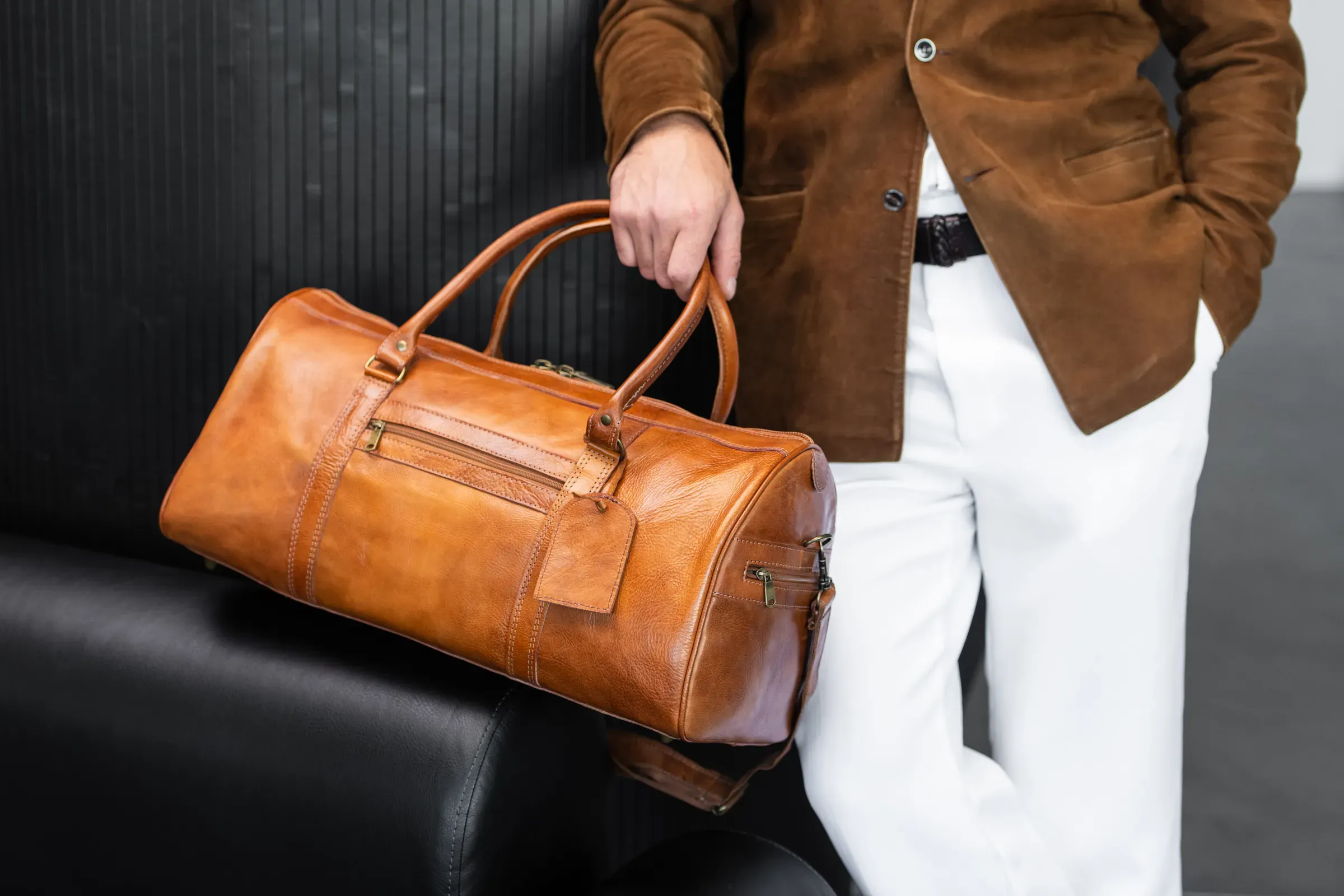
Close up of a man holding a premium tan leather duffel bag wearing a suede blazer and white trousers, duffel & weekender bags ecommerce
Duffel & weekender bagsShort trip travellers, gym goers and gift buyers who choose on material first, then capacity, and who look closely at hardware, stitching and the base of the bag in photographs before they trust the price.

How duffel & weekender bags makes money

Four levers, and what limits each one here

Revenue is traffic times conversion rate times order value times purchase frequency. In this niche each lever has its own ceiling.

Traffic

Traffic: material is the first word in the query

People type the material before they type the bag. Leather weekender, waxed canvas duffel, recycled nylon holdall, and then a capacity or a trip length after it. That makes material the primary axis for a duffel catalog, which is different from almost every neighbouring category where size leads. Each material deserves a collection with real copy about how it behaves in rain, how it ages, what it weighs and what it costs to look after. Full grain against top grain is a genuine buying question with real search volume behind it, and a brand that explains the difference honestly earns the visit from people who are still deciding what to buy rather than where to buy it.

Conversion

Conversion: photograph the bag packed and the leather up close

Two objections decide this page. The first is capacity, because a duffel has no structure and a shopper cannot tell whether three days of clothes will fit. Show it packed with named contents and state the litres and the internal dimensions. The second is the material itself, which has to survive being judged on a screen. That needs macro images of the grain, the stitching, the hardware and the base, images in daylight rather than under studio lighting, and an honest note on how the colour will darken with use. Add the shoulder strap drop and the empty weight, since a leather bag carried by hand through a terminal feels very different from a nylon one.

Order value

Order value: the things that go inside and on top

The duffel is a hub product with a natural set around it. A dopp kit in the same leather, a shoe bag, a garment folder, a laundry pouch, a matching luggage tag, a strap pad. Sold as a page rather than as a checkbox, a weekender and dopp kit set becomes a gift with an obvious story and a higher basket than the bag alone. Personalisation is the second lift, since a monogram or an embossed initial on a leather patch is a small production step that carries a meaningful premium and makes the purchase feel considered. The third is the care product, sold at the point of purchase and again later, which raises the order and starts the ownership relationship at the same time.

Frequency

Frequency: care, patina and the gift that repeats

A well made duffel is not replaced, so the repeat revenue lives elsewhere. Care is the first path: conditioner, wax reproofing for canvas, a replacement strap, a hardware repair. Those are small orders that keep the brand present and turn ownership into a relationship. The second path is the same customer buying again for someone else, which is why the gifting calendar matters more here than the replacement cycle. The third is the range, since a customer who bought a nylon gym duffel is a candidate for the leather weekender two years later. Retention work in this niche is about being the brand people think of on an occasion, not about pushing a second bag at a customer who does not need one.

Search visibility

Search: material collections, capacity guides and how the bag ages

Build the catalog on material first. A collection each for full grain leather, waxed canvas, ballistic nylon and recycled fabrics, with copy that explains behaviour rather than adjectives: how waxed canvas repels water and needs reproofing, how vegetable tanned leather darkens, what denier means in practice, which material suits a gym bag that lives in a car boot. Those pages rank because they answer a comparison the shopper is running before they choose a brand.

Capacity and trip length is the second layer. Weekender, holdall and overnight are used interchangeably by shoppers, so the pages should cover the words people use and translate them into litres and nights. A page on packing a duffel for two nights without checking a bag brings in the traveller who has not yet decided on a bag type at all.

The third layer is ownership content, which is where this niche has an advantage over most of the industry. How to condition leather, how to rewax canvas, how to remove a stain, how to store a bag between trips. These earn links, get quoted, and give the brand something to send owners that is not a discount. Technically, keep leather colourways as variants of one product, write original copy for each material collection rather than repeating it with a word swapped, and make sure high resolution imagery is served responsively so the macro shots do not slow the page down.

Queries that matter

  • leather weekender bag
  • waxed canvas duffel bag
  • full grain vs top grain leather bag
  • 40 litre duffel bag carry on
  • gym duffel with shoe compartment
  • how to condition a leather bag
  • duffel bag for 2 night trip

Material collections with genuine explanations, care and patina guides, and capacity pages written in nights rather than litres alone rank here. A grid of bags under a heading called Duffels does not.

AI answers

AI answers: material questions assistants are asked to settle

The questions put to assistants in this niche are about material behaviour and fit. Whether waxed canvas is genuinely waterproof, what full grain leather means and why it costs more, whether a duffel of a stated size will go in an overhead locker, how to care for a bag so it lasts. A store earns a citation when its material pages explain the property rather than praise it, when the specification carries litres, dimensions, empty weight and strap drop as text, and when the care instructions are specific enough to follow. We write those pages to stand alone and keep the same figures on the page, in the structured data and in the feed.

Is waxed canvas waterproof or only water resistant?
What is the difference between full grain and top grain leather?
Will a 40 litre duffel fit in an overhead locker?
How do I stop a leather bag from drying out?
How many nights of clothes fit in a weekender bag?

Questions shoppers put to assistants. A store gets named when its pages answer them in plain text.

Google Shopping and Merchant Center

Google Shopping and Merchant Center for duffels and weekenders

The attribute that matters most here and gets neglected most is material. It is a supported attribute, it appears in the queries people type, and a feed that leaves it blank while the title says Weekender Bag is competing on nothing. Send material properly, use pattern where a canvas or waxed finish has one, and put the capacity, internal dimensions, strap drop and empty weight into product_detail so the listing can answer the fit question in the panel.

Titles should lead with the material and the type, then capacity, then colour, because leather weekender bag is the search and the algorithm is matching text. Colourways group under item_group_id, and where a bag is offered in a personalised version the personalised item needs its own handling rather than being sent as a duplicate of the standard one.

Gifting season is where this category gets into trouble. Promotions applied at cart level put the feed price out of step with the page, stock on the popular leather colour disappears mid week, and rushed lifestyle images with seasonal text overlays get flagged. Set promotions as product level sale prices, keep availability syncing frequently through the peak, and keep the main image clean. Merchant Center promotions are worth using in this window because gifting shoppers respond to a visible offer, but only when the promotion terms on site match the feed exactly.

Feed attributes that decide eligibility

  • material
  • pattern for canvas and waxed finishes
  • product_detail for capacity, internal dimensions and strap drop
  • item_group_id for colourways
  • gtin or identifier_exists
  • shipping_weight
  • custom_label for gift price band

Disapprovals we see in this niche

  • Price mismatch when a gifting promotion applies only in the cart
  • Availability mismatch on a popular leather colour during peak weeks
  • Text or badge overlays added to product images for a seasonal sale
  • Missing material and pattern attributes leaving listings unmatched

Meta and social ads

Paid social: the grain, the pack and the bag five years on

Duffel creative sells texture and time. Macro footage of leather grain and stitching, hardware turning in the light, a hand pushing on the base to show it holds shape. Then the practical proof: the bag packed for two nights in real time, a suit folded in without creasing, the shoe compartment used. Then the long game, an owner showing a bag that has darkened over years, which is the most persuasive thing this category can put on screen and the hardest for a newer brand to fake, so it should only be run when it is real.

Audiences start with buyers and visitors, then broad prospecting with product forward creative. In the gifting window, creative should say who the bag is for and what the delivery cut off is rather than leaning on a discount. The policy points to respect are simple: any waterproof or lifetime claim in an ad has to match the specification and the warranty, leather sourcing statements need to be accurate, and creator footage needs written rights before it runs in the brand account.

  • Macro texture pass across grain, stitching, hardware and base
  • Packed in real time for two nights, contents named
  • A suit or shirt folded in and taken out uncreased
  • An owner's bag after several years, shown honestly
  • Care routine filmed as a short, useful sequence
  • Gift framing with the personalisation being applied

Policy line

Waterproof, full grain and lifetime claims in creative must match the product specification and warranty wording, leather sourcing statements have to be accurate, and creator footage needs written rights before it runs.

Conversion and the store

The store: proving a soft bag holds what you say it holds

A duffel page has to fight two kinds of doubt. Capacity doubt is answered with a packed photograph, a named contents list, litres and internal dimensions, and a plain sentence about how many nights it covers. Material doubt is answered with close photography, an honest description of how the finish will change, the empty weight, and the care instructions shown on the page rather than tucked into a policy link. Hardware deserves its own line, because zips and clips are where a shopper expects a cheap bag to fail.

Where the range is personalised, the page has to say what the monogram looks like, how long production adds, and that a personalised bag cannot be returned in the usual way. Hiding that until the confirmation email creates the worst kind of complaint. On mobile, colour selectors should show the actual leather rather than a colour dot, the gallery should open to the macro shots quickly, and the delivery estimate needs to be a date during gifting weeks. A gift wrapping and message option, offered at cart rather than as an afterthought, converts a browsing gift buyer better than a discount does.

Objections the page must answer

  • “Will three days of clothes actually fit”
  • “Is this real leather and how will it look in a year”
  • “How heavy is it when it is empty”
  • “Will the zip or the strap fail first”
  • “If I have it monogrammed, can I still return it”
  • “Will it arrive in time to give as a gift”

Email, SMS and retention

Email and SMS: an ownership programme, not a newsletter

This niche rewards contact that is about the bag rather than about the shop. The first sequence after delivery covers how to break the material in, how to store it and what to expect as it ages, which sets up the care products without selling them yet. A care reminder timed to a season, before winter for leather and before a wet season for canvas, sells conditioner and reproofing wax to people who are glad to be reminded.

The gifting calendar is the second engine and needs its own segment. People who bought as a gift last year are the best audience for the same occasion this year, and they respond to lead times and price bands rather than to percentages. A personalisation cut off reminder is one of the highest performing sends this category has, because the deadline is real and the shopper is already deciding. SMS is used sparingly for those cut offs and for restock alerts on a colour, since the audience for a premium bag has little tolerance for volume.

  1. Break in and storage guidance

    Within days of delivery, before the first trip

  2. Care product introduction

    Around six weeks after purchase

  3. Seasonal care reminder

    Before winter for leather and before the wet season for canvas

  4. Occasion prompt for previous gift buyers

    Ahead of the same occasion the following year

  5. Personalisation cut off

    In the final week that engraved orders can be produced and shipped

Where revenue leaks

The leaks we find in duffel & weekender bags stores

The Growth Analysis ranks these against your own numbers and says which to close first.

Get a Growth Analysis for your duffel and weekender range
  • Material left out of the feed and the title

    The word people search with is missing from the two places the algorithm reads, so a leather bag competes as a generic holdall and loses impressions it should own.

  • No packed photograph anywhere in the gallery

    Every image shows an empty bag on a plain background, so the capacity question goes unanswered and the shopper leaves to find a review that shows it full.

  • Personalisation terms revealed after payment

    The lead time and the return restriction appear in the confirmation email rather than on the product page, which turns a premium order into a dispute during the busiest weeks of the year.

  • Care products with no route to owners

    Conditioner and reproofing wax sit in the catalog unadvertised and unmentioned in any flow, so the easiest repeat order in the range never happens.

  • Gifting promotions applied only in the cart

    The feed keeps quoting the full price while the site shows a discount, which puts the account into price mismatch in the week it can least afford to lose visibility.

Platform notes

Where the platform changes the work

Shopify

Material, capacity, strap drop and care instructions belong in metafields so the specification block, the feed and the collection pages all read from one source. Personalisation is best handled with line item properties plus a production lead time surfaced on the product page, and gift messaging added at cart rather than through a checkout extension that hides it.

WooCommerce

Global attributes for material and capacity give indexable archives and consistent filters, and product add-ons handle monogramming, but the feed needs the material attribute mapped explicitly since most default mappings send only title, price and image.

BigCommerce

Custom fields carry the material and care detail, and product option rules can price personalisation without creating a separate SKU that duplicates the parent in the feed.

Questions

Duffel & weekender bags owners ask us

By CartKernel · Last reviewed

Should material or capacity lead the way we organise duffels?

Material, because that is how the query is phrased. A shopper types leather weekender or canvas duffel far more often than a litre figure, which is the reverse of how backpacks are searched. Build the material collections first with genuine explanations of how each behaves, then layer capacity and trip length pages on top and cross link them.

Is care content worth writing when we sell bags rather than care products?

Yes. Conditioning, reproofing and stain guides earn links and steady search traffic, they get quoted by assistants answering ownership questions, and they give the brand a reason to contact past customers that is not promotional. They also sell the care products, which are the most natural repeat order this range has.

How should personalised bags be handled in the product feed?

As a distinct item rather than a duplicate of the standard bag, with availability that reflects the production lead time and a description that states the personalisation is applied to order. Sending it as an identical copy of the plain version creates competing listings and a delivery promise the workshop cannot meet.

What changes about the account during the gifting season?

The buyer changes, so the campaigns should too. Gift searchers work from price bands, occasions and delivery dates rather than from material knowledge. They need their own campaigns, landing pages built around occasion and price, promotion data set at product level, and a firm stop when the shipping and engraving deadlines pass.

How do you photograph a soft bag so people trust the capacity?

Packed, with the contents named and visible beside it, plus a shot of the bag on a person for scale and a shot standing on its own with the base under load. Empty studio images look clean and settle nothing, and the capacity question is the most common reason a duffel comes back.

Do you work with brands that sell both a gym range and a premium leather range?

Often, and the important thing is to keep them separate in the navigation, the campaigns and the creative. The gym buyer and the leather buyer ask different questions and respond to different proof. Shared checkout and shared retention are fine, but a single collection that mixes them tends to underperform for both.

Grow your duffel & weekender bags store.

A free Growth Analysis ranks what your store should fix first, by revenue at stake, in about a week.