Skip to content

Books, stationery & paper · ecommerce growth

Wedding invitation marketing agency

Wedding stationery is bought in stages across a year or more, usually by someone who has never ordered print before and is quietly terrified of a typo reaching two hundred guests. The first conversion is almost never an invitation, it is a sample pack. We build the whole sequence: the style and etiquette content couples find while they are still planning, a sample path that turns into an order, and a proofing process that reassures instead of stalling.

The buyer, in brief

Consideration
Weeks to months from first saved image to a sample request, then days from sample to order
Purchase frequency
Three or four separate purchases across one engagement, then occasional life-event stationery afterwards
Seasonality
Engagement season from late December into February sets the intake, with ordering peaks running ahead of spring and summer wedding dates
Price band
Mid to high, with the full suite often the largest single stationery order a person ever places
Return risk
Rare on personalized print, which puts all of the weight on proofing accuracy and clear approval steps
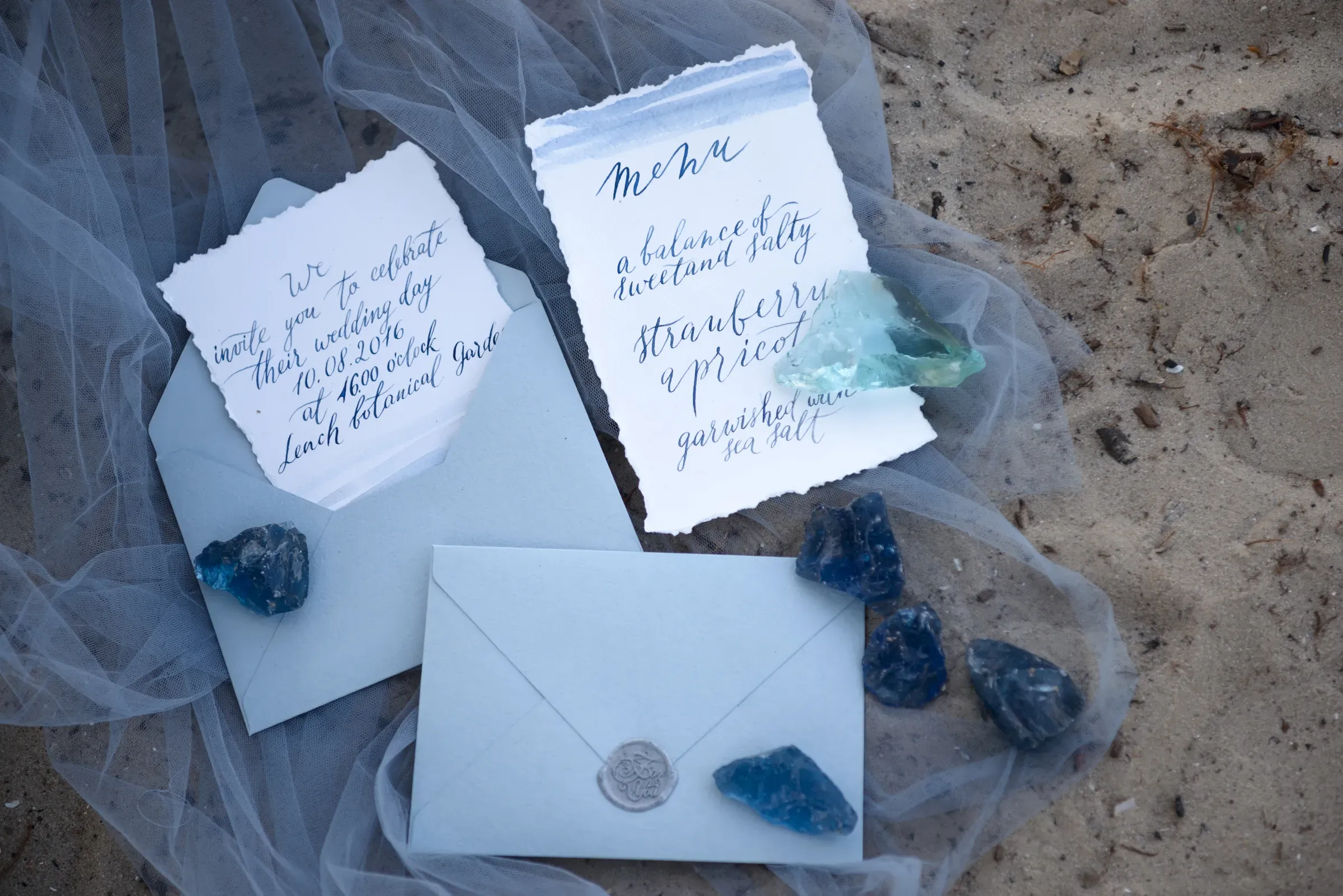
Wedding invitation. accessories wedding on the sand, wedding invitations & print ecommerce
Wedding invitations & printEngaged couples and the family members helping them, planning nine to eighteen months ahead, comparing styles they have saved for months, unsure how many to order or how to word anything, and unwilling to commit before holding a printed sample.

How wedding invitations & print makes money

Four levers, and what limits each one here

Revenue is traffic times conversion rate times order value times purchase frequency. In this niche each lever has its own ceiling.

Traffic

Traffic: styles today, etiquette for the whole year before

Couples start looking a year out and buy months later, which means the demand that matters most is informational. How many invitations to order for a guest list, when to send save the dates, how to word an invitation when parents are divorced or when both families are hosting, how to address envelopes, what goes inside a suite. That content reaches people long before any product page could, and it comes from a studio with genuine authority to answer. Alongside it sit style and method searches, letterpress, foil, vellum, deckled edge, seal and send, each of which deserves a collection page written by someone who understands what the method actually does to paper.

Conversion

Conversion: the sample pack is the real add to cart

Nobody commits to a large order of personalized print on the strength of a screen impression of paper. The sample pack is the conversion event that matters, and it should be easy to find, cheap or free, honestly described and fast to dispatch. What happens next decides the business: capturing the wedding date and the guest count at the request, then following up with timing advice rather than a discount. Studios that treat samples as a cost center send them out and wait. Studios that treat them as the funnel convert a large share of them, because a couple holding your paper is comparing feel and finish rather than price.

Order value

Order value: the suite, then the day itself

The invitation is one piece of a much larger order most couples do not realize they are going to place. RSVP cards, details and accommodation cards, envelopes with printed or calligraphed addressing, wax seals, vellum wraps and ribbon all belong to the same decision and are far easier to sell at that moment than later. Then comes the day-of stationery: menus, place cards, table plans, order of service, signage and favors, which is a second substantial order and one many studios never mention. Presenting the suite as a suite, with a clear picture of what the whole set looks like, moves the average order more than any discount could.

Frequency

Frequency: a sequence rather than a repeat

This customer buys three or four times in eighteen months and then, usually, not again. That makes the wedding date the single most valuable piece of data a studio can hold, because it turns every follow-up into a timed message rather than a guess. Save the dates around nine to twelve months out, invitations around three to four months out, day-of stationery six to eight weeks before, thank you cards after. A studio that captures the date at the sample request can run that entire sequence automatically. Afterwards, the relationship continues through referrals to other couples, which is why the post-wedding message matters more than it looks.

Search visibility

Search: planning questions, wording and printing methods

The planning content is the acquisition engine and it is a genuine service rather than a keyword exercise. Quantity guidance explaining that invitations are ordered per household rather than per guest, with extras for keepsakes and mistakes, prevents the most common ordering error in the category. Timeline guidance sets expectations for how far ahead each piece needs to be ordered. Wording pages covering different family arrangements, second marriages, hosting lines and formality levels are searched constantly and answered badly across most of the web, which leaves the position open to a studio willing to write them properly.

Style and method collections handle the commercial demand. Letterpress, foil, engraving, digital, vellum, handmade paper and deckled edges each need a page that explains how the method looks and feels, what it costs relative to the others, and what it does to lead times, with the studio's own work shown throughout.

The technical work is mostly about samples and structure. The sample pack needs its own indexable page and its own campaign, since it is the primary conversion. Suite pages should link to every component so a couple can see the whole set, and personalization options should not generate hundreds of near-duplicate URLs. Photography of real suites, named and described in text, carries far more weight here than stock imagery.

Queries that matter

  • how many wedding invitations for 100 guests
  • when to send save the dates
  • wedding invitation wording when parents are divorced
  • letterpress wedding invitations
  • vellum wrap invitation suite
  • wedding invitation sample pack
  • what to include in a wedding invitation suite

Etiquette, wording, quantity and timeline guides rank strongly here, alongside printing method collections showing real work. Product pages alone rarely reach couples early enough to be part of the decision.

AI answers

AI answers: the questions couples ask before they choose a studio

Wedding planning has moved substantially toward asking an assistant, and the questions are the practical ones a studio answers every week. How many invitations are needed for a guest list, how far ahead to send them, what belongs in a suite, how to word a line when both families are hosting, and what the difference between letterpress and foil actually is. Getting cited means publishing those answers as clear text with the reasoning included, keeping numbers and timelines consistent across every page they appear on, and describing printing methods factually rather than in atmospheric language. We write the guidance so it stands alone, then link it to the work that demonstrates it.

How many wedding invitations do I need for 100 guests?
How far in advance should invitations be sent?
What is the difference between letterpress and foil printing?
What should be included in an invitation suite?
How do you word an invitation when both families are hosting?

Questions shoppers put to assistants. A store gets named when its pages answer them in plain text.

Google Shopping and Merchant Center

Shopping and feeds for bespoke and made-to-order stationery

This is a niche where Shopping does part of the job and no more. A bespoke suite priced by quantity, paper and printing method cannot be represented honestly by a single feed price, and forcing it in produces mismatch warnings and disappointed clicks. What does belong in a feed is the fixed-price catalog: sample packs, ready-to-order designs at defined quantities, day-of stationery sold as sets, wax seals, envelopes and accessories. Those listings can be exact, and the sample pack in particular is worth advertising because it is the entry point to everything else.

Made-to-order print has no barcode, so identifier_exists is set to false with brand and MPN filled in properly. Paper stock, printing method, size and quantity belong in product_detail and size so the listing matches how couples describe what they want. Shipping settings must include proofing and production time, because a delivery estimate that assumes stock on a shelf will be wrong by weeks on a personalized suite.

Campaigns are best structured around the sample pack and the fixed catalog, with everything bespoke handled through search ads pointing at style collections and the enquiry path. Free listings are worth switching on for the accessory and day-of ranges, where the products are concrete and the competition is thinner than on invitations themselves.

Feed attributes that decide eligibility

  • identifier_exists false for personalized and made-to-order print
  • sample pack listed as its own fixed-price product
  • product_detail for paper stock, printing method and card size
  • size and quantity stated for fixed sets
  • custom_label separating samples, ready-to-order and day-of ranges
  • shipping settings including proofing and production time

Disapprovals we see in this niche

  • Price mismatch where a per-card price differs from the quantity-based checkout
  • Missing GTIN errors on bespoke printed suites
  • Delivery estimates that ignore proofing rounds and production
  • Availability mismatch when a paper stock or foil color is discontinued

Meta and social ads

Meta and social: paper that people want to save

This category is built on saved images, and the creative that earns saves is close, slow and tactile. The press making an impression into cotton paper, an envelope being addressed by hand, a suite laid out flat with every piece in place, a wax seal being pressed and lifted, a sample pack opened on a kitchen table. Real weddings shown with permission carry more weight than styled shoots, because couples are looking for evidence that the work exists outside a mockup.

Two constraints matter. Life-event audience options have narrowed and changed repeatedly over the years, so building a strategy that depends on a specific engagement segment continuing to exist is risky, and broad prospecting on strong creative plus lookalikes from sample requesters is the more durable approach. Second, real couples' photographs, names and wedding details need explicit written permission before appearing in advertising, since a wedding is a private event and a photographer usually holds the image rights as well. We keep a simple release process so the studio's best work can be used without a scramble later.

  • The press making an impression into thick cotton paper
  • An envelope being addressed by hand in real time
  • A full suite laid out piece by piece
  • A wax seal pressed, lifted and cooled
  • A sample pack opened and handled on a table

Policy line

Real couples' photographs, names and wedding details need written permission and usually a photographer's release before they appear in ads, and audience strategy should not depend on life-event targeting segments that change without notice.

Conversion and the store

The store: removing the fear of getting print wrong

Every objection in this niche comes back to irreversibility. Personalized print cannot be returned, so the page has to make the process feel controlled. That means the quantity guidance stated on the product page rather than in a blog post, the proofing process explained step by step with the number of revision rounds included, the production and delivery timeline shown as dates rather than as a range, and the sample pack offered as the low-risk first step at every point where hesitation is likely.

The suite view does the order value work. Showing the whole set together, with each component priced and selectable, lets a couple build what they need in one place instead of discovering the details card two weeks later. Wording help belongs inside the ordering flow, with templates for common situations, because the moment a couple stalls on wording is the moment an order gets postponed indefinitely. On mobile, where most of the initial browsing happens, close-up texture photography needs to load fast and zoom well, since paper is the thing being sold.

Objections the page must answer

  • “How many do I actually need to order for my guest list”
  • “What does the paper feel like and can I see it first”
  • “What happens if there is a typo after it prints”
  • “How many rounds of proofs are included”
  • “How long does the whole process take from order to delivery”
  • “Can the save the dates, invitations and menus all match”

Email, SMS and retention

Email and SMS: everything timed from the wedding date

Capture the wedding date at the sample request and the entire follow-up plan writes itself. A couple eleven months out gets save the date guidance, the same couple at four months gets invitation timing, at eight weeks gets day-of stationery, and after the date gets thank you cards. That sequencing outperforms any promotional calendar because it arrives exactly when the couple is thinking about that specific piece.

The sample follow-up is the flow that matters most. It should reference what was sent, answer the questions people ask after handling the paper, and make the next step obvious without pressure, since this is a considered purchase and pressure reads badly in a wedding context. Proof approval reminders protect the production schedule. A post-wedding message asking how the day went, with a gentle referral request, is worth more in this niche than most retention tactics, because couples talk to other couples who are planning. SMS suits proof approvals and delivery updates only.

  1. Sample pack follow-up

    Two days after the samples arrive

  2. Date-driven planning sequence

    Keyed to the wedding date at nine, four and two months out

  3. Proof approval reminder

    The day after a proof is sent, then every second day

  4. Day-of stationery introduction

    Six to eight weeks before the wedding date

  5. Thank you cards and referral

    Two to three weeks after the wedding date

Where revenue leaks

The leaks we find in wedding invitations & print stores

The Growth Analysis ranks these against your own numbers and says which to close first.

Get a Growth Analysis for your wedding stationery studio
  • Sample packs sent into silence

    The studio's strongest conversion moment ends with a parcel and no follow-up, so couples who liked the paper drift to whoever emailed them a week later.

  • The wedding date never captured

    Without the date, every message is a guess. With it, the whole eighteen-month sequence can be timed precisely, which is the difference between a list and a pipeline.

  • Unlimited proof rounds

    Revisions run without a stated limit, so margin drains into repeated changes and dispatch dates slip while everyone stays polite about it.

  • Day-of stationery never mentioned

    A second substantial order goes unasked for because menus, place cards and table plans were never introduced to a customer who already trusts the studio.

  • No quantity guidance on the page

    Couples order by guest count instead of by household, end up with far too many or too few, and blame the studio for a mistake the page could have prevented.

Platform notes

Where the platform changes the work

Shopify

Line item properties capture names, wording and guest counts against each order, draft orders handle bespoke quotes without forcing a bespoke price into the storefront, and metafields hold paper stock and method data for both the page and the feed.

WooCommerce

Product add-ons and quantity-based pricing cover suites priced per card, and a proofing workflow can be attached to the order status so approval is tracked in the same place as fulfillment rather than in an inbox.

Headless commerce

Worth it only where a studio needs a genuinely custom suite builder with live previews of personalized text, which is a real build rather than an app configuration and should be justified by order volume first.

Questions

Wedding invitations & print owners ask us

By CartKernel · Last reviewed

What should a wedding stationery studio treat as its main conversion?

The sample request, not the invitation order. Almost nobody commits to a large personalized print order without touching the paper first, so the site, the ads and the reporting should all be built around getting a sample into a couple's hands and following up properly once it arrives.

How far ahead do couples actually start looking for invitations?

Usually nine to eighteen months before the wedding, though they order much later. That gap is why planning and etiquette content matters so much: it reaches couples during the research phase, when no product page is relevant yet, and keeps the studio present until the ordering decision arrives.

Can bespoke stationery be sold through Google Shopping?

Partly. Sample packs, fixed designs at set quantities, day-of stationery and accessories can be listed accurately and perform well. Fully bespoke suites priced by quantity and method cannot be represented by a single feed price without mismatch problems, so those are better served by search ads and enquiry paths.

How many proof rounds should be included?

A stated number, published on the page. Two or three included rounds with a clear charge beyond that protects both the schedule and the margin, and couples find it reassuring rather than restrictive because it tells them the process has structure. Unlimited revisions quietly cost more than the order is worth.

What is the best way to increase the average order in this niche?

Show the whole suite together and introduce day-of stationery before the invitation order is complete rather than months later. Envelope printing, wax seals and details cards attach naturally at the point of decision. Once a couple has approved a proof, they are far more likely to add matching pieces than to start a new decision elsewhere.

How do you use real weddings in marketing without causing problems?

Ask at the point of delivery and get it in writing, including permission from the photographer whose images you want to use. Build a simple release into the post-wedding message, when goodwill is highest. That gives the studio a library of genuine work it can use in ads and on collection pages without checking rights every time.

Grow your wedding invitations & print store.

A free Growth Analysis ranks what your store should fix first, by revenue at stake, in about a week.