Skip to content

Electronics & gadgets · ecommerce growth

PC builder marketing agency

A build is planned long before it is bought. The customer has a parts list open in another tab, a budget they keep rearranging, and one component they refuse to compromise on. Whether they end up buying the parts or paying somebody to assemble them depends on which store answers the compatibility question and shows real stock at a real price. We build component stores and system integrators around that decision: pages that resolve socket and clearance questions, configurators that finish, feeds that survive weekly price movement, and a calendar planned around launches nobody in the store controls.

The buyer, in brief

Consideration
Weeks to months for a full build, hours for a single replacement part or an upgrade
Purchase frequency
A full system every four to six years, with upgrades in between: storage, memory, cooling and eventually the graphics card
Seasonality
Driven by silicon launches and major game releases more than by retail dates, with a heavy Black Friday, a back-to-school window and a January period when holiday machines get upgraded
Price band
From inexpensive fans and cables to complete high-end systems, with prices on key components moving week to week
Return risk
Concentrated in dead-on-arrival parts and compatibility mistakes, and complicated by the question of whether the store or the manufacturer handles the replacement
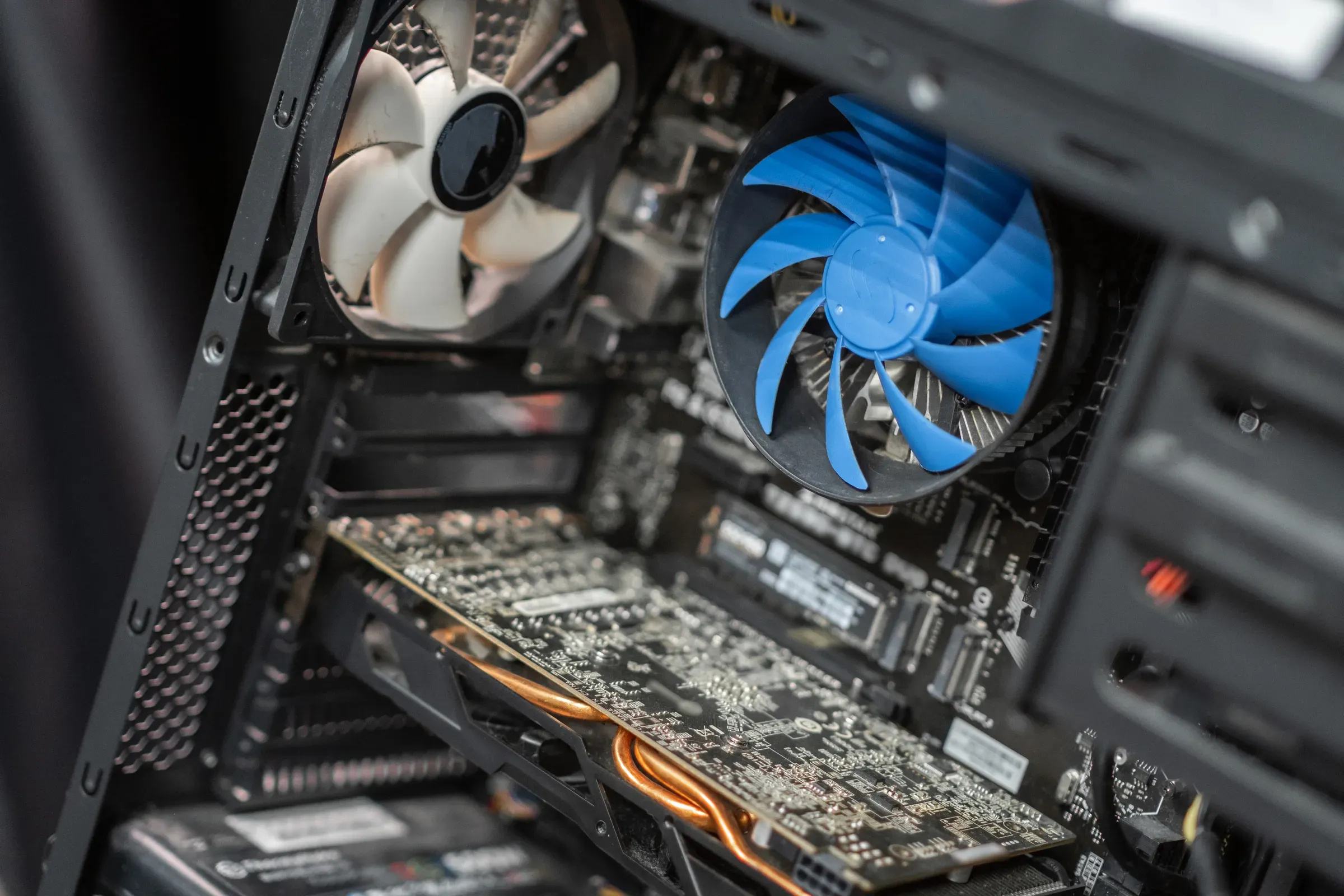
Inside a computer case showcasing components like a graphics card, cooling fan, and intricate circuitry, pc components & custom pcs ecommerce
PC components & custom PCsSelf-builders working from a saved parts list, gamers and creators who want a finished machine with a warranty, and small studios buying workstations. They verify socket and chipset support, power supply headroom, case clearance and memory compatibility, and they check current pricing across several sellers before committing to any single part.

How pc components & custom pcs makes money

Four levers, and what limits each one here

Revenue is traffic times conversion rate times order value times purchase frequency. In this niche each lever has its own ceiling.

Traffic

Traffic: sockets, clearances and the build somebody is planning

Component demand is compatibility demand. People search whether a cooler fits a case, whether a board supports a chip, how much power supply a card needs and which memory kit a motherboard has validated. Alongside that sit build-list queries, where somebody describes a budget and a purpose rather than a part. Very few stores build pages for either. The work is a compatibility layer generated from real product attributes, socket and chipset pages, clearance pages by case, and build guides at defined budgets and use cases that are updated as parts change. Those guides are also the only realistic way to rank against publications that review hardware full time.

Conversion

Conversion: the configurator either finishes or it does not

For a system integrator the configurator is the store. Almost every abandonment traces to the same causes: an incompatible option that is offered and then rejected at the end, a price that jumps without explanation, a lead time that only appears at checkout, or a step count that makes the buyer feel they have lost their place. A configurator that validates as it goes, shows the running total and the estimated build time from the first screen, explains why an option is unavailable rather than hiding it, and saves the configuration to a link converts far better. For component stores the equivalent is showing real stock, real dispatch timing and a compatibility check against the parts already in the cart.

Order value

Order value: the parts a build actually needs

Baskets in this niche grow by completing the build rather than by adding accessories. A graphics card order that does not prompt the buyer about power supply headroom is an incomplete sale and often a return. A motherboard should surface validated memory. A case should surface fans that fit its mounts and a cooler that fits its clearance. Thermal paste, cables of the right length, an operating system and storage are all natural additions when the store knows what is already in the cart. For assembled systems the honest upgrade path is the lever: more storage, better cooling and a longer warranty are worth explaining, and each should be justified by what the customer said the machine is for.

Frequency

Frequency: upgrades on a schedule the parts set

A finished build is not the end of the relationship, it is the start of a predictable upgrade sequence. Storage fills first, memory becomes the limit next, cooling and fans get revisited when a room gets warm, and the graphics card is replaced when a game or an application demands it. A store that records what a customer built can time each of those and can tell them what will and will not fit their existing system, which is a message no general retailer can send. Peripheral and monitor attach happens later too, usually once the machine has proven itself.

Search visibility

Search for builders: compatibility, part numbers and budget build lists

Compatibility pages are the highest-value asset a component store can own, and they should be generated rather than written. Socket pages listing every compatible processor and board, case pages listing coolers and card lengths that fit, and power supply guidance by card generation all answer questions asked thousands of times a month, and all can be built from attribute data the store already holds. The requirement is that the data stays correct, so these pages need an owner and a refresh process rather than a one-time publication.

Build lists at defined budgets and purposes are the second layer. They rank, they earn links and they convert directly, but they age fast because component prices and availability move constantly. The way to keep them useful is to build them from live catalog data with a visible last-updated date and a note when a listed part is unavailable, rather than as static articles that quietly become wrong.

The technical work is unusual because part numbers matter more than product names. A buyer searches an exact model string, sometimes with a suffix that distinguishes two otherwise identical cards. Product pages need those strings as indexable text, structured data that validates, and clear handling of discontinued parts, since a component that is no longer sold still attracts search traffic from people trying to upgrade an older machine and should point them to what replaces it.

Queries that matter

  • will this cooler fit in a named case
  • what power supply for a specific graphics card
  • am5 motherboard compatibility list
  • 1000 dollar gaming pc build 2026
  • ddr5 memory qvl for a named board
  • gpu length clearance mid tower
  • prebuilt vs custom pc which is better value

Generated compatibility pages, current build lists with live pricing and stock, and part pages carrying the exact model string rank in this niche. Static build articles from two years ago and category pages with no compatibility data do not.

AI answers

AI answers: compatibility questions assistants are asked about builds

Almost every assistant question in this category has a correct answer that depends on data, not opinion. Will this fit, is this enough power, does this board support this chip, is this bottlenecking that. Stores get named when the compatibility statement is on the page in plain text, when the exact part number appears where a person would type it, and when stock and price in the feed match the page an assistant is reading. Build recommendations are harder to be cited for, because assistants tend to prefer sources that show their reasoning, which is a good argument for build lists that explain each choice rather than just listing parts.

Will this graphics card fit in my case?
Does this motherboard support the processor I already own?
How many watts does this build need?
Is it cheaper to build this myself or buy it assembled?
Which memory is validated for this board?

Questions shoppers put to assistants. A store gets named when its pages answer them in plain text.

Google Shopping and Merchant Center

Feeds for components and assembled systems, which behave nothing alike

Component feeds are straightforward in principle and punishing in practice. Nearly every part carries a GTIN and an MPN and both should be present, because the exact model string is how a buyer searches and how Google matches. The difficulty is price and stock. Component pricing moves frequently and popular parts sell out in hours, so a feed refreshed once a day produces price mismatches and availability problems by mid-afternoon. Frequent updates, or a supplemental feed for price and availability, are not an optimisation here, they are the baseline for staying approved.

Assembled systems are a different problem. A custom build has no manufacturer barcode, so identifier_exists is set to false rather than borrowing a component's code. Configurable systems should be represented as defined configurations with fixed prices rather than as a price that changes with every option, since a listing whose price does not match the landing page is disapproved regardless of the reason. Build lead time belongs in the description and on the page, and availability should reflect the assembly queue rather than component stock.

Campaigns split by margin, which in this niche is dramatic. High-value low-margin parts cannot carry the same target as cases, cooling, cables and peripherals, and assembled systems sit somewhere else again with far higher order value and a longer path.

Feed attributes that decide eligibility

  • gtin and mpn carrying the exact model string including suffixes
  • identifier_exists false on custom assembled systems
  • product_detail for socket, form factor, wattage and clearance
  • price and availability updated far more often than daily
  • google_product_category at the computer component nodes
  • custom_label for margin band and for build versus part

Disapprovals we see in this niche

  • Price mismatch on components repriced during the day
  • Availability mismatch on parts that sold out between feed refreshes
  • Custom builds submitted with a borrowed component GTIN
  • Configurable system prices that do not match the landing page

Meta and social ads

Social creative for an audience that reviews hardware for fun

This audience is unusually well informed and unusually quick to detect a claim that has not been tested, so the creative that works is closer to documentation than to advertising. Build footage with cable management worth looking at, thermal and noise behaviour shown honestly, a machine actually running the workload it was bought for, and a customer's finished system with the parts named all perform. Renders of a case with lighting effects and no context do not.

Warm audiences carry most of the value: previous customers grouped by what they built, visitors who configured a system without ordering, and people who joined an in-stock notification list. Prospecting works broad, since hardware interest targeting is saturated with viewers rather than buyers. Any performance claim in creative should describe the exact configuration and settings it came from, because this audience will ask, and an unqualified number invites a public correction the brand does not need.

  • A full build shown start to finish with the parts list on screen
  • Thermals and noise measured on camera in a normal room
  • The same workload run on two configurations, side by side
  • A customer's finished machine with every component named
  • Cable management and assembly quality shown close up

Policy line

State the exact configuration and settings behind any performance figure shown, avoid implying a result from one component that came from the whole system, and secure written rights for customer build photographs before running them as advertisements.

Conversion and the store

The configurator and the compatibility check carry the revenue

For an integrator, most of the conversion work is inside the configurator. It should validate compatibility as options are chosen rather than at the end, keep the running price and the estimated dispatch date visible throughout, explain unavailable options rather than hiding them, and let a buyer save and share a configuration so they can consult somebody before ordering. Warranty terms, what testing is done before shipping and who handles a fault in month eight belong on the same page as the price, because those are the reasons somebody pays for assembly instead of building it themselves.

Component pages need a compatibility block driven by the parts already in the cart, honest stock language rather than a vague in-stock badge, and a clear statement of whether a faulty part is replaced by the store or through the manufacturer. On mobile, the parts list has to remain readable and editable, since a large share of planning happens on a phone even when the order is placed on a desktop later.

Objections the page must answer

  • “Will these parts actually work together”
  • “Is the power supply enough for this card”
  • “How long until it ships if it has to be assembled”
  • “Who handles a faulty component, you or the manufacturer”
  • “Is this price going to drop next week”
  • “Am I paying too much for assembly I could do myself”

Email, SMS and retention

Email around launches, restocks and the upgrade after the build

Two lists do most of the work in this niche and neither is a newsletter. The first is the in-stock notification list for parts that sell out, which converts at a rate no broadcast campaign approaches and which fills itself if the product page offers it properly. The second is the saved configuration list, since a large share of configurator abandonment is somebody thinking rather than somebody leaving. A short sequence that returns the exact build they assembled, with a note on any part that changed price or availability, recovers a meaningful share of those.

After a build ships, onboarding covers first boot, driver and firmware notes, what the warranty covers and how to ask for help, which reduces support load and early returns. From there the messages follow the machine on file: a storage upgrade when the drive they chose is likely full, memory when their workload suggests it, and a graphics card conversation timed to a generation rather than to a promotion. Every one of those can be filtered by what will physically fit the system the customer owns.

  1. Back in stock notification

    The moment a watched part returns to stock

  2. Saved configuration recovery

    One, three and seven days after a configuration is abandoned

  3. First boot and warranty registration

    On delivery of an assembled system

  4. Upgrade path by machine on file

    Nine to eighteen months after the build, filtered by what fits

  5. Launch waitlist

    From announcement to availability for a new component generation

Where revenue leaks

The leaks we find in pc components & custom pcs stores

The Growth Analysis ranks these against your own numbers and says which to close first.

Get a Growth Analysis for your PC build store
  • Configurations abandoned with no way to return to them

    A buyer spends twenty minutes assembling a system, closes the tab to think, and the store keeps neither the configuration nor a way to send it back to them.

  • Feeds refreshed once a day in a market that reprices hourly

    Component prices and stock move constantly. A daily feed produces price and availability mismatches every afternoon, and the account spends the evening serving listings that are already wrong.

  • Compatibility answered only by a third-party tool

    Buyers resolve fit questions on an external planner and then buy wherever that planner links. A store with its own compatibility data keeps both the answer and the order.

  • Build guides that were current two years ago

    Static build articles keep ranking and keep listing parts that are discontinued or badly priced, which costs more trust than the traffic is worth.

  • Assembled systems listed under a component barcode

    A custom build has no manufacturer identifier. Borrowing one from a part inside it creates a mismatch against a known product and puts the account at risk.

Platform notes

Where the platform changes the work

Shopify

Works well for component catalogs when socket, form factor, wattage and clearance live in metafields that drive both filtering and the compatibility blocks. A custom-built configurator with line-item properties handles assembled systems, but pricing logic should produce fixed configurations for the feed rather than a variable total.

WooCommerce

Suits large component catalogs where global attributes generate the socket and form-factor archives that match search demand, and where frequent price and stock syncing from a supplier feed matters more than storefront polish.

Headless

Justified when the configurator is the primary interface, needs real-time compatibility validation against live stock, and has to stay fast while a customer changes options repeatedly.

Questions

PC components & custom PCs owners ask us

By CartKernel · Last reviewed

Should a system integrator sell individual components as well as complete builds?

Usually yes, because component searches bring in the self-builders who become build customers later and upgrade customers throughout. Keep them as clearly separate paths with separate campaigns and targets, since a low-margin part and an assembled system cannot be judged against the same return on spend.

How often does a component feed need to update?

Far more often than daily. Prices and stock in this category change within hours, and both a price mismatch and an availability mismatch are grounds for disapproval. Most stores need a frequent supplemental feed for price and availability alongside the main feed, plus automated alerts when a large price gap appears.

Are build guides worth publishing when hardware sites already dominate them?

They are, if you build them from live catalog data instead of writing them as articles. A guide that shows current prices, real stock and a note when a part is unavailable is more useful than a review site's static list, and it converts on the page rather than sending the reader elsewhere to buy.

How should we handle a component generation launch?

Plan backwards from the announcement. Have the notification signup live before anything is orderable, prepare compatibility content for the new socket or standard, decide how the outgoing generation will be repriced and positioned rather than left to stagnate, and make sure the feed can handle a preorder or waitlist state without breaking availability rules.

What is the right way to talk about performance without overstating it?

Describe the exact configuration, the settings and the workload behind any figure, and present it as what that machine did rather than what a customer should expect. This audience verifies claims quickly. Precise, qualified numbers build more credibility than round ones, and they keep the store clear of results claims it cannot support.

Which metrics tell us whether a build store is actually growing?

Configurator completion rate by step, contribution margin after ad spend and returns split between parts and assembled systems, upgrade revenue from customers grouped by what they built, notification list size and its conversion on restock, and brand versus non-brand revenue, since integrator names attract a lot of direct search that can hide flat acquisition.

Grow your pc components & custom pcs store.

A free Growth Analysis ranks what your store should fix first, by revenue at stake, in about a week.