Skip to content

CPG & household · ecommerce growth

Air purifier brand marketing agency

An air purifier is bought in a hurry, usually because of smoke, pollen or a new pet, and then it sits in a corner needing a filter twice a year for the rest of its life. The device is the acquisition and the filter is the business, which changes almost everything about how the store should be built. We connect the two, from room-size guidance that gets the right machine into the right space to a replacement programme that keeps the filter revenue from drifting to generic sellers.

The buyer, in brief

Consideration
A few days of specification comparison for a first device, immediate for a filter
Purchase frequency
Devices once every several years, filters every six to twelve months by model and usage
Seasonality
Sharp peaks with pollen seasons and wildfire smoke, a secondary winter lift when windows stay closed
Price band
Mid to high for devices and low to mid for filters, so device margin and filter lifetime value have to be judged together
Return risk
Meaningful on devices, usually noise, size in the room or unmet expectations about odour, and close to none on filters
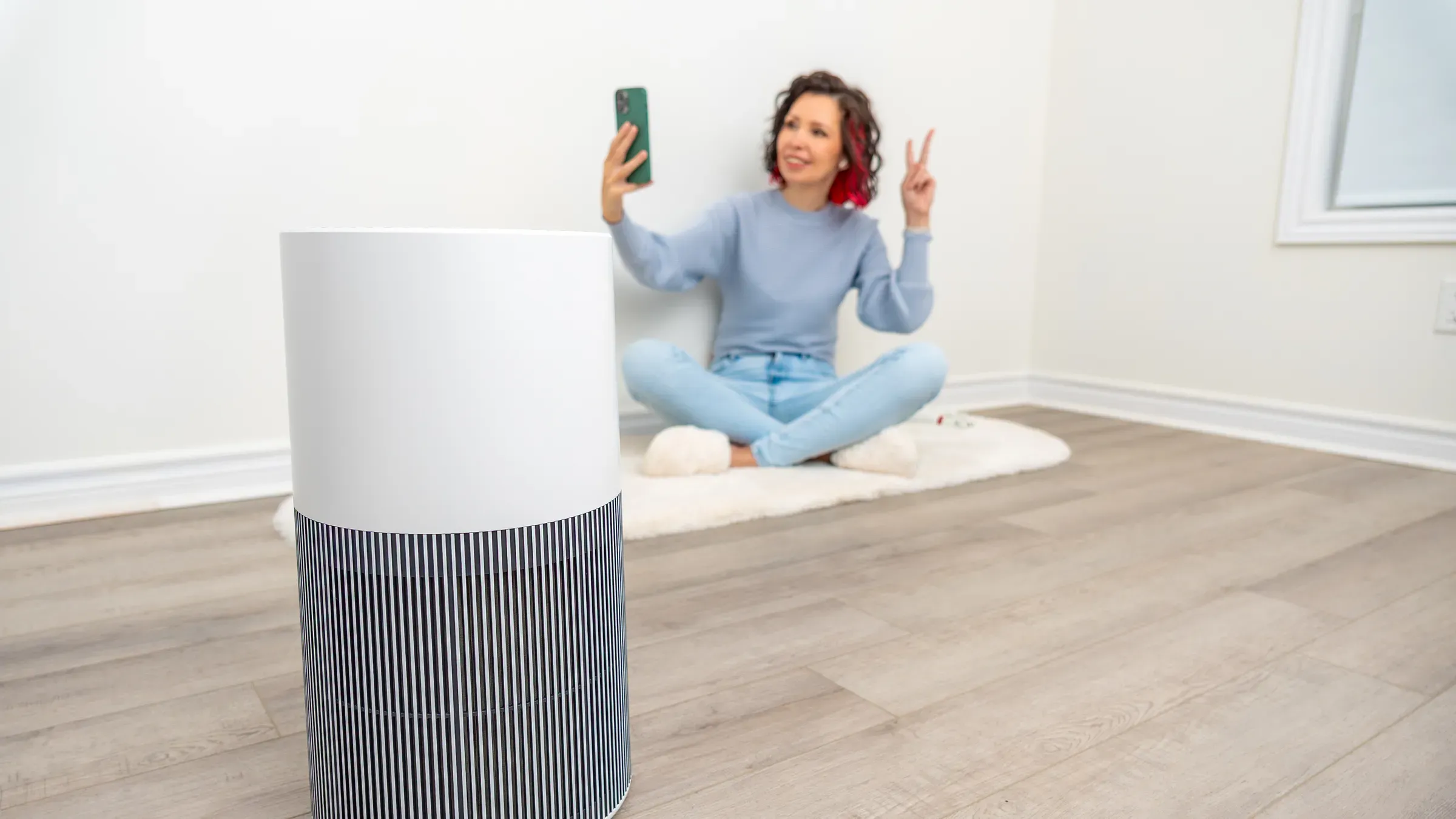
Young woman sitting on floor in cozy room, using smartphone and enjoying fresh air with air purifier,, air purifiers ecommerce
Air purifiersPeople reacting to something specific in their air, smoke, pollen, dust, cooking or a new animal in the house, plus parents buying for a child's bedroom who compare noise levels as carefully as performance figures.

How air purifiers makes money

Four levers, and what limits each one here

Revenue is traffic times conversion rate times order value times purchase frequency. In this niche each lever has its own ceiling.

Traffic

Traffic: room size, particles and the noise question

The searches worth having name a space or a problem. A purifier for a bedroom, for a nursery, for a large open-plan room, for a smoker's flat, for wildfire smoke, for cat allergens, for a workshop. Underneath sits a technical stream about clean air delivery rates, air changes per hour and what a filtration rating means. Noise is the third and most underserved, because a machine that cannot run in a bedroom overnight is useless to a large part of the audience. A brand that publishes coverage areas, air change figures and measured sound levels per fan speed can answer all three, and almost nobody does.

Conversion

Conversion: matching a machine to a room in numbers

The commonest failed purchase in this niche is a device too small for the space, and it produces a return, a refund and a poor review. Prevent it on the page. Publish the coverage area, the clean air delivery rate, the air changes per hour at a stated room size, the sound level at each fan speed and the running cost. A short room calculator that takes floor area and ceiling height and recommends the right model does more for conversion and for return rates than any amount of persuasive copy. Filter life and filter price belong on the device page too, because informed buyers are calculating the running cost before they order.

Order value

Order value: the device plus the first year of filters

The most useful bundle in this category is the machine with a year of filtration included, because it answers the running cost question and locks in the consumable relationship at the point of highest attention. Beyond that the basket grows through the second unit, since people who put a purifier in the bedroom often want one for the living room, and through pre-filters, carbon inserts and stands. Where the range includes a specialist filter for smoke or for volatile compounds, presenting it as an option at the point of purchase captures a decision the customer would otherwise make months later on a different site.

Frequency

Frequency: a device that quietly asks for money twice a year

Filter replacement is the whole economic case for this category, and it fails in a specific way. The indicator light comes on, the customer searches the filter model number, and a generic equivalent appears above the brand's own listing. Winning that moment requires three things: knowing which device each customer owns, reminding them shortly before the indicator triggers rather than after, and having a filter page that ranks for the model number so the search finds you. Usage matters too, since a purifier running constantly through a smoke season exhausts a filter far faster than one used occasionally, and the reminder schedule should reflect that.

Search visibility

Search: room-size guides, specification explainers and filter model pages

Room and use-case guides are the acquisition layer. A page for the bedroom, the nursery, the open-plan living space, the small flat, the office, each recommending a model with the coverage arithmetic shown rather than asserted. These pages are searched constantly during pollen and smoke seasons and they convert because the shopper has a specific space in mind.

Specification explainers are the trust layer. What clean air delivery rate means, how air changes per hour relate to room size, what a filtration rating covers and what it does not, and where regulation applies, including the certification requirements that apply to air cleaners sold in some jurisdictions. A brand that explains these clearly becomes the reference and gets cited when someone else is being compared.

Filter pages are the revenue layer and they are chronically neglected. Every filter should have a page that names the model numbers it fits, states its rated life, explains what it is made of and links back to the devices. Those pages compete directly with generic sellers on the model number search, and they are usually the only chance the brand has to win that query. Technically, filters and devices need bidirectional links, and device variants such as colour belong in one product rather than several.

Queries that matter

  • air purifier for a bedroom what size
  • clean air delivery rate explained
  • air purifier for wildfire smoke
  • replacement filter for my purifier model
  • quietest air purifier for sleeping
  • do air purifiers help with pet allergens
  • how often to change an air purifier filter

Room-size guides with real coverage arithmetic, specification explainers and filter pages built around model numbers rank here. Device pages listing features without coverage or noise figures do not.

AI answers

AI answers: sizing, noise and what a purifier can honestly do

Assistants field a lot of purifier questions because the specifications are confusing and the marketing is loud. What size machine a room needs, how loud it is at night, how often the filter changes, whether it helps with a particular particle. Stores get cited when coverage areas, air change rates and sound levels per fan speed exist as published numbers, when filter life is stated in hours or months with the usage assumption named, and when claims stay within what testing supports. We write sizing and specification content answer-first, keep filter compatibility readable as text, and avoid the health framing that makes a page unquotable and an ad unrunnable at the same time.

What size air purifier do I need for my room?
How loud is this purifier on its lowest setting?
How often does the filter need replacing?
Which filter fits this purifier model number?
Do air purifiers remove smoke particles from indoor air?

Questions shoppers put to assistants. A store gets named when its pages answer them in plain text.

Google Shopping and Merchant Center

Google Shopping and Merchant Center for purifiers and filters

Devices and filters need opposite treatment in the same feed. Devices are durables judged on specification, so coverage area, clean air delivery rate, noise level and energy use belong in structured detail, and colour variants belong in one item group. Filters are compatibility products, so the model numbers they fit have to appear in the title and in detail attributes, because the query is almost always a model number and nothing else.

Claims are where this category gets into difficulty. Anything suggesting a purifier treats, prevents or protects against illness, allergies or asthma moves the listing into healthcare policy and, in several markets, into regulated territory around medical devices. Performance should be described as particle reduction under stated test conditions, not as a health benefit. Where a jurisdiction requires certification for air cleaners, such as the ozone emission certification required for units sold in California, that has to be genuine before the product is advertised there.

Regional targeting deserves thought. Demand rises sharply where the air quality is currently poor, and a feed with accurate availability plus campaigns that can shift budget quickly captures a spike that lasts days rather than weeks.

Feed attributes that decide eligibility

  • product_detail for coverage area and clean air delivery rate
  • product_detail for sound level by fan speed
  • product_detail for compatible device model numbers on filters
  • item_group_id for device colour variants
  • energy efficiency and power consumption where required
  • multipack for filter sets
  • google_product_category at the air purifier node

Disapprovals we see in this niche

  • Health protection or allergy treatment claims on device listings
  • Filter listings with no model compatibility, matched to the wrong searches
  • Coverage figures in the title that do not appear on the landing page
  • Advertising in a jurisdiction where the required air cleaner certification is not held

Meta and social ads

Meta and social ads: making invisible performance visible

The creative problem is that nothing can be seen. What works is indirect evidence: a particle counter reading falling in real time, a used filter held next to a new one after a smoke season, a sound meter showing the machine at its lowest setting next to a sleeping child's room, a smoke box demonstration. Sizing content performs well as creative too, because the shopper genuinely does not know what their room needs and a short explanation is useful rather than promotional.

The policy line is health. Ads must not claim to prevent illness, treat allergies or asthma, or protect a household from disease, and creative implying the viewer's home air is dangerous runs into both health claim and personal attribute rules. Demonstrations should show particle reduction under stated conditions rather than implying a medical outcome. During air quality events the temptation to run fear-based creative is strong and it is exactly when review is strictest, so approved compliant assets should exist before the season rather than being written during it.

  • A particle counter reading dropping in real time in one room
  • A used filter after a smoke season next to a new one
  • A sound meter beside the machine at its quietest setting
  • A room measured and matched to the right model on camera
  • A smoke box demonstration with the test conditions stated on screen

Policy line

No claims about preventing illness or treating allergies and asthma, no implying the viewer's home air is dangerous, demonstrations limited to particle reduction under stated conditions, and compliant assets prepared ahead of air quality events.

Conversion and the store

The store: sizing the machine and pricing the years

Two numbers decide this purchase and both are usually missing. The first is whether the machine suits the room, which needs coverage area, air changes per hour at a stated size and a calculator that turns floor area into a recommendation. The second is what it costs to keep running, which needs filter price, filter life and an honest annual figure. Buyers who cannot find these leave to read a review site, and they frequently buy whatever that site recommends.

Noise is the third factor and it is the leading cause of returns after sizing. Publish measured sound levels at each fan speed and describe what the lowest setting is actually like in a bedroom. On mobile, keep the coverage figure and the running cost near the price rather than in a specification tab. On filter pages, the model compatibility statement should be the first thing visible, since the person reading it arrived from a model number search and wants a yes or no before anything else.

Objections the page must answer

  • “Is this machine big enough for my room”
  • “How loud is it when I am trying to sleep”
  • “What will filters cost me each year”
  • “Which filter fits the unit I already own”
  • “What can it actually do about the smell or the dust I have”

Email, SMS and retention

Email and SMS: registration, replacement and the second room

Everything begins with knowing which machine a customer owns. Capture the model at first order or through a short registration step, then time the filter reminder from the rated life adjusted for how heavily the device is used, arriving before the indicator light rather than after it. Include the exact filter so no lookup is required, and offer the twin pack with the annual cost stated. That single flow decides whether the lifetime value of this category is realised or handed to generic sellers.

The onboarding sequence should cover placement, because a purifier in the wrong position performs poorly and generates disappointment that reads as a product fault. Where to put it, what to keep clear around it, when to run it and what the settings do. Later, the second-room prompt is the most natural upsell in the catalog, since satisfied owners commonly want another. SMS suits the filter reminder and air quality alerts where a brand can send them responsibly and without alarm.

  1. Device registration and placement

    On delivery, before the first week of use

  2. Filter replacement reminder

    Before the rated life expires, adjusted for hours of use

  3. Annual filter pack offer

    Inside the second replacement reminder

  4. Second room prompt

    Three to six months after a satisfied first purchase

  5. Seasonal readiness

    Ahead of local pollen and smoke seasons

Where revenue leaks

The leaks we find in air purifiers stores

The Growth Analysis ranks these against your own numbers and says which to close first.

Get a Growth Analysis for your air purifier brand
  • Filter searches won by generic sellers

    The indicator light comes on, the owner searches the filter model number, and the manufacturer has no page for it. A generic equivalent takes the order and every order after it.

  • Machines sold into rooms they cannot handle

    Without coverage arithmetic on the page, buyers guess and undersize. The device disappoints, the return comes back, and the review that follows costs more than the refund.

  • Noise discovered after delivery

    Sound levels are absent or given as a single figure with no fan speed attached. A purifier bought for a bedroom turns out to be unusable at night, which is the most avoidable return in the category.

  • Spike demand met with stale stock data

    An air quality event brings a week of exceptional demand, and the feed advertises models the warehouse cannot ship. The traffic was cheap and the opportunity does not come back for a season.

  • Health framing that stalls the account

    Creative or feed copy edges into allergy and illness territory, and the listings and ads go into review during the exact weeks when demand is highest.

Platform notes

Where the platform changes the work

Shopify

Device specifications and filter compatibility belong in metafields, with a metaobject mapping every filter to the models it fits so the picker, the filter pages and product_detail all agree. A registration flow capturing the model at first order is what makes the replacement programme possible.

WooCommerce

Global attributes for coverage area, noise level and compatible model drive filtered archives that suit specification searches. Cross-sells need setting on both the device and the filter, and the filter needs its own indexable page rather than existing only as an option on the machine.

Headless commerce

Where a brand runs a connected device with an app, the filter counter in the app and the reminder programme in the store should read the same usage data, so the replacement prompt reflects real running hours rather than a calendar assumption.

Questions

Air purifiers owners ask us

By CartKernel · Last reviewed

How do we stop customers buying filters from generic sellers?

Publish a page for every filter that names the model numbers it fits, so it can win the model number search that owners actually perform. Capture the device at first purchase and send the reminder before the indicator light triggers, with the exact filter linked. Convenience and timing beat price for most owners, but only if you reach them first.

What can an air purifier brand safely claim in ads?

Particle reduction under stated test conditions, coverage area, air change rates and noise levels. Claims about preventing illness or treating allergies and asthma move into healthcare policy and regulated medical territory. The specification story is also more persuasive to the buyers who compare carefully, which is most of this market.

How should we handle demand spikes during smoke or pollen events?

Prepare before the season. Have compliant creative approved, availability data refreshing frequently, sizing guides published and budget headroom agreed. Demand arrives within a day and automated bidding cannot learn that quickly, so someone needs to be watching and willing to act manually.

Is a room size calculator worth building?

It is one of the few tools in ecommerce that pays for itself twice, once in conversion and once in reduced returns. Undersizing is the most common failed purchase in this category. A calculator taking floor area and ceiling height and recommending a model sets the expectation correctly before the order rather than after it.

Should the device and its filters be advertised in the same campaign?

No. A device is an infrequent, considered purchase whose value lies in years of filter orders, while a filter is a cheap repeat bought on a model number. Combined, the reporting misleads in both directions. We separate them and judge device acquisition against subsequent filter revenue.

Do we need any certification to advertise air cleaners in every market?

Requirements vary by jurisdiction, and some markets require air cleaners to be certified before they can be sold there, including certification relating to ozone emissions in California. Confirm what applies in each place you advertise before campaigns run, because geographic targeting is easy to set and easy to get wrong.

Grow your air purifiers store.

A free Growth Analysis ranks what your store should fix first, by revenue at stake, in about a week.