Skip to content

Industrial & B2B · ecommerce growth

Restaurant supply marketing agency

A restaurant supply catalog serves two buyers at once. One is a chef replacing a cracked hotel pan between services who needs it tomorrow. The other is an owner speccing a build-out who needs a quote, a gas connection size and a delivery appointment. Both check listings and dimensions before they trust a page. We build the catalog, the quoting path and the reorder loop so the fast smallwares order and the slow equipment project can both be served properly.

The buyer, in brief

Consideration
An hour for smallwares during service, weeks or months for equipment inside a build-out budget
Purchase frequency
Disposables and smallwares weekly to monthly, equipment on a break-fix and expansion cycle
Seasonality
Patio and outdoor gear from spring, catering volume through the fall, and a build-out wave in the quieter weeks after the new year
Price band
From a few dollars for a pan to five figures for a full cook line
Return risk
Low on equipment because freight and installation make returns impractical, higher on smallwares where size or capacity was misjudged from a photograph
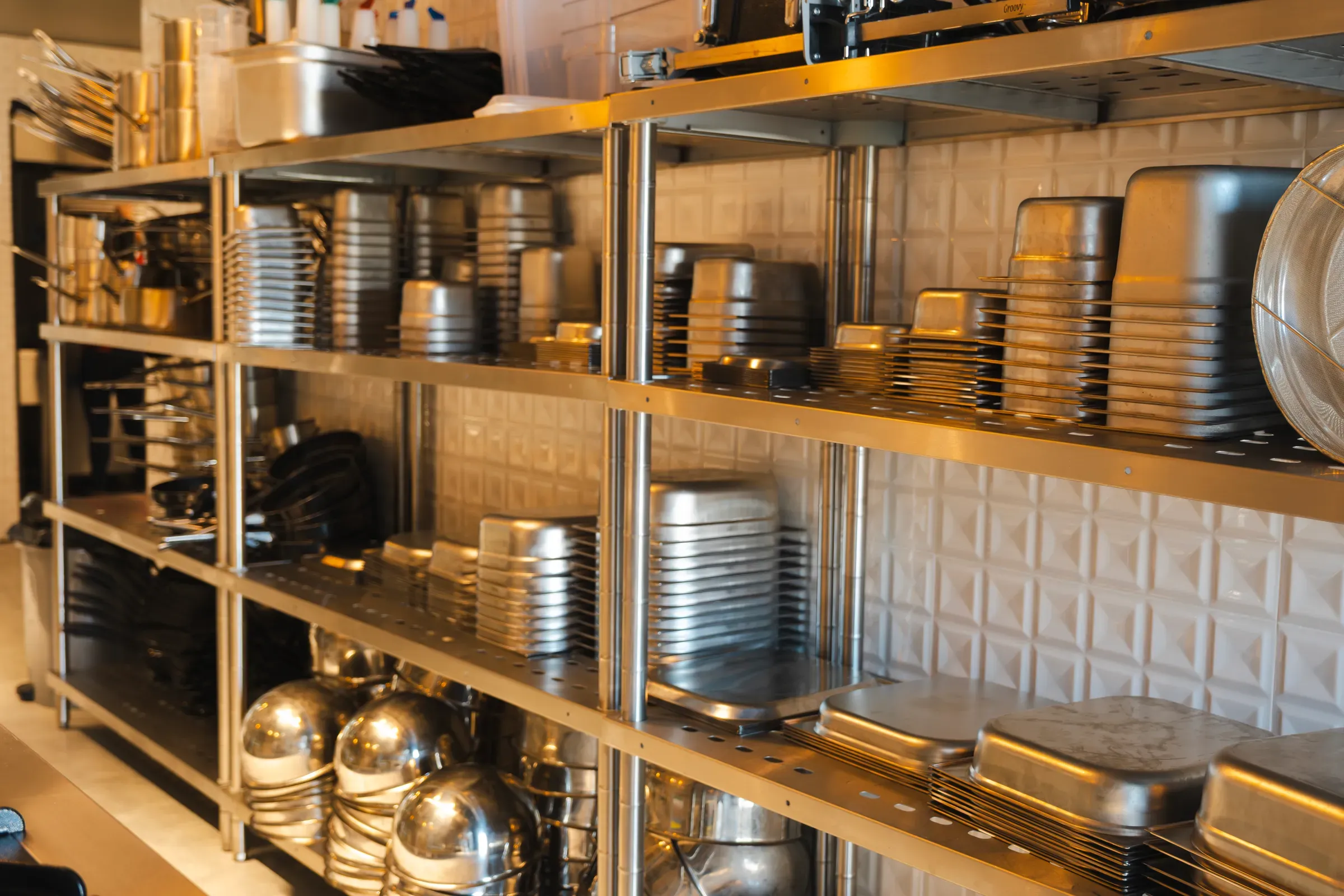
Stainless steel shelves displaying precisely stacked bakeware, pans, and other kitchen equipment, creating an, restaurant & foodservice supply ecommerce
Restaurant & foodservice supplyChefs, kitchen managers, franchise operators and owners opening or refitting a location, with caterers and food trucks alongside them. They check the sanitation listing, the exact dimensions against the space available, the gas or electrical requirement, and whether replacement parts will exist for the model in five years.

How restaurant & foodservice supply makes money

Four levers, and what limits each one here

Revenue is traffic times conversion rate times order value times purchase frequency. In this niche each lever has its own ceiling.

Traffic

Traffic: kitchens search in stations and sizes

A commercial kitchen buyer searches with the vocabulary of the line. Full pan, half pan, sixth pan, sheet pan sizes, gauge, capacity in quarts, cover counts, and equipment by model number when something has failed. A catalog arranged as tabletop, kitchen and equipment answers almost none of it. The structural work is organizing around stations and jobs: prep, cooking, holding, warewashing, front of house and storage, with sizing references beneath each. Equipment gets model pages carrying the cut sheet as text, and the replacement parts that fit each model get their own pages, because a broken door gasket at six in the morning is one of the highest intent searches in this niche.

Conversion

Conversion: the specification, not the photograph

Stainless steel photographs look alike, so the page has to sell on numbers. Exterior and interior dimensions, doorway clearance, capacity in the units chefs use, gas connection size or electrical requirement including phase, required clearances behind and above, and whether the item ships assembled. Sanitation listings need stating in text, because an inspector will ask and a buyer will not risk it. Service coverage matters as much as price on equipment: who repairs it locally, how long the warranty runs and whether parts are stocked. For smallwares, case quantity and per-unit price decide the order, since a kitchen buying pans buys twelve of them.

Order value

Order value: outfit the station in one pass

The natural unit of a large order here is a station rather than an item. A prep station needs the table, the cutting boards, the pans, the racks and the storage containers, and a buyer opening a location is happy to order all of it at once if a page exists that lists it. Station bundles and opening checklists convert those visits and rank for the searches new operators make. On the smallwares side, case pricing does the lifting, since a kitchen would rather have six spares in the stockroom than one in the pass. Equipment packages go the other way, converting through a quote where freight, install and lead times can be handled together.

Frequency

Frequency: breakage and disposables set the clock

Foodservice reorders on two rhythms. Disposables run out on a schedule set by covers served, which makes them ideal for a par level list and a standing order. Smallwares wear and disappear, and a kitchen that bought twelve pans in March will need more by autumn without anyone planning it. The store that keeps a per-kitchen reorder list and prompts against it becomes the default supplier, because reordering from history takes a chef thirty seconds between services. Equipment has the slowest cycle but the most valuable follow-up, since preventive maintenance parts and consumables such as filters and gaskets are the reason to stay in contact between purchases.

Search visibility

Search: stations, model numbers and the parts that fit them

There are three distinct search intents in foodservice supply and each wants a different page. Category and sizing searches come from buyers who know the type but not the exact item, and they need station pages and sizing references that explain capacity, gauge and fit before showing a grid. Model searches come from operators replacing a known unit, and those pages have to confirm the model, publish the cut sheet as text, list the utility requirements and link to every part that fits. Parts searches are the most urgent traffic in the category, typed by someone whose kitchen is partly out of action, and they convert on availability more than on price.

Sizing references earn links and keep earning them. Pan and sheet dimension charts, capacity guidance by cover count, and clearance requirements are looked up constantly by people who then buy. Written once and kept accurate, they carry a store for years.

Technically, the biggest issue is cut sheets that exist only as supplier PDFs, which hides every specification a buyer would search for. Second is parts catalogs with no relationship to the equipment they serve, so neither page ranks. Third is discontinued equipment left live with no successor linked, when the buyer would happily accept the replacement model.

Queries that matter

  • full size hotel pan 4 inch deep
  • nsf stainless prep table 48 inch
  • commercial undercounter dishwasher dimensions
  • replacement door gasket by model number
  • 6 burner range with oven natural gas
  • hotel pan sizes chart
  • how many amps does a commercial fryer draw

Station pages with real sizing guidance, model pages carrying the cut sheet as text, parts pages tied to the equipment they fit, and dimension references rank here. Grids of stainless photography under supplier copy do not.

AI answers

AI answers: fit, utilities and sanitation questions

The questions assistants field for this category are dimensional and regulatory. Will this fit through a standard doorway, what pan sizes fill a steam table well, what electrical supply does a unit need, is a piece of equipment listed for the inspection a kitchen faces. A store gets named in those answers by publishing the specification as text next to the product, keeping sanitation listings stated accurately rather than implied, and maintaining reference pages that answer the sizing question without requiring a purchase. We write those references answer first, keep utility figures identical to the manufacturer cut sheet, and make sure parts pages state the models they fit in plain language.

What size hotel pan fits a standard steam table well?
Will a 48 inch prep table fit through a 36 inch doorway?
What clearance does a commercial fryer need behind it?
Which door gasket fits this refrigerator model?
Does this equipment carry a sanitation listing for inspection?

Questions shoppers put to assistants. A store gets named when its pages answer them in plain text.

Google Shopping and Merchant Center

Merchant Center for a catalog that mixes pans and cook lines

The feed challenge here is range. The same account carries a two dollar spatula sold in dozens and a fifteen thousand dollar cook line that ships on a truck, and one shipping configuration cannot serve both. Freight items need their own shipping treatment with realistic handling times, while smallwares need multipack and unit pricing so a case of twelve pans is compared per pan. Titles should carry the type, the size or capacity, the material and the model number, since operators search all four.

Policy issues are narrow but real. Cutlery listings can attract dangerous product review if titles or images lean toward weapon language, so knives are described by their kitchen use and photographed on a work surface. Anything that implies a food safety outcome beyond the certification the product holds is best avoided in feed copy. Special order equipment with a long lead time should never be listed as in stock, because availability mismatch is both a policy problem and a customer service one.

Campaigns split by the two businesses inside the catalog. Smallwares and disposables run on volume with repeat value in mind, equipment runs at a much higher target with quote requests counted as conversions alongside orders.

Feed attributes that decide eligibility

  • gtin and mpn straight from the manufacturer
  • product_detail for capacity, gauge and utility requirements
  • product dimensions for equipment fit
  • multipack and unit pricing for smallwares cases
  • shipping_weight with freight items separated
  • custom_label for smallwares versus equipment

Disapprovals we see in this niche

  • Availability mismatch on special order equipment shown as in stock
  • Shipping errors where a freight item inherited a parcel rate
  • Dangerous products review on cutlery titles and imagery
  • Price mismatch when equipment pricing changed on the page only

Meta and social ads

Meta and social ads: kitchens filmed at working speed

Foodservice operators watch other kitchens, so creative filmed on a live line outperforms anything staged. An install time lapse of a cook line going in, a chef explaining why they buy one pan gauge over another, a five item opening checklist, or a quick repair using a part the store stocks all travel well and reach an audience that recognizes the setting immediately. Job title and business targeting narrows it, but strong creative broad usually reaches more of the right operators than a stack of interests.

Catalog retargeting is worth running for smallwares where repeat purchase is frequent, and worth suppressing for high value equipment where a considered follow-up beats a repeated product ad. The claims to watch are sanitation and food safety: what a listing certifies and what a kitchen must do are different things, and creative should stay with the certification. Any customer footage from a working kitchen needs written rights, and it needs a check that the practices shown would not embarrass either party.

  • A cook line install filmed as a time lapse
  • A chef explaining a gauge or capacity choice on camera
  • The five item checklist for a new location opening
  • A quick repair using a part kept in stock
  • Front of house setup filmed before service

Policy line

Keep sanitation and food safety statements to what the certification covers, avoid implying a product satisfies an inspection on its own, and hold written rights for any footage filmed in a customer kitchen.

Conversion and the store

The store: two checkout journeys under one roof

Smallwares and equipment need different paths through the same store. A smallwares page converts on case quantity, per-unit price, dimensions and same-day dispatch, with reorder from history the fastest route of all. An equipment page converts on the specification block, the utility requirements, the delivery method and a visible quote request, because very few operators buy a cook line with a card. Trying to force both through one template is the most common structural mistake in this niche.

Delivery detail decides the equipment order. Dock or no dock, liftgate, inside delivery, uncrating, install and old unit removal all change the price and the date, and asking those questions before checkout prevents the cancellation that otherwise arrives two days later. On mobile, which is where a chef browses between services, the priority is a specification block that reads without zooming, a clear stock and cutoff line, and a quote request that takes one screen.

Objections the page must answer

  • “Will it fit through the door and into the space I have”
  • “Does it carry the listing my inspection requires”
  • “What gas or electrical supply does it need”
  • “Who services it locally and where do parts come from”
  • “When will it arrive and do I need a dock”
  • “Is the smaller model enough for my cover count”

Email, SMS and retention

Email and SMS: par levels, maintenance and the next opening

Foodservice email works when it maps to the kitchen calendar rather than to a promotional one. The first flow after an equipment purchase is an install and startup checklist with the parts list and the maintenance interval attached, which prevents early service calls and puts the store in front of the customer before the first problem. Smallwares and disposables follow a par level reminder set from the case quantity and the volume the kitchen described.

The two flows that produce the most incremental revenue are maintenance and quote follow-up. Filters, gaskets and cleaning consumables are due on a known interval and almost nobody tracks them, so a reminder that names the model and the part is welcome rather than promotional. Equipment quotes need chasing at two days and again at two weeks, because build-out budgets move slowly and the quote is often waiting on a landlord rather than on a decision. Text alerts suit stock and delivery windows for accounts that opted in.

  1. Install and startup checklist

    On delivery of an equipment order

  2. Par level reorder

    Set from case quantity and the kitchen's stated volume

  3. Maintenance parts reminder

    At the service interval stated by the manufacturer

  4. Equipment quote follow-up

    Two days and again at two weeks

  5. Seasonal patio and catering prep

    Eight weeks before the season starts

Where revenue leaks

The leaks we find in restaurant & foodservice supply stores

The Growth Analysis ranks these against your own numbers and says which to close first.

Get a Growth Analysis for your restaurant supply store
  • Cut sheets that live only as downloads

    Every dimension and utility figure a buyer searches for is trapped in a supplier PDF, so the page competes on a photograph while a plainer listing that typed the numbers out takes the ranking.

  • Parts with no link to the equipment they fit

    The most urgent searches in the category go unanswered because a gasket page never names a model and a model page never lists its parts.

  • Equipment quotes that nobody chases

    A build-out quote sits unanswered while the operator waits on a permit, and by the time the project restarts the store has been forgotten.

  • Delivery questions asked after the sale

    Dock access, liftgate and uncrating discovered after payment turn a completed order into a cancellation and a refund on a freight booking.

  • Discontinued models left live with no successor

    An operator searching a model they have run for a decade lands on a dead page instead of the current replacement they would have bought immediately.

Platform notes

Where the platform changes the work

Shopify

Two templates matter here: a smallwares page built for case quantity and speed, and an equipment page built around a specification block, freight options and a quote request. Metafields carry cut sheet data, and B2B company profiles on Plus cover operator account pricing and terms.

WooCommerce

Suits a deep parts catalog where products are related to equipment models through custom taxonomies, which makes both the parts pages and the model pages rank. Freight and parcel rate classes need separating carefully so a cook line never inherits a parcel rate.

BigCommerce

Price lists give chain and franchise accounts their contracted pricing, and complex products with required options suit equipment configuration such as gas type, voltage and stand choice without a custom build.

Questions

Restaurant & foodservice supply owners ask us

By CartKernel · Last reviewed

Should equipment and smallwares run on the same store?

Yes, on the same store but not the same template. Smallwares need case quantity, per-unit pricing and fast reorder. Equipment needs a specification block, utility requirements, freight options and a quote request. One shared template forces both into a compromise that converts neither, while two templates on one catalog keeps the cross-sell intact.

How important is a parts catalog to a foodservice supply site?

It is often the highest intent traffic on the site. A kitchen with a failed unit will buy the part from whoever confirms it fits and can ship it now. Tying every part to the models it serves, and every model page to its parts list, turns a neglected corner of the catalog into a reliable source of urgent, high margin orders.

Can we take orders for equipment online, or is it always a quote?

Both work when they are separated. Standard units with known freight and no configuration can be bought outright with delivery options selected at checkout. Configured equipment, packages and anything needing install or a site visit belongs on a quote, with the request form on the product page rather than hidden in a contact page.

How do you handle freight and delivery options in the store?

By collecting the delivery facts before payment rather than after. Dock access, liftgate requirement, inside delivery, uncrating and removal of the old unit are asked as options on the product page or in a freight quote step, each carrying its own cost. That prevents cancellations and gives the carrier accurate information the first time.

What content actually earns links for a restaurant supply site?

Reference material a kitchen uses without buying anything: pan and sheet dimension charts, capacity guidance by cover count, utility and clearance requirements, and opening checklists for a new location. These get bookmarked and cited by culinary programs and operators, and they feed the category pages beneath them for years.

How should chain and franchise accounts be priced online?

Through account-specific catalogs and price lists rather than through coupon codes. A franchise buyer should sign in and see their contracted price, their approved item list and their location's shipping address already set, so ordering matches the agreement without anyone checking a spreadsheet. Purchase order capture and terms sit on the same account.

Grow your restaurant & foodservice supply store.

A free Growth Analysis ranks what your store should fix first, by revenue at stake, in about a week.