Skip to content

Home & furniture · ecommerce growth

Cookware brand marketing agency

Cookware is chosen by material long before it is chosen by brand. The shopper wants to know whether carbon steel really needs seasoning, whether a clad stainless pan works on their induction hob, how hot it can go in the oven, and what a lifetime warranty covers when a handle loosens. We build the growth system for that: material comparison pages that rank, feeds carrying induction compatibility and oven ratings, sets and open stock structured so both can be found, and recipe-led flows that turn a first pan into a kitchen.

The buyer, in brief

Consideration
Days for a single pan, several weeks for a set, and longer when the purchase is tied to a registry or a kitchen renovation
Purchase frequency
One or two pieces a year as a kitchen is built up, with a full set bought at a life event and cleaners or seasoning oils reordering in between
Seasonality
A heavy fourth quarter for gifting and roasting season, a spring registry period, a back-to-school lift on small pieces, and a January surge in cooking at home
Price band
Wide, from single entry-level pans to premium multi-ply sets, with the set price setting the anchor for everything else
Return risk
Warping, sticking on coated pans, and pieces that turned out to be the wrong diameter for the hob or the oven, most of them arriving after cooking has already happened
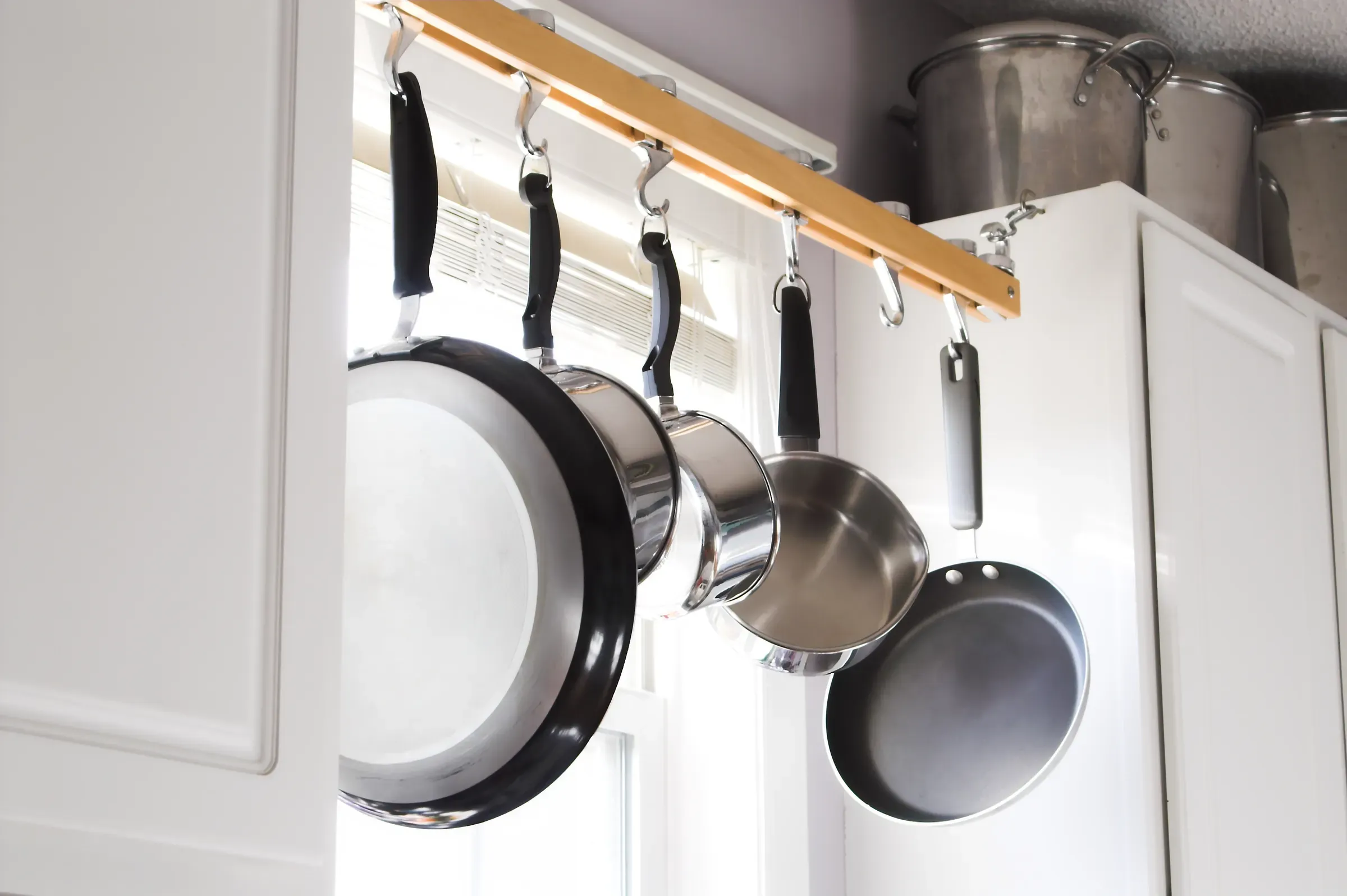
Stainless steel pots and pans hanging from hooks in kitchen, kitchenware & cookware ecommerce
Kitchenware & cookwareHome cooks upgrading one pan at a time, people setting up a first kitchen, and registry and gift buyers, who compare materials and construction, check induction compatibility and oven-safe temperatures, read what the warranty covers, and want to know whether the handle stays cool and how the piece is cleaned.

How kitchenware & cookware makes money

Four levers, and what limits each one here

Revenue is traffic times conversion rate times order value times purchase frequency. In this niche each lever has its own ceiling.

Traffic

Traffic: material comparisons carry more demand than product names

Almost nobody searches for a pan by model number. They search for the material and the job: carbon steel versus cast iron, best pan for searing steak, induction compatible cookware set, ceramic nonstick without PTFE, twelve inch skillet with a lid. A catalog sorted into Pans, Pots and Sets meets none of that. The traffic lever is a structure built on material, piece type, diameter, hob compatibility and cooking job, with comparison and technique content sitting beside it, because the comparison query usually comes first and the product query follows within days. Material explainers earn links from cooking sites in a way a product page never will, and they give the collections an authority source to link from. Product pages hold the structure up when diameter, capacity, base construction, oven rating and hob compatibility are written as text.

Conversion

Conversion: the four facts between a pan and a cart

A cookware page loses the sale when the shopper cannot confirm the piece fits their kitchen. Four facts settle it: the cooking surface diameter as distinct from the rim diameter, whether it works on induction, the maximum oven temperature with and without the lid, and what the warranty actually covers. Most product pages offer a rim measurement and a marketing sentence. We add a dimensions block with both diameters, the height and the weight, a hob compatibility row naming induction, gas, ceramic and halogen, an oven rating stated as a number, and a warranty summary in plain sentences with a link to the full terms. Care instructions belong on the page too, because someone considering carbon steel wants to know what seasoning involves before they commit rather than after the parcel arrives.

Order value

Order value: sets, open stock and the pieces that get used

Cookware order value moves through two mechanisms and a store needs both. Sets carry the large basket and the gifting demand, and they need their own pages with the piece list, every diameter and the total weight so a buyer can judge whether the count is padded with lids. Open stock carries the cook who already owns a pan and wants one more, and it converts better through a build-your-own path than through a fixed set. Attachments here are honest rather than forced: the lid that fits the pan being bought, a protector for stacking, the seasoning oil for carbon steel, the cleaner for stainless. The most effective single addition is often a compatibility table showing which lids fit which pans, because that table turns browsing into a second item without any persuasion at all.

Frequency

Frequency: a kitchen is built one piece at a time

The repeat cycle in cookware is driven by cooking rather than by wear. Someone who buys a skillet and starts using it discovers they want a saucepan, then a Dutch oven, then a sheet pan, and the brand that taught them to use the first piece is the one they buy the rest from. That is why recipe and technique content is a retention asset rather than a blog: a series teaching searing, braising and oven finishing keeps the brand present between purchases and makes the next piece obvious. Coated pans have a genuine replacement cycle of a few years, cleaners and seasoning oils reorder faster, and registry buyers come back for the pieces the registry did not cover. We report pieces per household and revenue per customer over thirty-six months.

Search visibility

Search: material, diameter and the job the pan has to do

Cookware search demand sits in three layers and a catalog has to answer all of them. The comparison layer is largest: carbon steel versus cast iron, stainless clad versus aluminum, ceramic coatings versus PTFE, enameled cast iron versus bare. The specification layer follows: induction compatible cookware, oven safe to five hundred degrees, twelve inch skillet with a lid, five ply stainless saucepan. The job layer runs alongside both: best pan for searing, pan for a glass top stove, pot for making stock. Each layer needs a different page type. Comparisons and technique guides are articles, specification demand becomes filtered collections built from attributes, and job demand becomes curated collections that make a recommendation rather than showing a raw grid.

Product pages carry the specification detail that makes all of it credible. Cooking surface diameter and rim diameter, capacity in both quarts and litres, base construction and ply count, handle material and attachment, oven rating, hob compatibility, dishwasher guidance and country of manufacture all belong in text, with Product and Offer markup that validates. Where a coating is used, name it plainly, because that is exactly what the query is asking about.

The technical work is separating sets from open stock in the index. A set page and the individual pans inside it will compete if nothing distinguishes them, so the set page targets set demand and links down to each piece, while the piece pages target their own diameter and material queries and link back up. Color variants of one pan share a URL. Recipe content needs accurate recipe markup and should link to the pieces it was cooked in rather than to a homepage.

Queries that matter

  • carbon steel vs cast iron skillet
  • induction compatible cookware set
  • 12 inch stainless skillet with lid
  • ceramic nonstick pan without ptfe
  • best pan for searing steak
  • how to season a carbon steel pan
  • oven safe cookware to 500 degrees
  • 5 ply stainless steel saucepan

Material comparisons, technique guides and specification collections built from real attributes rank in this niche, along with set pages that list every piece with its diameter. A Cookware collection sorted by price does not, and neither does a product page that gives a rim measurement and calls it the size.

AI answers

AI answers: the cookware questions assistants are asked mid-decision

The questions assistants field in this category are practical and checkable: whether a pan works on induction, what temperature it can take in the oven, whether a ceramic coating contains PTFE, how to season carbon steel for the first time, and what a lifetime warranty really covers. Stores that get cited state hob compatibility, oven ratings, coating type, ply construction and warranty terms as plain text rather than as icons, use the same numbers in the feed and in the structured data, and say who makes the cookware and where. We write the material and care pages answer first, keep the warranty language identical everywhere it appears, and check that specification tables are served as HTML rather than assembled in the browser after load.

Does this pan work on an induction cooktop?
What temperature is this skillet oven safe to?
Do ceramic nonstick pans contain PTFE?
How do you season a carbon steel pan for the first time?
What does a lifetime cookware warranty actually cover?

Questions shoppers put to assistants. A store gets named when its pages answer them in plain text.

Google Shopping and Merchant Center

Google Shopping and Merchant Center for cookware and kitchen tools

Cookware feeds are specification feeds. Most pieces carry a manufacturer barcode, so gtin is expected and identifier_exists set to false is only correct for genuinely own-brand pieces that have none. Size carries the diameter in the unit the query uses, material carries the construction rather than a trade name, and product_detail carries hob compatibility, oven rating, ply count, coating type, capacity and handle material. Sets take is_bundle with the piece count in the title, multipack covers matched pairs, and color variants of one pan share an item_group_id. Titles that lead with material, piece and diameter match the way the search is typed.

The policy exposure in this category is chemical and safety language. Nontoxic, chemical free and health claims about coatings are the wording most likely to draw a misrepresentation review, and where a product carries a state chemical warning that obligation belongs on the page. Made-in claims have to be accurate down to where the piece is manufactured rather than where the company is registered. Prices move during gifting weekends and registry promotions, so sale pricing is scheduled rather than typed at the last minute.

Campaigns split by basket rather than by category. Sets and Dutch ovens carry a large order value and can support a higher cost per click, single pans compete with grocery and department retailers and need a target that reflects it, and accessories run as a small campaign whose real job is basket completion. Free listings run alongside all of it, because cookware is compared over several sessions before anyone buys.

Feed attributes that decide eligibility

  • gtin, or identifier_exists on own-brand pieces
  • size for the cooking surface diameter
  • material for construction rather than a trade name
  • product_detail for induction compatibility, oven rating and ply
  • is_bundle with the piece count for sets
  • item_group_id for color variants
  • multipack for matched pairs

Disapprovals we see in this niche

  • Nontoxic or chemical free wording in titles and descriptions
  • Missing GTIN on pieces that carry a manufacturer barcode
  • Set listings whose piece count on the page differs from the title
  • Price mismatch during a registry or gifting promotion

Meta and social ads

Meta ads: heat on camera and claims kept off it

Cookware is one of the few categories where the product demonstrates itself. A steak going into a hot pan with the sear left audible, an egg sliding across a coated surface with no oil, a pan moving from the hob into the oven and back, a seasoning session filmed from start to finish: each of those is a complete ad on its own. Heat distribution filmed side by side under a thermal view, and a handle temperature check after ten minutes on high, answer objections nobody writes down but everybody has.

What has to stay off camera is chemistry. Claims that a coating is nontoxic or free of chemicals, and comparisons implying another material is unsafe, are the fastest route into a policy review and they are unnecessary, because the cooking footage sells better anyway. Audiences start with buyers segmented by piece, since someone who bought a skillet is a strong candidate for a saucepan and a poor candidate for another skillet. Creator content works well when the creator genuinely cooks, and written rights are secured before anything runs in the account.

  • A steak searing in the pan with the sound left in
  • An egg cooked with no oil on a coated surface
  • A pan moving from the hob to the oven and back in one take
  • A first seasoning of a carbon steel pan filmed end to end
  • A handle temperature check after ten minutes on high heat
  • Two materials heating side by side under a thermal view

Policy line

Keep nontoxic, chemical free and safety comparisons out of the creative, state any required chemical warning on the landing page, and secure written rights for creator cooking footage before it runs.

Conversion and the store

The store: the specification block that sells a pan

The cookware product page converts on a specification block most templates do not have. It needs both diameters, the height, the weight, capacity in two units, the base construction, the oven rating, a hob compatibility row that names induction explicitly, the handle material and the care method. Weight matters more than brands expect, because a cast iron skillet a shopper cannot lift and pour with one hand becomes a return. Warranty is the second block: one plain paragraph on what is covered, what is not, and how a claim is made, since a lifetime warranty with no detail reads as marketing rather than reassurance.

Set pages need the piece list with every diameter and capacity spelled out and a note on which lids are shared, because buyers have learned to be wary of counts inflated by lids. A lid and pan compatibility table belongs on both page types. On mobile the specification block should be open rather than collapsed, and the induction line has to be visible without a tap, because a shopper with an induction hob will leave rather than go hunting for it.

Objections the page must answer

  • “Will it work on my induction hob”
  • “How hot can it go in the oven with the lid on”
  • “Is it too heavy to lift and pour with one hand”
  • “What does the warranty cover when a handle loosens”
  • “Does the coating need special utensils and can it go in the dishwasher”
  • “Is the piece count in this set padded with lids”

Email, SMS and retention

Email and SMS: first cook, seasoning and the next piece

Cookware retention begins with the first cook rather than the first newsletter. A message timed to arrival covers how to prepare the piece, what to expect the first time it is heated, and the mistake that ruins that particular material, whether that is soap on a seasoned surface or high heat on a coating. For carbon steel and cast iron a short seasoning sequence across the first two weeks does more for the review score than any request for feedback, because a badly seasoned first pan turns into a complaint that reads like a product fault.

After that the flows are recipe led. A technique series keyed to the piece bought teaches searing, braising or baking and links to the pieces each recipe uses, which is how a skillet buyer becomes a Dutch oven buyer. Registry and gifting sequences run separately on their own calendar. Coated pan buyers get a replacement prompt when the surface is genuinely past its stated life rather than on an arbitrary date. Cleaners and seasoning oils reorder on a shorter cycle, and SMS stays reserved for restocks and delivery updates.

  1. First cook

    On delivery, before the piece is used

  2. Seasoning series

    Days two, seven and fourteen for carbon steel and cast iron

  3. Technique and recipe series

    Weekly for six weeks, keyed to the piece that was bought

  4. Next piece

    Six to eight weeks after the first order, based on what the recipes used

  5. Registry and gifting

    Through registry season and the weeks before December

  6. Consumables and coating replacement

    Cleaners at six months, coated pans at the end of their stated life

Where revenue leaks

The leaks we find in kitchenware & cookware stores

The Growth Analysis ranks these against your own numbers and says which to close first.

Get a Growth Analysis for your cookware brand
  • Induction compatibility left off the page

    A large share of the market cooks on induction, and a shopper who cannot confirm it within seconds moves to a retailer that states it on the product card.

  • Sets and open stock competing for the same searches

    The set page and the pans inside it target identical phrases, so neither ranks well and the store loses the set query and the single pan query together.

  • Coating language written by the marketing team

    Nontoxic and chemical free reach the feed, listings go into review, and the correction has to be made in the middle of the gifting quarter.

  • Warranty stated as a single word

    Lifetime appears on the page with nothing behind it, so the shopper treats it as decoration and the objection it was meant to answer is left standing.

  • Recipe content that links nowhere

    The brand publishes recipes that never say which piece they were cooked in, so the strongest retention asset in the category produces no second order.

Platform notes

Where the platform changes the work

Shopify

Diameters, oven ratings, ply construction and hob compatibility live in metafields so they render in the specification block and map into product_detail for the feed. Sets are built as their own products rather than as cart bundles, so they can rank, be advertised and carry is_bundle correctly.

WooCommerce

Global attributes for material, diameter and hob compatibility drive both the filters and the attribute archives worth indexing, and the feed plugin needs to send size and material as attributes rather than folding them into the description text.

BigCommerce

Color and handle variants belong to one product rather than several listings, and the faceted search needs canonical rules so diameter and material filters do not create thousands of near-identical URLs for a modest catalog.

Questions

Kitchenware & cookware owners ask us

By CartKernel · Last reviewed

Should a cookware brand sell sets or individual pieces online?

Both, on separate pages targeting different demand. Set pages carry gifting and registry searches and need the full piece list with every diameter, while open stock pages carry the cook adding one pan. Cross-linking them and offering a build-your-own path lets a shopper move between the two without the pages competing for the same phrases.

What has to be on a cookware product page to reduce returns?

Cooking surface diameter as well as rim diameter, the weight, the oven rating, hob compatibility including induction, the care method and the warranty terms. Most returns in this category come from a piece that did not fit the hob or the oven, or a coating used in a way the page never explained. Stating all of it costs a few lines and saves the freight.

Can we say our cookware is nontoxic or free of forever chemicals?

That wording draws policy attention and is usually unnecessary. Name the coating and the materials precisely, state what is not used in plain factual terms, and carry any regulatory warning where it is required. Precise material language performs better in search anyway, because the query itself names the material rather than the marketing phrase.

How do you use recipe content without building a blog nobody reads?

By keying it to pieces and to flows rather than to a publishing calendar. Each recipe names the pan it was cooked in and links to it, the technique series goes only to people who own that piece, and the pages carry accurate recipe markup. The content then answers real searches and moves the second purchase instead of sitting in an archive.

Which cookware searches are worth paying for?

Specification and material terms naming a diameter, a construction or a hob type, because the shopper has settled everything except the store. Comparison terms deserve a small budget for the remarketing pool they build. Broad category terms are contested by large retailers and rarely pay alone, so they are tested with caps and kept only if they hold up.

How do you prepare a cookware brand for the fourth quarter?

By fixing the feed and building the gift pages before demand arrives, scheduling promotional pricing so the feed and the site change together, and splitting gift campaigns from everyday campaigns because their landing pages and offers differ. Sets and Dutch ovens carry the quarter, so their stock, lead times and shipping cut-offs go on the page rather than being assumed.

Grow your kitchenware & cookware store.

A free Growth Analysis ranks what your store should fix first, by revenue at stake, in about a week.