Skip to content

Fashion & apparel · ecommerce growth

Eyewear brand marketing agency

Nobody buys glasses without imagining them on their own face. The shopper measures nothing, knows no numbers, and decides on whether a frame suits them, whether the lenses do what the brand says, and whether a prescription pair will actually be right when it arrives. We build eyewear brands around that: frame shape, face fit and lens technology pages that rank, a prescription path that collects what a lab needs without losing the order, feeds that carry lens and measurement data, and try-on creative that answers the only question that matters.

The buyer, in brief

Consideration
Same day for a sunglasses impulse, one to three weeks for prescription eyewear and home try-on
Purchase frequency
Sunglasses roughly annually or whenever a pair is lost, optical frames every one to two years around an eye test
Seasonality
Sunglasses climb from spring through summer and again around winter sun travel, while optical demand follows eye exams and benefit years
Price band
Wide, from accessible sunglasses to premium frames with lens upgrades that can double the ticket
Return risk
Higher than most accessories and driven by fit and by how a frame looks, with prescription orders needing a clear remake policy
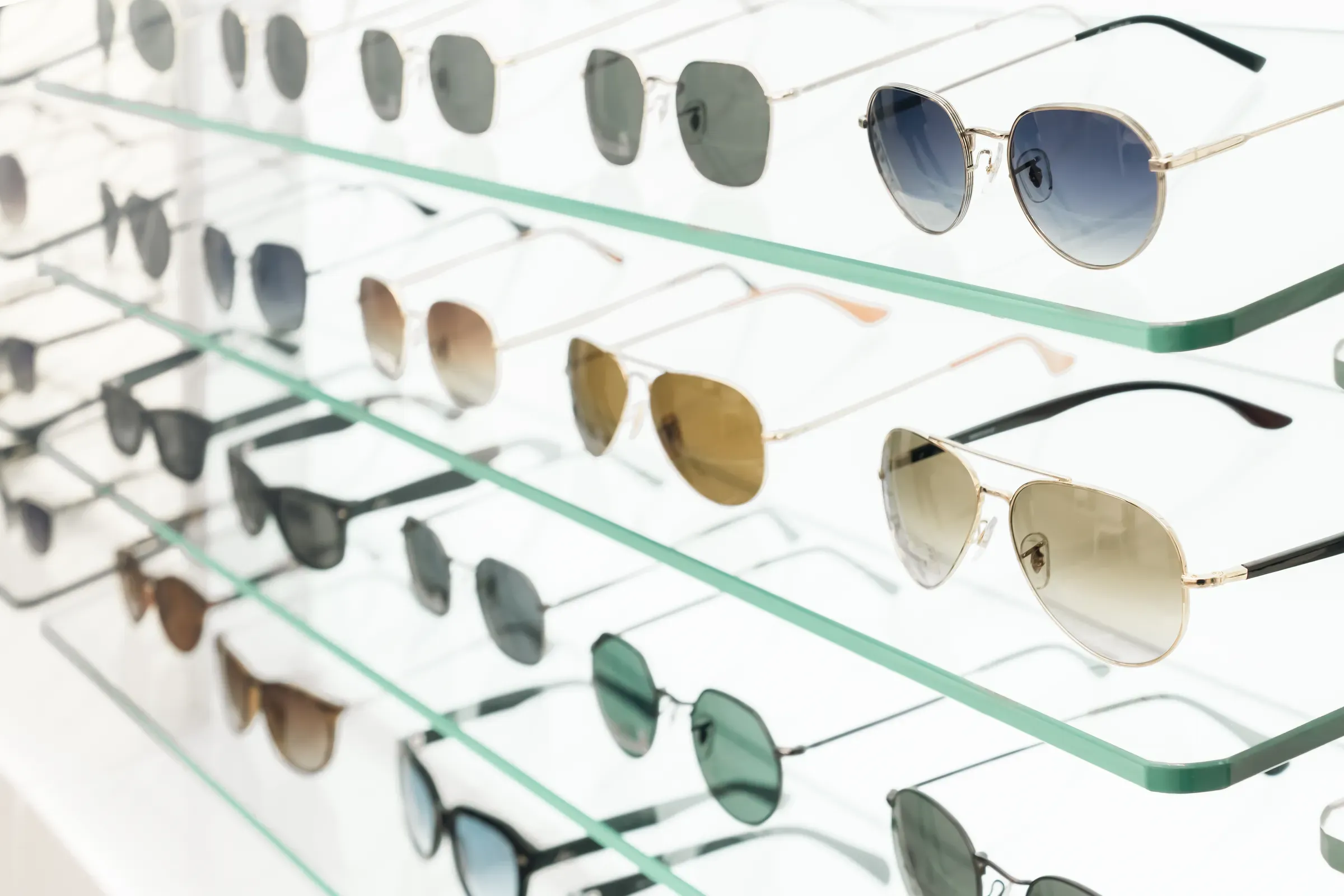
Various sunglasses are arranged neatly on glass shelves in a shop. The display shows multiple styles and, eyewear & sunglasses ecommerce
Eyewear & sunglassesShoppers choosing on how a frame looks on their face, who compare frame width and lens type, ask whether lenses are polarised and what UV rating they carry, and want the return terms in view before they risk a prescription order.

How eyewear & sunglasses makes money

Four levers, and what limits each one here

Revenue is traffic times conversion rate times order value times purchase frequency. In this niche each lever has its own ceiling.

Traffic

Traffic: frame shape, face fit and lens technology

Eyewear search has three distinct vocabularies and most stores serve only one. Shape queries name the frame: round metal, cat eye, aviator, browline, rimless. Fit queries describe the wearer: sunglasses for a wide face, small frames for a narrow bridge, glasses for a low nose bridge. Lens queries name the technology: polarised, photochromic, blue light filtering, category 3 tint. Each set deserves its own collection with copy explaining what the term means and which frames qualify, plus the measurement ranges that make a fit claim true. Prescription and plano demand also split, and a store that sends both to the same page loses one of them.

Conversion

Conversion: seeing it on the right face

The decision is visual and personal, so conversion work is about substituting for the mirror. Photographs of every frame on several face shapes and skin tones, a stated frame width, lens width, bridge and temple length in millimetres, and a comparison against the glasses the shopper already owns do more than a rendered try-on alone. Virtual try-on helps when it is fast and honest about scale, and a home try-on kit converts hesitant buyers at a cost worth measuring. The prescription flow is the other half: asking for the prescription and the pupillary distance in a way people can complete, explaining what to do if they do not have their numbers, and stating remake terms plainly.

Order value

Order value: the lens upgrade is the margin

On optical products the frame is the headline and the lenses carry the margin. Anti-reflective coatings, thinner high index lenses, photochromic and polarised options, and prescription sunglasses as a second pair are where the ticket grows, and they grow it far more than a frame upsell would. That means the lens selection step has to explain each option in plain language, with a reason a real person would recognise, rather than presenting a list of names and prices. On the sunglasses side, cases, cleaning kits, replacement lenses and spare temple screws are small additions, while a second pair offer at checkout is the one that changes the number.

Frequency

Frequency: the eye test, the loss and the second pair

Eyewear repeats on three clocks. Prescriptions are usually reviewed every year or two, so a reminder timed to the customer's own exam date arrives with a reason attached. Sunglasses are lost, sat on and scratched, which makes a replacement path and a spare-pair offer more valuable than a discount. The third clock is fashion, since someone who bought a round metal frame will look at a new shape the following season. Recording the prescription details, the frame measurements that fitted and the lens options chosen makes every one of those messages specific, which is what separates a useful reminder from a newsletter.

Search visibility

Search: shape, fit and lens pages, with prescription kept separate

Frame shape collections are the foundation and they are usually missing. Round, aviator, cat eye, rectangle, browline, oversized and rimless each carry steady demand, and a collection that explains the shape, who it tends to suit and which of your frames belong there will rank far better than a filtered view of one sunglasses page. Fit collections built on measurement ranges answer the queries about wide faces, narrow bridges and small heads, and they are honest only if the measurement data behind them is real.

Lens technology pages carry the informational demand and the comparison queries: polarised against tinted, how photochromic lenses behave, what a lens category means, what a UV rating covers. These earn links and feed the product pages internally. Guides on measuring your current frames and reading a prescription do the same job for the optical side of the catalog.

Technically, prescription and plano versions of the same frame should not fragment into duplicate products, colourways stay as variants on one canonical URL, and configurator steps must not generate indexable URLs. Structured data has to reflect the price a shopper can actually pay before lens options are added, or the rich result and the landing page disagree.

Queries that matter

  • polarised sunglasses for driving
  • sunglasses for a wide face
  • round metal glasses frames
  • what does lens category 3 mean
  • prescription sunglasses online
  • blue light glasses explained
  • frame width mm size guide

Shape, fit and lens technology collections with genuine explanation rank here, along with measurement and prescription guides. A single sunglasses grid with colour filters does not.

AI answers

AI answers: fit measurements and lens questions

Assistants are asked which frame shape suits a face, what frame width fits a wide head, whether polarised lenses help while driving, what a lens category number means and whether a store can make prescription sunglasses from an existing prescription. Those are answerable questions, and a store is cited when its measurement data, lens explanations and prescription terms exist as plain text on crawlable pages rather than inside a configurator. Claims about lens technology should stay within what the product can support, since assistants and shoppers both check. We write lens and fit pages answer first and keep frame measurements consistent between the page, the structured data and the feed.

Which sunglasses fit a wide face?
Do polarised lenses help when driving?
What lens category do I need for strong sunlight?
Can I order prescription sunglasses using my current prescription?

Questions shoppers put to assistants. A store gets named when its pages answer them in plain text.

Google Shopping and Merchant Center

Google Shopping and Merchant Center for frames and lens options

Eyewear listings need the accessory attributes done properly: color for the frame, size where a frame runs in more than one, material for acetate, metal or titanium, and gender or unisex set honestly. The measurements that decide fit belong in product_detail as lens width, bridge, temple length and total frame width, and product_highlight is where polarisation, UV rating and photochromic behaviour go. Branded frames with retail barcodes need the GTIN, while own-label frames set identifier_exists to false.

Pricing is the difficult one. A frame that starts at one price and rises with prescription lenses must list at the price a shopper can actually pay for the item as shown, with lens options priced on the page, or the listing will not match the landing page. Claims are the other risk: statements about eye health, screen fatigue or vision improvement move a listing toward the healthcare policies and need evidence on the page, so lens descriptions should say what the lens does optically rather than what it does medically.

Campaigns split by intent and margin. Sunglasses run seasonally against a curve, optical frames run steadily and can afford more because of lens attachment, and free listings carry the long tail of shape and colour combinations.

Feed attributes that decide eligibility

  • product_detail for lens width, bridge and temple length
  • product_highlight for polarisation and UV rating
  • material for acetate, metal or titanium
  • color for the frame, not the lens tint alone
  • item_group_id across colourways
  • gtin or identifier_exists

Disapprovals we see in this niche

  • Price mismatch when the feed price assumes lenses
  • Healthcare policy attention on eye health or screen fatigue claims
  • Missing measurement data, so listings lose the fit queries
  • Image policy on lifestyle shots that obscure the frame

Meta and social ads

Meta and social ads: try-on content, not product shots

Eyewear creative lives or dies on faces. A carousel of frames on a white background performs poorly next to a single video of one person trying four shapes and saying which suits them and why. Try-on content, the same outfit styled with different frames, and close footage showing how a frame sits on the bridge and where the temples meet the ears all answer the imagination problem. Lens demonstrations work too, such as filmed glare on water with and without a polarised lens in front of it.

Prospecting broad with strong creative beats interest targeting, and catalog retargeting works when feed images show the frame clearly at an angle rather than flat. Claims are the constraint: statements about eye strain, headaches, sleep or vision belong nowhere in an ad unless the brand can substantiate them, and creative should avoid implying anything about the viewer's appearance or eyesight.

  • One person trying four shapes and explaining the pick
  • Polarised glare demonstrated on water or a windscreen
  • How a frame sits on the bridge and behind the ear, filmed close
  • The same outfit with three different frames
  • A home try-on kit unboxed and used

Policy line

Vision, eye strain and sleep claims need substantiation and can attract health policy review, and creative should not imply the viewer has a visual or cosmetic problem.

Conversion and the store

The store: measurements, try-on and a prescription flow people finish

A frame page has to give three things the shopper cannot get elsewhere: photographs on faces that resemble theirs, the four measurements in millimetres with an explanation of what each one means, and a fit statement saying which face widths the frame suits. A comparison against a common reference and a video of the frame turning help more than another studio still. Return and remake terms belong on the page, because the risk of ordering eyewear unseen is what stalls the decision.

The prescription flow is the second build. It should explain what is needed before asking for it, allow a prescription to be uploaded, typed or requested from a practice, handle pupillary distance with a measuring guide, and save progress so an interrupted order can be finished later. Lens options need plain descriptions and a recommendation, and the running price should be visible as the choices are made rather than appearing at the last step.

Objections the page must answer

  • “Will this shape suit my face”
  • “Is it wide enough, or too wide, for my head”
  • “What do the numbers printed on the frame mean”
  • “Are the lenses actually polarised and what UV do they block”
  • “What happens if my prescription order comes back wrong”
  • “Can I try before I commit to a full price pair”

Email, SMS and retention

Email and SMS: the exam clock, the second pair and the lost pair

The most valuable email an optical store sends is a reminder timed to the customer's own eye examination cycle, because it arrives with a reason rather than an offer. Recording the prescription date at purchase is what makes that possible. Alongside it, a second pair prompt a few weeks after a successful first order converts well, since the fit question has already been answered and prescription sunglasses are the obvious next purchase.

On the sunglasses side, flows follow loss and season. A care and cleaning sequence, a replacement lens or screw reminder, and a spring restart send do most of the work, with new shape launches going to people whose previous choice suggests they will care. SMS suits order and lab status updates on prescription work, where the wait is the anxiety, and it should stay away from promotional sends in this category.

  1. Prescription and exam reminder

    Twelve to twenty-four months after purchase, on the customer's cycle

  2. Second pair and prescription sunglasses

    Three to six weeks after a successful optical order

  3. Lab and order status

    At lab and at dispatch, by SMS for prescription work

  4. Care, cleaning and replacement parts

    Two weeks after delivery, then seasonally

  5. Home try-on follow-up

    Day three and day six of a try-on window

Where revenue leaks

The leaks we find in eyewear & sunglasses stores

The Growth Analysis ranks these against your own numbers and says which to close first.

Get a Growth Analysis for your eyewear brand
  • Measurements missing from the page

    Without lens width, bridge and temple length a shopper cannot compare a frame to the glasses they already own, so they leave to find the numbers somewhere else.

  • A prescription form that asks before it explains

    The order stalls at the pupillary distance field because nobody said what it is or how to measure it, and the visitor does not come back to finish.

  • Feed prices that assume lenses

    The listing shows a price the landing page does not, which draws a mismatch flag and costs the account its Shopping presence in the middle of the season.

  • Sunglasses collections unpublished in winter

    Taking seasonal pages down every autumn discards the rankings they earned, so the store starts again from nothing each spring.

  • One page for prescription and plano

    Two different buyers with two different questions land on the same template, and neither gets the answer that would have completed the order.

Platform notes

Where the platform changes the work

Shopify

Frame measurements and lens attributes live in metafields so they render on the page, feed product_detail and stay consistent in structured data. A prescription configurator should treat lens choices as options on one product rather than as variants that fragment the catalog and the feed.

WooCommerce

Global attributes for shape, material and measurement ranges drive both the filters and the indexable archives, while variable product pricing has to keep the base frame price honest for the feed as lens add-ons are priced separately.

BigCommerce

Product options handle lens selection without creating duplicate listings, and faceted search needs canonical rules so shape and colour filters do not multiply in the index.

Headless commerce

A headless build helps when a try-on or lens configurator has to feel instant, provided the frame pages still render as crawlable HTML with the measurements and lens copy present in the source.

Questions

Eyewear & sunglasses owners ask us

By CartKernel · Last reviewed

How do you sell frames online when people cannot try them on?

By replacing the mirror with data and faces. Photographs of each frame on several face shapes, the four frame measurements in millimetres explained in plain language, a fit statement about which head widths it suits, and a video of the frame turning. Virtual try-on and home try-on kits add to that, but the measurements and an honest fit note do most of the work.

Should prescription and non-prescription products live in the same store?

Yes, in one catalog with two paths. The frame is the same product, so splitting it duplicates the page and the feed. What differs is the journey: the plano buyer wants to check out immediately, while the prescription buyer needs an explanation, an upload step and a lens selection. Building both paths on one product page keeps the search authority in one place.

Can we advertise blue light or eye strain benefits?

Only within what you can evidence, and carefully. Claims about screen fatigue, headaches, sleep or vision draw health policy attention on Meta and in Merchant Center, and the substantiation has to be findable on the landing page. Describing what the lens does optically, such as filtering a stated part of the spectrum, is safer and more accurate than describing a medical outcome.

What should an eyewear feed contain that a general apparel feed would not?

The measurements and the lens facts. Lens width, bridge, temple length and total frame width in product_detail, polarisation, UV rating and photochromic behaviour in product_highlight, the frame material, and a price matching what the page charges before lens upgrades. Those attributes are what make a listing eligible for fit and lens queries rather than only for the frame name.

How do we reduce returns on eyewear without a try-before-you-buy programme?

By making fit checkable before the order. Publish the measurements, tell people how to read the numbers printed inside their current glasses, and offer a comparison so they can match. State which face widths a frame suits and where a style runs narrow. Then track returns by frame and by reason, because one style with a fit problem usually explains a large share of them.

When should a sunglasses brand start spending each year?

Before the weather turns, because the searches turn first. Interest builds from early spring and again ahead of winter sun travel, so budget is loaded against the query curve and pulled back as stock clears. Collections stay published through the off season so their rankings survive, and email restarts the season with the people who bought last year rather than with a cold audience.

Grow your eyewear & sunglasses store.

A free Growth Analysis ranks what your store should fix first, by revenue at stake, in about a week.