Skip to content

Fashion & apparel · ecommerce growth

Leather goods marketing agency

A leather bag is bought on two questions a photograph cannot answer: what is it actually made of, and will my things fit inside it. Buyers compare full grain against top grain, read about tanning and hardware, then look for internal dimensions and whether a laptop or a passport will go in. We build leather goods brands around that: material and capacity pages that rank, product pages that state dimensions and what they hold, gifting and personalisation paths built for the season, and feeds that keep a genuine maker clearly identifiable.

The buyer, in brief

Consideration
One to six weeks, with saved items, repeat visits and often a wait for a specific colour
Purchase frequency
One or two pieces a year, with wallets, belts and small leather goods filling the gaps
Seasonality
Steady with strong gifting peaks in December and around Mother's Day, Father's Day and graduations, plus a travel-goods lift before summer
Price band
Mid to premium, with the price defended by material, construction and repairability rather than by discount
Return risk
Low but colour and capacity driven, since leather photographs differently under different light and volume is hard to judge on screen
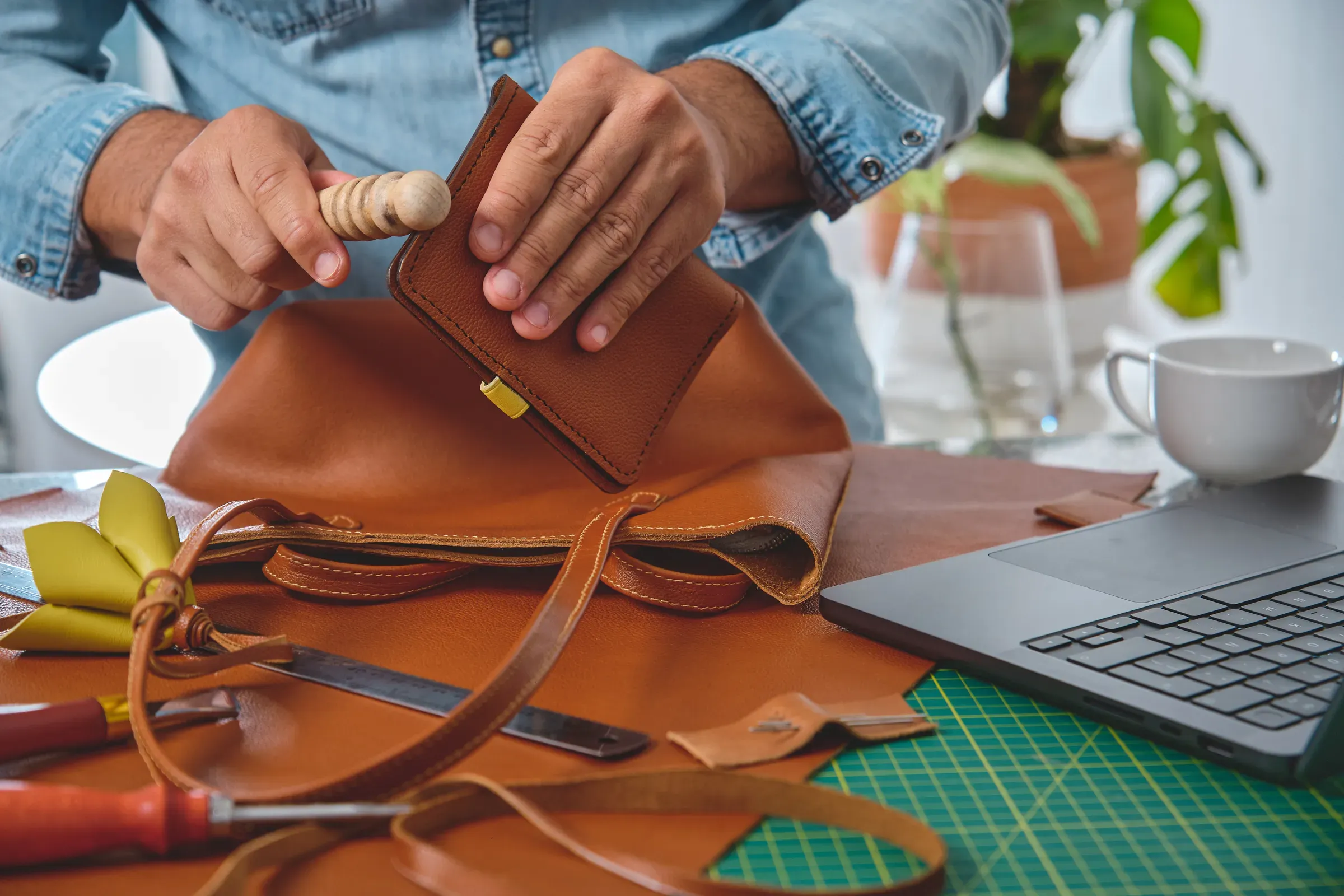
Leather craftsman working on handbag in workshop, handbags & leather goods ecommerce
Handbags & leather goodsConsidered buyers who compare leather grades and tanning, look for internal dimensions and what a bag holds, study hardware and stitching in close photographs, and want to know whether repairs are possible before paying a premium.

How handbags & leather goods makes money

Four levers, and what limits each one here

Revenue is traffic times conversion rate times order value times purchase frequency. In this niche each lever has its own ceiling.

Traffic

Traffic: leather grade, capacity and use case

The searches that convert here name a material, a capacity or a job. Full grain leather tote, vegetable tanned wallet, crossbody that fits a passport, laptop bag for a 16 inch machine, weekender sized for carry on. Most leather brands write about heritage and craft and publish a bags collection, which answers none of those. The traffic work is collections built on grade and tanning, on capacity and on use case, each with copy that explains the term honestly and the products that qualify. Explanatory pages on leather grades, tanning methods and how a patina develops earn links and answer the research half of the demand, which in this category is unusually large.

Conversion

Conversion: dimensions, weight and what actually fits

The bag either holds the shopper's life or it does not, and most product pages never say. Internal and external dimensions, the weight empty, the strap drop, the depth of the main compartment, the pocket layout and a plain list of what fits, a 14 inch laptop, a water bottle, a passport, remove the biggest doubt. Photographs with objects inside do this better than measurements alone. The second conversion job is colour, because leather shifts under different light, so several photographs taken in daylight and indoors plus an honest note about how the finish will darken with use prevent the return that follows a surprise.

Order value

Order value: the small leather goods and the personalisation

A bag is a single high-value item, so the basket grows through what goes with it. A matching wallet or card holder, a replacement or alternative strap, a leather care kit and a dust bag are natural attachments and each carries strong margin. Personalisation is the larger lever: embossed initials or a stamped message raise the price, remove the return risk and turn a purchase into a gift. It needs a preview, a stated lead time and a clear policy, because a personalised item cannot be resold. Gift wrapping and a note card are small additions that convert well in season and cost little to offer.

Frequency

Frequency: care, repair and the next piece

Leather goods are bought rarely and kept for years, so retention runs on ownership rather than replenishment. A care sequence that teaches conditioning and storage, a repair or refinishing service with a clear price, and hardware replacement for zips and clasps all bring the customer back and support the argument that justified the price. The next purchase is usually a different category rather than a repeat, a wallet after a bag, a belt after a wallet, a travel piece before a trip, so the store needs to know what the customer already owns. Gifting is the other cycle, since someone who bought for themselves often returns to buy for someone else.

Search visibility

Search: grade and tanning pages, capacity collections and use cases

The material vocabulary is the backbone of this category and it is where a genuine maker can out-rank a reseller. Pages that explain full grain, top grain and split leather, the difference between vegetable and chrome tanning, and how a patina forms answer a large amount of research demand and earn links from people writing about the subject. They should link into the collections that carry each grade, so the authority reaches the products rather than sitting on a blog.

Commercial collections are built on capacity and use rather than on style names alone. A laptop bag collection stating the machine sizes it fits, a travel collection built around carry-on dimensions, a crossbody collection with strap drops, and an everyday carry collection each match a query somebody types. Colour collections earn their place when the colour is part of the search, such as a tan leather tote.

Technically, colourways stay as variants under one canonical product URL and personalised versions should not become separate products. Original photography is a ranking asset here, because the same supplier images appear on many sites, and structured data should carry material, colour and dimensions so they agree with the feed.

Queries that matter

  • full grain leather tote bag
  • vegetable tanned leather wallet
  • crossbody bag that fits a passport
  • leather laptop bag 16 inch
  • what is full grain leather
  • carry on leather weekender
  • how to condition a leather bag

Explanatory pages on grades and tanning, capacity and use-case collections, and product pages with original photography and real dimensions rank here. Heritage copy over a shop-all grid does not.

AI answers

AI answers: what the leather is and what the bag holds

The questions assistants get here are material and capacity questions: what full grain leather means, whether vegetable tanned leather will darken, which bag fits a 16 inch laptop and a water bottle, and whether a maker will repair a piece years later. Stores get named when the grade, the tannage, the dimensions and the repair terms are stated as plain text rather than implied by adjectives, when the same wording appears on the page, in the structured data and in the feed, and when the About page says who makes the goods and where. We write the material and capacity pages answer first and keep dimensions consistent everywhere they appear.

What is the difference between full grain and top grain leather?
Which of these bags fits a 16 inch laptop?
Does vegetable tanned leather darken over time?
Can this bag be repaired if the zip fails?

Questions shoppers put to assistants. A store gets named when its pages answer them in plain text.

Google Shopping and Merchant Center

Google Shopping and Merchant Center for a maker in a crowded category

Leather goods sit in apparel and accessories, so color, size where relevant, material and age_group still matter, and material has to be specific, since full grain cowhide reads differently from genuine leather and shoppers search both terms. Product_detail carries dimensions, capacity, strap drop, hardware finish and tannage, which is what makes a listing eligible for the capacity queries. Own-brand pieces without a retail barcode set identifier_exists to false, and item_group_id ties colourways into one listing.

Two policy areas need attention. Intellectual property rules mean a maker whose designs are copied should keep its own listings unambiguous, with original photography, a clear brand value and consistent business details, and should report infringing listings through the channel's own process rather than referring to them in ad copy. Exotic materials carry documentation requirements and channel restrictions, and some are not permitted at all, so those items may need to stay out of the feed entirely.

Campaign structure follows margin and gifting. Core carry pieces are bid to margin, personalised items are handled carefully because their price varies, and gifting terms are funded seasonally with a dispatch cut-off reflected in the ads.

Feed attributes that decide eligibility

  • material stated specifically, such as full grain cowhide
  • product_detail for dimensions, capacity and strap drop
  • color with the finish name and a base colour
  • item_group_id across colourways
  • identifier_exists on own-brand pieces
  • product_highlight for what the bag holds

Disapprovals we see in this niche

  • Intellectual property review on branded or licensed listings
  • Restricted material rules on exotic skins
  • Price mismatch on personalised items priced from a base
  • Image policy for text overlays or logos on product photography

Meta and social ads

Meta and social ads: the workshop and the object in use

Two kinds of creative carry this category. The first is process: cutting, skiving, edge painting, saddle stitching and hardware being set, filmed close and without narration where the sound of the work is good enough. It communicates the price without arguing about it. The second is use: the bag packed and unpacked, what fits inside, how the strap sits, how it looks after two years. Ageing and patina content performs well because it is the proof that the material claim was true.

Prospecting broad with good creative outperforms narrow interest targeting, and retargeting matters because consideration is long. Catalog ads need images shot in consistent light so colour is not a surprise. Personalisation content converts strongly in gifting season, showing the embossing being applied. Any statement about the material has to be exact, since genuine leather and full grain mean different things and this audience knows it.

  • Saddle stitching and edge painting filmed close
  • The bag packed with real objects, then emptied
  • The same piece new and after two years of use
  • Initials embossed onto a wallet in real time
  • A maker explaining why a panel is cut a certain way

Policy line

Material descriptions must be accurate to the grade and tannage, exotic skins carry documentation and channel restrictions, and creative should avoid comparative claims about other makers.

Conversion and the store

The store: dimensions, colour honesty and a personalisation preview

The product page has to make the object physical. Internal and external dimensions, empty weight, strap drop, compartment depth and a plain list of what fits are the difference between a saved item and an order. Photographs that show the bag held by a person, packed with everyday objects and shot in daylight as well as indoors answer the size and colour questions at once. Material detail belongs on the page in specific words, with the tannage, the hardware finish and the lining named.

Personalisation needs a live preview, a font choice, a character limit, a stated lead time and a clear note that a personalised item cannot be returned. Gifting needs its own layer during the season: packaging shown as a photograph, a note card option, a dispatch cut-off and an extended returns window stated on the page. Repair and care terms sit near the price, because they are part of what the shopper is buying.

Objections the page must answer

  • “Will my laptop, water bottle and everything else fit”
  • “What grade of leather is it and how was it tanned”
  • “Is the colour in the photograph the colour I will get”
  • “How will it look after a year of use”
  • “Can it be repaired and by whom”
  • “If it is a gift, can it be returned or exchanged”

Email, SMS and retention

Email and SMS: care, patina and the piece that completes the set

The post-purchase sequence is about ownership. Conditioning and storage guidance arrives after delivery, a note on how the leather will change over the first months follows, and a reminder to condition arrives at the seasonal change. This is useful content that also happens to justify the price, and it keeps the brand present through a long gap between purchases.

The next purchase is usually a different category, so segmentation matters more than frequency. Someone who bought a tote is a candidate for a wallet or a card holder, not another tote. Gifting sequences run twice a year with real cut-off dates and personalisation lead times stated clearly, and SMS is reserved for personalisation proofs and dispatch updates during those peaks. A repair and refurbishment offer sent a year or two later reaches customers nobody else is contacting.

  1. Care and conditioning guide

    On delivery and again at three months

  2. Patina and ageing note

    Six to eight weeks after the first use

  3. Complete the set

    Two to three months later, by the category already owned

  4. Gifting with cut-off dates

    Two seasonal sequences, with personalisation lead times stated

  5. Repair and refurbish offer

    Twelve to twenty-four months after purchase

Where revenue leaks

The leaks we find in handbags & leather goods stores

The Growth Analysis ranks these against your own numbers and says which to close first.

Get a Growth Analysis for your leather goods brand
  • No dimensions, no capacity, no answer

    The page shows the bag from four angles and never says what fits inside, so the shopper saves it and buys the one that told them.

  • Supplier photography on every listing

    The same images appear across many sites, so there is nothing distinctive to rank and nothing that proves the maker is the source of the product.

  • Personalisation without a preview or a lead time

    The buyer cannot see what the embossing will look like or when it will arrive, so a higher-value order quietly becomes a lower-value one.

  • Care and repair treated as customer service

    The service that keeps a customer for a decade is hidden in a help centre instead of sitting on the product page where it defends the price.

Platform notes

Where the platform changes the work

Shopify

Dimensions, capacity, tannage and hardware detail live in metafields so they show on the page, feed product_detail and stay consistent in structured data. Personalisation apps should add engraving as an option on the existing product rather than creating duplicate listings.

WooCommerce

Global attributes for grade, tannage and capacity power the filters and the indexable archives, and product add-ons handle personalisation while keeping the base price honest for the feed.

BigCommerce

Custom fields carry the specification and care detail, and product options handle monogramming on one listing so colourways and personalisation do not fragment the catalog.

Questions

Handbags & leather goods owners ask us

By CartKernel · Last reviewed

How do we compete in Shopping when copies of our designs are listed too?

By making your own listings unmistakably yours and keeping the account clean. Original photography, a consistent brand value, specific material wording, complete business details and returns terms that match the site all help the listing and the trust signals behind it. Infringing listings are reported through the channel's own process, and never referred to in ad copy or on the site.

What belongs on a handbag product page that most brands leave out?

The measurements and the contents. Internal and external dimensions, empty weight, strap drop, compartment depth and a plain list of what fits, alongside photographs of the bag packed with ordinary objects. Then the material detail in exact words, the hardware finish, the lining and the repair terms. Those turn a saved item into an order more reliably than another lifestyle photograph.

Is personalisation worth offering on leather goods?

Usually, if it is built properly. A live preview, a font choice, a character limit, a stated lead time and a clear non-returnable note let it raise the price and remove the return risk at the same time. Without a preview it does the opposite, because the buyer will not commit to something they cannot picture on the piece.

How should colour be handled when leather photographs differently in every light?

By showing it in more than one light and saying so. Daylight and indoor photographs of the same piece, a close view of the grain, and an honest note about how the finish darkens with use prevent most colour returns. Where a hide varies naturally, saying that on the page turns a potential complaint into part of the appeal.

What retention programme works when people buy a bag once every few years?

One built on ownership rather than repeat purchase. Care and conditioning guidance, a patina note, hardware replacement, and a repair or refurbishment service with a stated price keep the relationship alive. The next order is usually a smaller piece in a different category or a gift, so segmenting by what the customer already owns matters more than sending more often.

Do explanatory pages about leather grades actually bring buyers?

They bring the research half of the demand and they earn links, which lifts the commercial pages. Someone reading about full grain and vegetable tanning is deciding whether the price is justified, and the page that answers them well is often the one they buy from. Those pages must link down to the collections carrying each grade, or the traffic arrives and stops.

Grow your handbags & leather goods store.

A free Growth Analysis ranks what your store should fix first, by revenue at stake, in about a week.