Skip to content

Footwear · ecommerce growth

Kids shoe brand marketing agency

A parent buying kids' shoes is measuring a foot on the kitchen floor with a ruler and a printout, guessing how much room to leave and knowing the pair will be outgrown before it wears out. They buy on a school calendar rather than a fashion one, and they come back every few months whether or not the brand remembers them. We build kids' shoe stores around that growth cycle: a measuring guide that ranks and converts, feeds with the age_group and size data Shopping needs, campaigns aimed at the parent and a size-up reminder timed to how fast small feet grow.

The buyer, in brief

Consideration
Hours to a couple of days, faster when a school term or a growth spurt forces it
Purchase frequency
Every few months for toddlers, two or three times a year for school-age children, plus sandals and boots by season
Seasonality
Back-to-school from late July through September, a smaller lift in January, sandals in spring and boots in autumn
Price band
Low to mid, with parents willing to pay more for first walkers and school shoes that last a term
Return risk
High: parents order two sizes and return one, so exchange handling and the measuring guide decide the margin
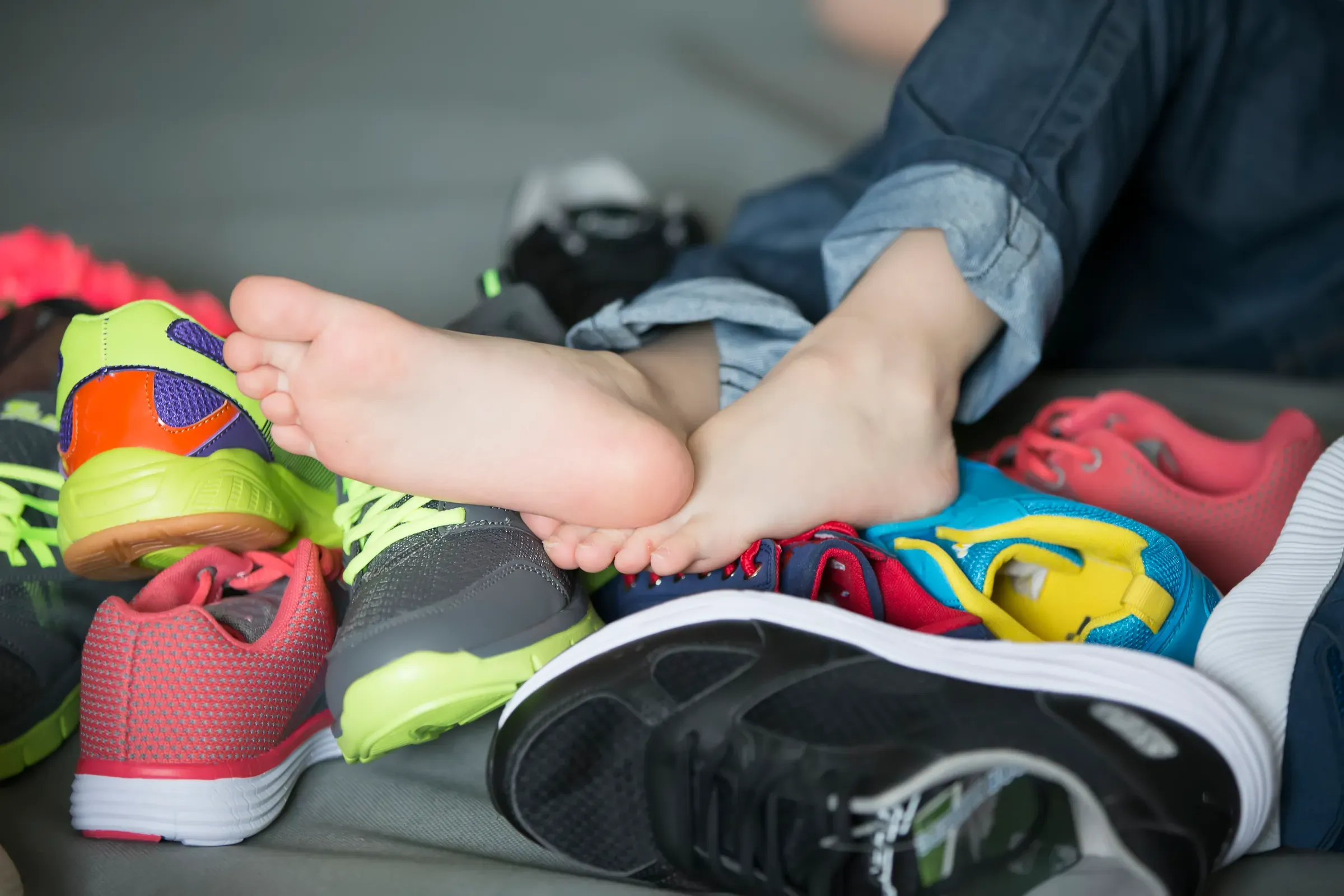
Bare feet in a pile of shoes. Children's foot on the background of sneakers. Foot and shoes, kids shoes ecommerce
Kids shoesParents and grandparents buying for a child who is not in the room, who need a reliable way to measure at home, a clear rule for growing room, a flexible sole for a first walker and a black shoe that will survive a term of playground.

How kids shoes makes money

Four levers, and what limits each one here

Revenue is traffic times conversion rate times order value times purchase frequency. In this niche each lever has its own ceiling.

Traffic

Traffic: measuring guides, conversion charts and the first-walker query

Kids' shoe searches are practical and repeated: how to measure a child's foot at home, what size a EU 27 is in US kids sizes, how much room to leave, which shoes suit a first walker, which black school shoe survives. Most brands answer none of these because the size chart is an image and the collections are named by gender. The traffic lever is a measuring guide with a printable gauge, size conversion pages built as real HTML tables, and stage collections (pre-walker, first walker, toddler, school, junior) with copy that explains what changes at each stage. Those pages bring parents in before they know which brand they want, which is the only moment a small kids' brand can win them.

Conversion

Conversion: the printable gauge and the growing-room rule

A parent converts when the store removes the guesswork. The product page has to state the inner length in millimetres or the scale the size uses, link to the printable gauge, give one clear rule for growing room and say whether the model runs wide or narrow for a child's foot. It has to show the sole flexing in a hand for first walkers and the toe cap for school shoes. The exchange path matters more than the returns policy, because a parent who ordered two sizes wants the wrong one gone with no cost and no argument. We build the fit block per model, put the gauge link beside the size selector and make the free size exchange the first line under the price.

Order value

Order value: siblings, the next size and the school set

Kids' baskets grow through the household rather than through accessories. A second child in the family, the next size up for a toddler who is about to outgrow the pair, socks in the matching size and a school set of shoes, trainers and a plimsoll lift the order without a discount on the main pair. Back-to-school is the one moment a parent buys for the whole term, so a set built for that week with a small saving converts well. The store needs a sibling option in the cart and a next-size prompt that is explained honestly, because a parent will buy ahead for a child who grows fast if the store says why.

Frequency

Frequency: a size-up reminder that knows the child's age

Kids outgrow shoes on a schedule the brand can estimate from the size and age on the first order, and the store that sends a measuring reminder at the right moment gets the next order before the parent searches again. Frequency in this niche is a size-up flow timed by age band, a back-to-school preview in late July, seasonal sandals and boots in the child's current size and a sibling offer once the family is known. The data is on the first order; the work is to store the child's size and birth month as customer fields and let the flows use them rather than sending everyone the same newsletter.

Search visibility

Search: the measuring guide as the hub and stage collections around it

Kids' shoe search is built on questions that repeat every few months, and the answer pages are the store's front door. The measuring guide is the hub: how to measure at home, a printable gauge that is sized correctly when printed, the growing-room rule and a table that converts between US kids, UK, EU and centimetres. Size conversion pages for the common queries (EU to US kids shoe size, toddler shoe size by age) are built as HTML tables with a paragraph explaining the caveats, not as images, so they rank and can be quoted.

Stage collections carry the buying queries. Pre-walker, first walker, toddler, school and junior each get a collection with copy on what the foot needs at that stage, a grid filtered by the stage tag and links from the products. Occasion collections for school shoes, sandals, boots and trainers sit beside them. Product pages carry the inner length, the fit note, the sole flexibility and the closure type in text.

Technically, sizes are variants of one product, the two size scales the store sells in are handled as one variant option with both labels, and a model in several colours stays one product per colour under the same style so the index holds one page per shoe rather than one per size.

Queries that matter

  • how to measure a child's foot at home
  • toddler shoe size chart by age
  • EU to US kids shoe size conversion
  • first walker shoes soft flexible sole
  • black school shoes that last
  • how much room should be in kids shoes
  • kids shoes for wide feet

Measuring guides with a printable gauge, conversion tables in HTML and stage collections with real copy rank in this niche. A Boys and a Girls collection with a grid rank for nothing a parent types.

AI answers

AI answers: measuring, growing room and first shoes

Parents ask assistants how to measure a toddler's feet at home, how much room to leave, what size a EU 27 is in US kids, when a child needs their first proper shoes and whether a particular school shoe runs wide. The stores that get cited state the inner length per size, give one clear growing-room rule, publish the conversion table as text and describe what a first walker needs in plain sentences. We write the measuring and conversion pages answer-first, keep the size data consistent across the page, the markup and the feed, and check that the pages are plain HTML the assistants' crawlers can read.

How do I measure my toddler's feet at home without a gauge?
How much growing room should a kids' shoe have?
What is a EU 27 in US kids shoe sizes?
When does a baby need their first proper walking shoes?
Which school shoes run wide for a child with a broad foot?

Questions shoppers put to assistants. A store gets named when its pages answer them in plain text.

Google Shopping and Merchant Center

Google Shopping and Merchant Center for children's sizes

Kids' shoe feeds are decided by age_group and size. Merchant Center needs age_group set to infant, toddler or kids as appropriate, never adult, and the size value has to be in the scale size_system declares, because a US toddler 7 and a US youth 7 are different shoes and the feed has no way to tell them apart except through the value and the age_group. Gender can be unisex where the shoe is. Each model is one item_group_id with size and colour variants, and product_type carries the stage (first walker, school) so campaigns can split on it. Titles lead with the shoe type, the stage, the closure and the colour.

Back-to-school is the risk window. Sizes break in the second week of August, and a feed that updates once a day sends paid clicks to sizes that are gone. Availability needs to be live. Multi-buy and sibling discounts applied on the page but not in the feed create price mismatches, so promotions go through the promotions feed or the sale_price fields rather than a cart rule the feed cannot see.

Campaigns split by stage and season: school shoes in a campaign that ramps from late July, first walkers and toddler shoes in a steady campaign all year, sandals and boots by season, and free listings on for every stage collection and product.

Feed attributes that decide eligibility

  • age_group as infant, toddler or kids
  • size and size_system in the kids scale
  • gender including unisex
  • item_group_id per model
  • product_type for stage
  • custom_label_0 for back-to-school

Disapprovals we see in this niche

  • age_group set to adult on toddler and kids sizes
  • Size values in the wrong scale for the target country, so youth and toddler sizes collide
  • Availability mismatch on broken sizes in mid-August
  • Price mismatch when a multi-buy or sibling discount applies on the page but not in the feed

Meta and social ads

Meta and social ads: the flex test and the parent audience

Kids' shoe creative shows what a parent checks in a shop: the sole bent in one hand, the shoe going on a wriggling foot, the toe cap after a term of playground, two sizes side by side to explain growing room. Measuring videos with the printable gauge do double duty as ads and as service content. Parents describing fit at school pickup, with rights secured, carry more weight than any product shot. Catalog ads suit retargeting parents who viewed a stage collection, with feed images that show the sole and the closure.

Audiences are parents and previous buyers, then broad prospecting with stage-specific creative, because Meta does not permit interest-based targeting of minors and an ad aimed at a child would not serve anyway. Imagery of children needs documented parental consent, and any statement about foot development is described rather than asserted so it does not read as a health claim.

  • The flex test: bending the sole in one hand
  • Measuring a foot with the printable gauge on the kitchen floor
  • The same school shoe after a term of playground
  • Two sizes side by side to show growing room
  • A parent describing the fit at school pickup, with rights secured

Policy line

Ads reach parents rather than children: Meta does not allow interest-based targeting of minors, images of children require documented consent, and claims about foot development are described as design features rather than promised as outcomes.

Conversion and the store

The store: inner length, the gauge and a free size exchange

The kids' shoe product page has to make the size decision for a parent who cannot see the foot. It states the inner length per size or the scale used, links to the printable gauge beside the size selector, gives the growing-room rule in one sentence and says whether the model runs wide or narrow for a child. For first walkers it shows the sole flexing; for school shoes it shows the toe cap and the closure a child can manage alone. The free size exchange is the first line under the price, because that is the question a parent is silently asking.

The sibling and next-size prompts sit in the cart drawer, explained honestly. On mobile, the size selector with both scales labelled, the exchange line beside the price and a sticky add-to-cart matter more than the layout, and the back-to-school week needs a school set page that a parent can finish in one visit.

Objections the page must answer

  • “What size do I order if my child is between sizes”
  • “How do I measure at home without a shop gauge”
  • “Will it survive a term at school”
  • “Can I send the size that does not fit back for free”
  • “Is the sole flexible enough for a first walker”
  • “Can my child do the closure alone”

Email, SMS and retention

Email and SMS: the size-up clock and the school calendar

Kids' shoe flows run on the child's growth and on the school year. The order confirmation carries the printable gauge and the growing-room rule so the parent can check the pair on arrival. A fit check at one week asks whether the size is right while an exchange is free. The size-up reminder is the flow that makes the niche work: timed by age band from the size and birth month on file, it asks the parent to measure again and links to the next size of the same model.

The back-to-school preview goes to the list in late July, sized to each child, with the school set. Seasonal sandals and boots are sent in the child's current size. Once a second child is known, the sibling flow offers the matching stage. SMS is limited to shipping in the August window and a restock of the child's size. Win-back is the size-up reminder itself, sent once more before the child would have moved two sizes on.

  1. Gauge and growing-room rule

    On order confirmation

  2. Fit check

    One week after delivery

  3. Size-up reminder

    Every few months, shorter for toddlers and longer for school-age children

  4. Back-to-school preview

    Late July, sized to each child

  5. Seasonal in the current size

    Sandals in April, boots in September

  6. Sibling stage offer

    After a second child's size is recorded

Where revenue leaks

The leaks we find in kids shoes stores

The Growth Analysis ranks these against your own numbers and says which to close first.

Get a Growth Analysis for your kids shoe brand
  • Two sizes ordered, one returned, both reported as revenue

    Ad platforms count the double order as two sales, the return arrives two weeks later, and the campaign that looks profitable in the dashboard is not.

  • The size chart is an image

    The conversion table parents search for every month exists as a JPEG, so it ranks for nothing, cannot be quoted by an assistant and cannot be read on a phone.

  • age_group left blank or set to adult

    Shopping cannot tell a toddler 7 from a youth 7, the listing is limited or shown for the wrong query and the account pays for clicks that cannot convert.

  • Back-to-school campaigns that start in September

    The school shoe budget switches on after the first day of term, when the parent has already bought, and the brand spends the money on the January lift instead.

  • The child's size never stored

    Every order records a size and nobody keeps it, so the size-up reminder that would bring the parent back cannot be sent.

Platform notes

Where the platform changes the work

Shopify

Inner length per size, stage and fit notes live in metafields so they render on the page and pass into the feed; the child's size and birth month are stored as customer metafields and drive the size-up flow through the email platform. Collections built from stage tags make the stage pages indexable.

WooCommerce

Variable products by size with a second attribute for the scale label keep both systems on one page; global attributes for stage and closure power the filters and the indexable archives, and the feed plugin must map age_group per product rather than per store.

BigCommerce

Custom fields carry inner length and stage, customer groups can hold the sibling data, and the faceted search needs canonical rules so size and stage filters do not multiply in the index.

Questions

Kids shoes owners ask us

By CartKernel · Last reviewed

How do we stop parents ordering two sizes and returning one?

By making the single-size order safe: inner length per size on the page, a printable gauge that prints to scale, one growing-room rule, a fit note per model and a free size exchange stated under the price. Parents order two sizes when they cannot trust the chart; give them a way to measure and most stop.

Why does Merchant Center limit our children's shoe listings?

Usually because age_group is missing or set to adult, or because the size values are in a scale that does not match size_system for the target country. Kids' scales overlap with adult ones numerically, so Google relies on those two attributes to place the listing. Fixing them per product is the whole job.

When should a kids' shoe brand start its back-to-school campaigns?

Pages and feed ready by early July, list preview in late July, paid campaigns ramping from the last week of July and running to mid-September. Parents buy in the two weeks before term, and campaigns that start in September pay for a peak that has ended.

Can we advertise kids' shoes to children on Meta or YouTube?

No, and there is no need to. Meta does not allow interest-based targeting of minors, and children do not buy shoes. The audience is parents: previous buyers, visitors to stage collections and broad prospecting with creative that shows what a parent checks in a shop. Imagery of children needs documented consent.

How does a size-up reminder work for a kids' shoe store?

The first order records the size and, if the parent gives it, the child's birth month. A flow timed by age band sends a measuring reminder with the gauge and a link to the next size of the same model. It runs on customer fields inside the platform and the email tool, and we report how many next-size orders it produces each month.

Do stage collections like first walker and school really rank?

Yes, when they carry real copy on what the foot needs at that stage, a grid filtered by a stage tag and links from the products. Those are the words parents type. Collections named by gender with a hero image rank for nothing a parent searches for, which is why so many kids' brands depend on marketplaces.

Grow your kids shoes store.

A free Growth Analysis ranks what your store should fix first, by revenue at stake, in about a week.