Skip to content

Footwear · ecommerce growth

Custom shoe brand marketing agency

A made-to-order shoe is sold weeks before it exists. The buyer picks a last, a leather, a sole and a stitch colour, sends measurements or a foot tracing, pays a deposit and then waits. Everything about the store has to make the wait feel safe: a configurator that shows what was chosen, a measurement process that removes the fear of the wrong size, a checkout that takes a deposit and a lead time stated in weeks the workshop can keep. We build custom shoe stores around that promise and the production calendar behind it.

The buyer, in brief

Consideration
Weeks, with several visits to the configurator, a saved design and often an email or call before the deposit
Purchase frequency
A second pair on the same last within a year or two once the first fits, then a slow steady cadence
Seasonality
Wedding season drives groom and party orders in spring and early summer, gifting drives vouchers in December, and lead times push both earlier
Price band
Premium to luxury, usually paid as a deposit and a balance
Return risk
Low in volume by design, since custom goods are usually non-returnable, but every fit failure is a remake at the workshop's cost, so measurement quality is the margin
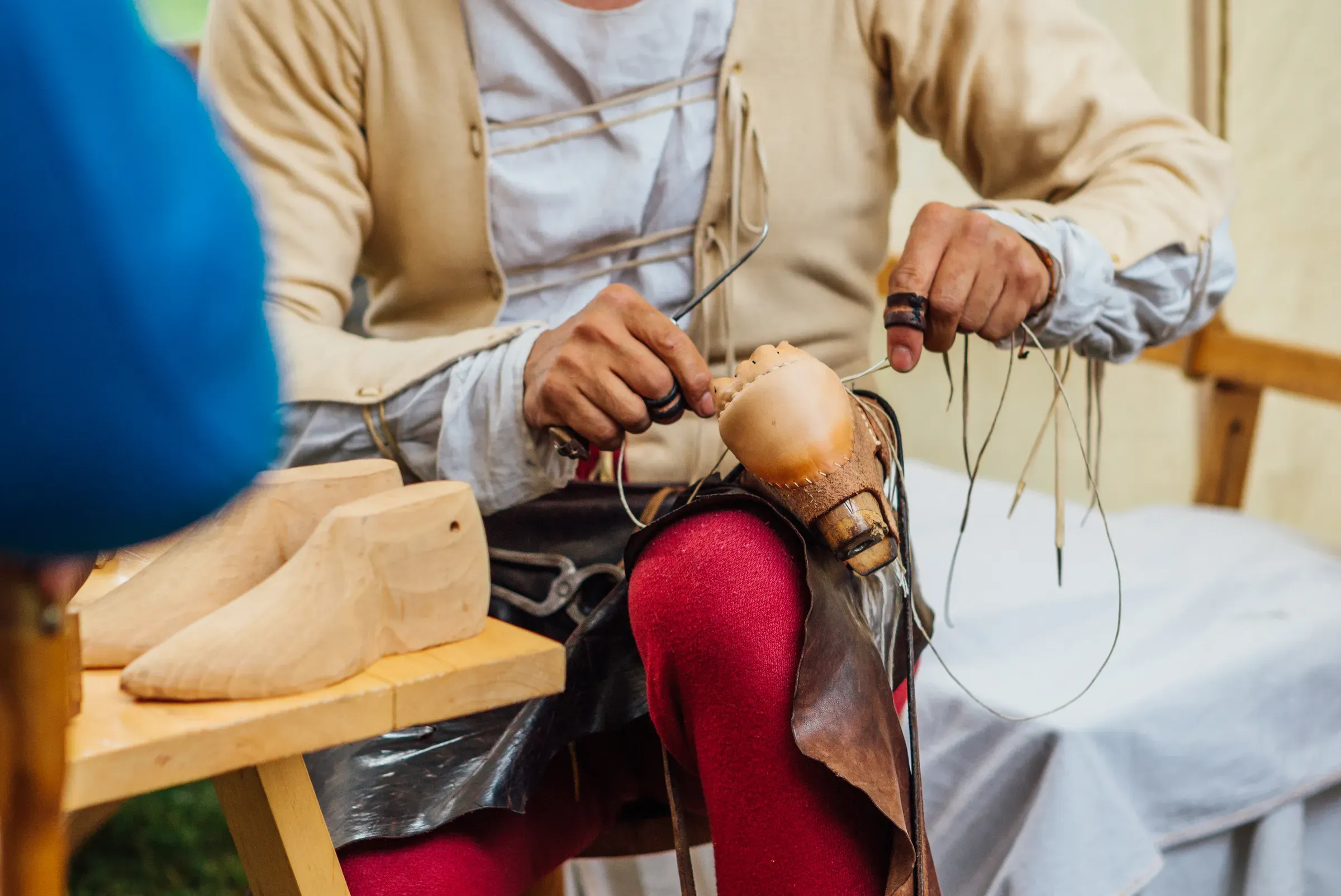
Medieval Shoemaker Crafting Leather Shoe By Hand Traditional Historical Reenactment Artisan Leatherwork, custom & made-to-order shoes ecommerce
Custom & made-to-order shoesAdults paying a premium for a pair made to their choices or their feet, often with a hard-to-fit foot or an occasion in mind, who want to see exactly what they configured, understand how measurement works and know what happens if the pair does not fit when it arrives.

How custom & made-to-order shoes makes money

Four levers, and what limits each one here

Revenue is traffic times conversion rate times order value times purchase frequency. In this niche each lever has its own ceiling.

Traffic

Traffic: bespoke, made-to-measure and the style plus fit query

Custom shoe demand is searched three ways: by the process (made to order, made to measure, bespoke shoes), by the style and occasion (custom oxford shoes, wedding shoes for the groom, custom dress shoes for wide feet) and by the question (how long do bespoke shoes take, how to measure feet for custom shoes). A store built around the configurator captures almost none of it, because a configurator is not a page an engine can rank. The traffic lever is a set of style and occasion pages with real copy and a gallery of finished orders, a process guide that explains the three tiers honestly and measurement content that answers the fear before the shopper has to ask. Those pages carry the visit; the configurator carries the order.

Conversion

Conversion: the configurator, the tracing and the lead time

A custom shoe converts when the shopper can see what they built, trust the measurement and believe the date. The configurator has to update the preview and the price with every choice, save a design without an account, and hand off to a checkout that takes a deposit. The measurement step has to be explained before it is required: what to trace, what to photograph, what the workshop does with it and what happens if the numbers look wrong. The lead time has to be a range the workshop keeps, shown beside the price, with wedding and gift dates checked against it. We build those three pieces as one flow and state the remake and adjustment policy in plain words, because a non-returnable purchase needs a clearer promise than a returnable one.

Order value

Order value: the second pair on the same last and the trees

Order value in custom footwear grows from the last. Once a customer's measurements are on file and the first pair fits, a second style on the same last is a low-risk order for both sides and a natural offer at the moment the first pair is confirmed to fit. Shoe trees shaped to the last, a care kit for the chosen leather and a second sole option at the point of order belong on the configurator's final step. Wedding orders carry a groomsmen set. A gift voucher for a made-to-order pair sells the experience without the measurement problem. The pages that carry this are the fit-confirmed email and the account page that shows the customer's last and previous designs.

Frequency

Frequency: the last on file is the relationship

A custom shoe customer does not need to be re-acquired if the store keeps their last, their measurements and their designs and speaks to them as someone whose feet it already knows. Frequency is built from a fit-confirmed follow-up that opens the door to the second pair, a seasonal note when a new leather or sole becomes available for their last, a reminder when a pair is old enough to want a resole from the workshop that made it and a design-saved reminder for the shopper who configured and left. The brand that treats the measurement as the start of a relationship rather than the end of a checkout gets the second and third pair without another ad.

Search visibility

Search: process guides, style and occasion pages and the gallery of finished pairs

Custom footwear ranks on explanation and evidence. The process guide is the entry page: what made to order, made to measure and bespoke each mean, what the customer chooses at each tier, how measurement differs, what the lead time is and what the remake policy covers. It is the page a shopper reads twice and sends to someone else, and it earns links from style publications and forums. Measurement content sits beside it: how to trace a foot, how to photograph it, what the workshop needs and how the numbers become a last.

Style and occasion pages carry the buying queries: custom oxford shoes, made-to-order chelsea boots, wedding shoes for the groom, custom shoes for wide feet or for different-sized feet. Each has real copy, a starting configuration with its actual price, the lead time and a gallery of finished orders with the customer's permission, which is the most convincing content the category has and the least often published.

Technically, the configurator is kept out of the index and linked from the style pages, each style has one canonical page rather than one per option combination, and finished-order gallery entries are indexable pages with structured data describing the product they show.

Queries that matter

  • made to order leather shoes
  • made to measure vs bespoke shoes
  • custom dress shoes for wide feet
  • how to trace your foot for custom shoes
  • custom wedding shoes for groom
  • how long do bespoke shoes take
  • custom shoes for different sized feet

Process guides, style and occasion pages with a starting price and lead time, measurement content and a gallery of finished orders rank in this niche. The configurator itself does not, and a homepage that says handmade with a video ranks for nothing a buyer types.

AI answers

AI answers: what tier, how to measure, how long and what if it does not fit

Shoppers ask assistants what separates made to order from made to measure and bespoke, how to measure their feet at home for custom shoes, how long a pair takes, what a deposit covers and whether custom shoes can be returned or remade if the fit is wrong. The stores that get named explain the tiers in plain sentences, publish the measurement process as steps, state the lead time as a range and put the remake policy in text rather than in a modal. We write the process guide and the measurement page answer-first, keep the lead time consistent between the page, the feed and the checkout, and make sure the policy pages are plain HTML the assistants' crawlers can read.

What is the difference between made to order, made to measure and bespoke shoes?
How do I measure my feet at home for custom shoes?
How long does a made-to-order pair of shoes take?
Can custom shoes be returned or remade if they do not fit?

Questions shoppers put to assistants. A store gets named when its pages answer them in plain text.

Google Shopping and Merchant Center

Google Shopping and Merchant Center for pairs that do not exist yet

Custom footwear feeds have to tell the truth about time. A made-to-order pair is not in stock; it is available with a lead time, and the feed carries that as min_handling_time and max_handling_time in business days, with availability set to in stock only when the workshop will start it on order. Pairs that ship on a scheduled production run are preorder with an availability_date. The offer in the feed is a starting configuration at its actual price, not a from price, because Google expects the feed price to match what the landing page charges for that configuration. Own-brand pairs without a barcode set identifier_exists to false. product_detail carries the last, the construction and the leather options.

Policy is about returns and prices. The account's return policy has to match the page: if custom pairs are non-returnable, the policy in Merchant Center and the policy on the page must both say so, and a remake policy is not a return policy. A page whose price changes as options are selected has to load at the configuration and price the feed describes.

Campaigns are structured by style and margin, with occasion styles labelled for their season, gift vouchers as their own offer, and free listings on for every style page.

Feed attributes that decide eligibility

  • min_handling_time and max_handling_time
  • availability and availability_date for production runs
  • identifier_exists
  • product_detail for last, construction and leather
  • price as the starting configuration's actual price
  • custom_label_0 for occasion

Disapprovals we see in this niche

  • Availability set to in stock with no handling time on pairs that take weeks
  • Missing availability_date on preorder offers for a production run
  • Return policy mismatch when custom pairs are non-returnable and the account policy says otherwise
  • Price mismatch when the feed shows a starting price and the page loads a different configuration

Meta and social ads

Meta and social ads: the workshop, the tracing and the box arriving

Custom shoe creative sells the process because the product cannot be shown in advance. The last being shaped, the leather being clicked, the welt being sewn, a customer's foot tracing arriving and the finished pair going into the box carry more than any rendered configuration. A design session filmed over the shoulder shows how easy the configurator is. Customers unboxing a pair they designed, with rights secured, are the strongest asset because the audience wants to see that the wait ended well.

Audiences begin with saved-design visitors and past customers, then interest prospecting around classic menswear and craft, where the niche is small enough that interest targeting still works. Retargeting runs long, because the consideration is weeks, and it is sequenced through the process rather than repeating one ad. Policy is about honesty: lead times in ads have to match the page, handmade and country-of-origin claims have to be true, and a deposit ad has to say it is a deposit.

  • The last being shaped and the leather being cut
  • A customer's foot tracing arriving at the workshop
  • A design session filmed over the shoulder
  • The finished pair going into the box
  • A customer unboxing a pair they designed, with rights secured

Policy line

Lead times, handmade and origin claims in ads must be true and match the page, a deposit must be described as a deposit, and no ad may imply a returnable purchase where custom pairs are non-returnable.

Conversion and the store

The store: a configurator that saves, a measurement page that reassures and a deposit checkout

The custom shoe store has to carry the shopper from a style page into a design and out through a deposit without losing them to doubt. The configurator updates the preview and the price on every choice, works on a phone, saves the design to a link without forcing an account and shows the lead time and the remake policy on its final step. The measurement page explains what the workshop needs before the shopper commits, with photographs of a good tracing and a bad one. The deposit checkout states the balance, when it is due and what the deposit covers.

The style page carries the starting configuration at its actual price, the gallery of finished orders and the occasion date check. On mobile, the configurator must be usable one-handed and the saved-design link must survive a closed browser, because most designs are finished in a second session.

Objections the page must answer

  • “What if the measurements I send are wrong”
  • “Will it arrive before the wedding”
  • “What does the deposit cover and when is the balance due”
  • “Can it be remade or adjusted if it does not fit”
  • “Will the finished pair look like the preview”

Email, SMS and retention

Email and SMS: the wait, made visible

Custom shoe flows exist to make the wait feel safe. After the deposit, a measurement guidance message explains exactly what to send and by when; a confirmation says the measurements arrived and were checked. Production updates land at real stages, when the last is ready, when the upper is closed, when the pair is lasted and finished, because silence during a six-week wait is the main source of cancellations. Dispatch carries fit guidance and the adjustment window.

A fit-confirmed follow-up a fortnight after delivery asks the question directly and, once the answer is yes, opens the second pair on the same last. A saved-design reminder goes to shoppers who configured and left, with the design link and the lead time against any date they entered. Seasonal notes announce new leathers or soles for the customer's last. SMS is used only for production milestones and dispatch. Win-back is the resole offer from the workshop that made the pair.

  1. Measurement guidance

    Immediately after the deposit

  2. Measurements received and checked

    On receipt, with any query from the workshop

  3. Production milestones

    At each real stage: last ready, upper closed, lasted, finished

  4. Dispatch and fit guidance

    On dispatch, with the adjustment window stated

  5. Fit confirmed, second pair on your last

    Two weeks after delivery

  6. Saved design reminder

    Two days after a design is saved without a deposit

Where revenue leaks

The leaks we find in custom & made-to-order shoes stores

The Growth Analysis ranks these against your own numbers and says which to close first.

Get a Growth Analysis for your custom shoe brand
  • Every option built as a variant

    Ten leathers by six soles by four stitch colours by twelve sizes becomes thousands of variants, the platform limit is hit, the feed fills with duplicates and the configurator stalls on a phone.

  • The lead time in a FAQ nobody opens

    The shopper with a wedding in five weeks pays a deposit for a pair that takes eight, and the workshop absorbs a cancellation and a refund instead of a sale.

  • No deposit option

    Full payment up front for a pair that will not exist for two months turns serious shoppers into saved designs that never convert.

  • Saved designs that go nowhere

    Hundreds of configurations sit in the database with no link sent and no reminder, and the store pays to re-acquire people who already designed their shoe.

  • A feed that says in stock

    Shopping lists the pair as available today, the page says eight weeks, and the account collects mismatches on its most expensive products.

Platform notes

Where the platform changes the work

Shopify

Design choices are carried as line item properties rather than variants, so the configurator stays outside the variant limit; deposits run through a partial-payment or deposit app, saved designs are stored against a draft or a metafield, and the customer's last and measurements live in customer metafields for the second-pair flow.

WooCommerce

Product add-ons carry the design choices and a deposits extension takes the partial payment; the lead time and handling time need to be written per product so the feed plugin sends min and max handling time rather than a store default.

Headless

A custom front end can run a real-time preview configurator with saved designs and a deposit checkout as one flow, which is the strongest version of this store; the trade-off is that the style and process pages still need to be server-rendered so they can rank.

Questions

Custom & made-to-order shoes owners ask us

By CartKernel · Last reviewed

Should a custom shoe configurator use product variants or line item properties?

Line item properties or an add-on system, almost always. Building every leather, sole, stitch and size combination as a variant runs into the platform's limit, fills the feed with duplicates and slows the configurator. The design choices travel with the order line; the product stays one record with one page that can rank.

How do you handle Google Shopping for made-to-order shoes with a long lead time?

With handling time in the feed. Made-to-order pairs are submitted with min and max handling time in business days, scheduled production runs as preorder with an availability_date, and a starting configuration at its actual price so the landing page matches. Listing the pair as in stock without a handling time is the fastest route to availability mismatches on your most expensive products.

What should the measurement process look like on a custom shoe website?

Explained before it is required. A page that shows what to trace and photograph, a good example and a bad one, what the workshop does with the numbers and what happens if they look wrong. After the deposit, a guidance message and a confirmation that the measurements were checked. Fit failures are remakes at the workshop's cost, so the measurement step is where the margin lives.

Can custom shoes be sold with a deposit rather than full payment?

Yes, and they should be. A deposit with a stated balance and due date lowers the barrier for a pair that will not exist for weeks, and it gives the campaigns a conversion to optimize toward. The deposit terms, what it covers and the remake policy go on the configurator's final step and in the confirmation email.

How long does it take for custom shoe pages to rank?

Process guides and measurement content can move within a few months because the competition is thin and the pages answer questions nobody else does well. Style and occasion pages typically take longer, three to six months, and a gallery of finished orders with structured data builds over time. Anyone promising faster is describing paid traffic.

What do you report for a made-to-order shoe brand?

Deposits and balances as separate lines, saved designs and how many become deposits, lead time kept against lead time promised, remakes and adjustments as a cost line, second-pair orders from customers with a last on file, and revenue by style and occasion. Everything reconciles to orders in the platform rather than to what the ad platforms report.

Grow your custom & made-to-order shoes store.

A free Growth Analysis ranks what your store should fix first, by revenue at stake, in about a week.