Skip to content

Health & wellness · ecommerce growth

Men's health brand marketing agency

Men's health is researched in private and bought quickly. The shopper has already read a forum thread about minoxidil concentrations or saw palmetto, wants to know what will show on the parcel and on the card statement, and decides in a single session once the active ingredient is settled. We build the store around that behaviour: ingredient and question pages that answer before the checkout, a paid setup that stays inside Google's healthcare rules, and a subscription program that survives the months before anything visible happens.

The buyer, in brief

Consideration
Weeks of quiet reading, then a purchase made in one sitting once the ingredient is settled
Purchase frequency
Monthly for topicals and 30-count bottles, every two to three months for larger supplies and grooming refills
Seasonality
A January lift, a smaller one before summer, and a November attention spike that raises traffic more than orders
Price band
Low to mid per order, with three-month supplies and routine sets moving the first basket upward
Return risk
Few physical returns and a lot of silent churn, because progress in this category is slow and undramatic
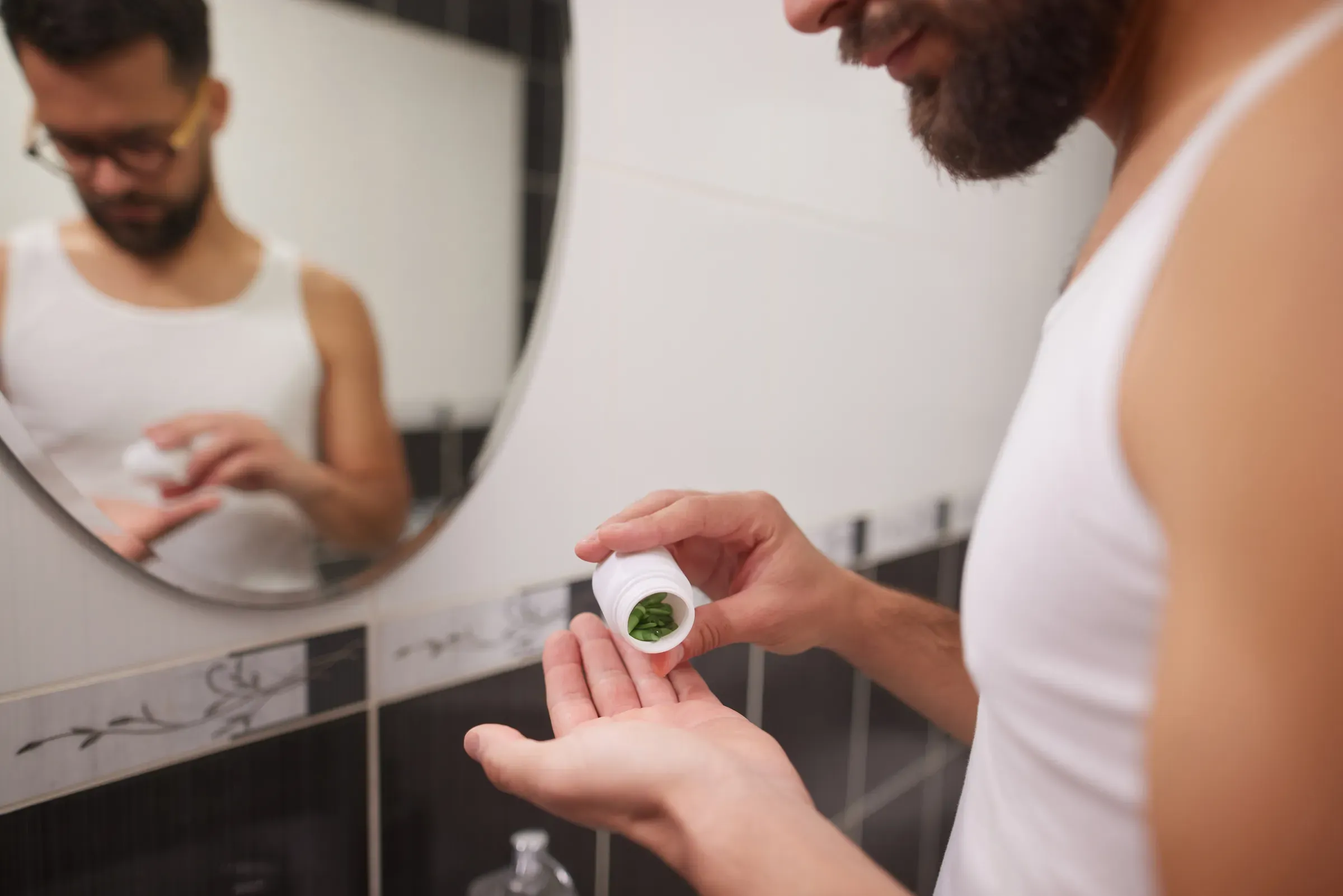
Man taking vitamin supplements as part of morning health routine, men's health ecommerce
Men's healthMen in their late twenties to fifties who research alone and late, compare active ingredient and concentration rather than brand, and check the shipping and billing descriptor before they trust a store they have not bought from before.

How men's health makes money

Four levers, and what limits each one here

Revenue is traffic times conversion rate times order value times purchase frequency. In this niche each lever has its own ceiling.

Traffic

Traffic: the active and the concentration, not the category

Demand sits on the ingredient and its strength. Men search minoxidil foam against liquid, saw palmetto dose for hair, ashwagandha and testosterone, DHT blocker shampoo, and they search it as a question because they are still deciding. Almost nobody types men's health. A catalog organised the way the company thinks about itself therefore misses the demand entirely. The traffic lever is a page for each active, each concentration and each format, plus an answer library where the question itself is the destination rather than a blog post pointing at a product grid.

Conversion

Conversion: privacy stated as a fact on the page

Two things stop the order and neither is price. The first is discretion: what the outer box looks like, whether anything on the shipping label names the product, what the card statement will read, whether a signature is needed at the door. The second is patience: a topical applied twice daily is judged over months, and a page that avoids saying so converts a customer who will quit in week six. Putting both in plain text near the buy button, rather than in a policy page, is what moves this conversion rate.

Order value

Order value: the routine and the three-month supply

A single bottle is rarely the right first order in this niche, because a single bottle cannot outlast the period in which the customer decides whether anything is happening. The routine set is the honest answer: the topical, the cleanser or shampoo, the supplement and the applicator presented in the order they are used, with the supply length stated. A three-month supply priced sensibly against the monthly one raises the first basket and buys the time the product needs. Applicators, replacement heads and travel sizes finish the basket without discount games.

Frequency

Frequency: winning the months before anything shows

The churn point in men's health is month two, not month twelve. Nothing visible has happened, the novelty has gone, and the subscription is the easiest thing on the statement to cancel. Retention work here is expectation management delivered on a schedule: what the first eight weeks normally look like, why consistency matters more than dose, and a private progress prompt at set intervals that gives a slow product something to show. The subscription offer belongs near the end of the first supply, with a pause and a longer interval available before any discount is mentioned.

Search visibility

Search for men's health: actives, concentrations and questions asked at night

The queries name the ingredient and the strength, then ask whether it works. Minoxidil foam or liquid, saw palmetto dose, biotin against a DHT blocker, ashwagandha for testosterone, beard growth for patchy areas. Each of those needs its own page with the active, the concentration, the format and the application rate written as text, and each question needs an answer page that resolves the question rather than deflecting into a product grid. A collection called men's health serves none of it.

The informational results are held by telehealth publishers and health media with large editorial teams, so a page that restates the same summary will not displace them. What earns a position is the detail those publishers leave out: what a concentration means when it is applied, how formats behave differently on a scalp or on skin, how long a bottle lasts at the stated application rate, what the formula deliberately does not contain, and what the label is permitted to say. Ingredient pages written to that depth attract links and pass authority into the products.

Technically the work is about keeping the retail catalog clearly separate from anything that looks like a pharmacy. If the brand also runs a consultation arm, keep it on its own paths and templates, and keep prescription drug names off the retail pages, because one page can change how a crawler, an ad reviewer and a payment provider classify the whole domain. Strength variants sit under one canonical product, and availability stays honest so nothing is indexed that cannot be bought.
Queries that matter

  • minoxidil foam vs liquid
  • saw palmetto for hair loss dose
  • ashwagandha testosterone supplement
  • dht blocker shampoo
  • does biotin actually help hair
  • beard growth kit for patchy beard
  • multivitamin for men over 40

Active-ingredient explainers, format and concentration comparisons, and honest timeline pages rank in this niche. Collections named after the category, and product pages carrying a manufacturer paragraph, do not.

AI answers

Assistants answer the questions men would rather not ask a person

The questions put to assistants here are practical and slightly private: whether an ingredient does anything, what dose is reasonable, whether two products can be used together, what happens on stopping. Stores get named when the answer already exists on the page in plain language, when the active and the concentration appear as text rather than inside a label image, and when the site says who formulated the product and where it is made. We write the ingredient and routine pages answer-first, keep the wording identical across the product page, the feed and the FAQ, and confirm the pages render as HTML for the crawlers behind the major assistants.

Does minoxidil work on a receding hairline?
What happens if I stop using a hair loss treatment?
Is a testosterone support supplement the same as testosterone?
Can I use a DHT blocker shampoo and a topical together?

Questions shoppers put to assistants. A store gets named when its pages answer them in plain text.

Google Shopping and Merchant Center

Merchant Center for men's health: segment the feed before you optimise it

Eligibility is settled before performance in this catalog. Google's healthcare and medicines policy treats over-the-counter medicines as restricted, permitted only in approved countries and only for advertisers that meet the policy, while prescription products require certification and are limited to specific markets. Unapproved substances and products promoted for sexual enhancement are not advertisable at all. A store selling a topical drug beside vitamins and grooming items therefore needs the feed segmented, so a restricted line cannot take an account-level warning with it.

The attributes that matter are the ones that answer the query. Titles carry the active, the strength, the format and the supply length, because that is the string a man types. Product_detail carries the active ingredient, the concentration and the application rate. Unit_pricing_measure lets Shopping compare a 60-count against a 180-count honestly. Age_group set to adult keeps listings out of contexts they do not belong in, and item_group_id ties pack sizes of one strength together instead of splitting reviews and ranking signals across near-duplicates.

Campaigns are then split by whether an item is restricted, subscription-eligible or a first-order product. Free listings are worth enabling for the unrestricted part of the catalog, and the restricted part is excluded by custom label rather than left for a reviewer to find.

Feed attributes that decide eligibility

  • gtin or identifier_exists
  • product_detail for active and concentration
  • unit_pricing_measure for supply length
  • age_group set to adult
  • item_group_id across pack sizes
  • custom_label for restricted versus unrestricted lines

Disapprovals we see in this niche

  • Restricted or prohibited drug flags when a topical medicine reaches a standard feed
  • Healthcare policy flags on descriptions that name hair loss or low testosterone as a condition
  • Misrepresentation when a subscription price shows on the page but not in the feed
  • Account-level warnings triggered by a single sexual enhancement listing

Meta and social ads

Meta for men's health: film the product, never the viewer

Meta is usable in this niche, but only if the creative describes the product and never the person watching. The personal attributes policy prohibits any ad implying the viewer is losing hair, has low energy or has a sexual health concern, and before-and-after imagery is not permitted. That rules out most of what the category instinctively wants to film. What clears review is the product itself: the applicator, the texture, the label read at normal speed, the routine in order, and a customer describing what he does rather than what he had.

Audiences begin with customers and site visitors, because interest targeting for men's grooming is broad and expensive, then move to broad prospecting once there is enough creative to feed it. If Meta classifies the domain as health and wellness, lower-funnel events can be restricted, so optimisation may run on an earlier event and reporting has to be reconciled against the store rather than accepted at face value. Creator footage needs written rights and a script review, since a claim made by a creator becomes a claim the brand owns.

  • The dropper and the scalp application shown step by step
  • What is in the bottle, read from the label at normal speed
  • An unbranded parcel opened on a doorstep
  • A formulator explaining why this concentration and this format
  • A customer describing his morning routine in his own words, rights secured

Policy line

No implied hair loss, body shape or sexual health status in the viewer, no before-and-after, adult targeting for anything in the sexual health adjacency, no prescription drug promotion, and lower-funnel event sharing may be restricted for health-classified domains.

Conversion and the store

Product pages that settle privacy and patience in one scroll

Discretion has to be written down. Say what the outer box looks like, whether the shipping label names the product, what the billing descriptor reads and whether anyone has to sign for the parcel. Every one of those is a question the shopper has and will not ask, and answering them beside the buy button removes more friction than a redesign. The same applies to the timeline: state honestly that a topical is judged over months and describe what the early weeks normally look like, because the customer who was not told is the customer who cancels in month two.

The template that carries revenue is a routine page rather than a single product page. It shows the order of application, what each item contributes, what to expect at each stage and how long each supply lasts, then sells the set. Guest checkout matters more here than in most categories because account creation feels like a permanent record, and express payment options cut the number of fields a man has to complete on a phone late at night.

Objections the page must answer

  • “Will the packaging or the card statement say what this is”
  • “How long before I know whether it is working”
  • “What happens if I stop using it”
  • “Is this the same active as the one I read about”
  • “Do I have to talk to anyone to buy it”

Email, SMS and retention

Email and SMS: hold the customer through the invisible months

Retention is decided in the first ninety days, before there is anything to see. The onboarding sequence sets the timeline honestly, demonstrates the application method and describes what a normal early stage looks like, so that no change is not read as failure. A private progress prompt at fixed intervals gives a slow product something to show, and it belongs in email where it stays between the brand and the customer rather than on a public page.

Replenishment is calculated from the application rate rather than the calendar. A topical used twice a day empties on a predictable date, a 30-count bottle on another, a grooming refill on a third, and the reminder should arrive a few days before each one. The subscription offer lands after the first supply rather than at the first checkout, and the save flow offers a pause and a longer interval before it offers money. SMS suits shipping and reorder moments, with message previews written so nothing on a lock screen names the category.

  1. Timeline and application onboarding

    Day one to day seven after the first order

  2. Private progress prompt

    Month one, month three and month six

  3. Subscription offer after the first supply

    Around day twenty-five of a thirty day supply

  4. Replenishment by application rate

    A few days before the calculated empty date for each format

  5. Pause and interval save

    At the first cancellation attempt, before any discount

Where revenue leaks

The leaks we find in men's health stores

The Growth Analysis ranks these against your own numbers and says which to close first.

Get a Growth Analysis for your men's health brand
  • A collection named after the company's own vocabulary

    The catalog is organised as men's health rather than by active and concentration, so the searches that carry the category land on a publisher or a marketplace instead.

  • One restricted item inside a shared feed

    A topical medicine sits in the same feed as the vitamins, so a policy review affects the entire account rather than a single product line, and the compliant products stop serving too.

  • Churn in month two

    The customer stops before the product had a chance to do anything, because nobody described what the first eight weeks normally look like.

  • A billing descriptor nobody chose

    The statement shows whatever the processor assigned, which produces support tickets and disputes in a category where discretion was the reason for buying online.

Platform notes

Where the platform changes the work

Shopify

Subscription contracts with a stated first term, a portal that allows pause and interval changes without contacting support, and metafields for active, concentration and application rate so the same values render on the page and map into the feed. Any consultation flow stays on its own templates.

WooCommerce

Global attributes for active and strength drive the filters and the attribute archives that can be indexed, and the feed plugin has to map strength into product_detail rather than leaving it inside the description where nothing can use it.

Headless

Where a brand runs retail and a consultation product together, a headless front end lets both live under one domain with genuinely separate templates, routing and analytics, which keeps classification and reporting clean.

Questions

Men's health owners ask us

By CartKernel · Last reviewed

Can we advertise a minoxidil product in Google Shopping?

It depends on the market and on certification. Google treats over-the-counter medicines as restricted, allowed only in approved countries and only for advertisers meeting the policy, and prescription products need certification. We check the policy for every country you ship to, segment the feed so restricted items sit apart from supplements and grooming, and keep the unrestricted catalog advertising while the rest is resolved.

How do we run Meta ads without implying the viewer is losing hair?

By filming the product instead of the person. The applicator, the label, the routine and the parcel all pass review, and a customer can describe what he does each morning without stating what he had. We write scripts against the personal attributes policy before anything is produced, and review creator footage for claims the brand would then be responsible for.

What should the packaging and the card statement actually say?

Something the customer recognises and nobody else needs to. A plain outer box with no product name, a shipping label carrying a neutral company name, and a billing descriptor you chose deliberately rather than the default your processor assigned. All three belong on the product page as plain text, because saying it out loud is what closes the sale.

Is a subscription the right offer for a hair or testosterone support product?

Usually, but not at the first checkout. Progress here takes months, so a subscription sold before the customer has any reason to believe in the product cancels early and costs more than it earned. We place the offer near the end of the first supply, make pause and longer intervals easy to find, and report churn by cohort month rather than as one blended number.

Should the retail store and a consultation service share one site?

They can share a domain but not templates, tracking or feeds. Prescription language on a retail page changes how ad reviewers, payment providers and crawlers classify everything around it. We separate the paths, keep prescription drug names off the retail catalog, and report the two funnels as different lines so neither one hides the other.

What does the first quarter of work usually cover for a men's health brand?

A policy and feed audit first, because eligibility gates everything else. Then the ingredient and question pages that carry organic demand, then the privacy and timeline blocks on product pages, then onboarding and replenishment flows. Paid search is rebuilt around actives and defended at the brand once the feed is clean and segmented.

Grow your men's health store.

A free Growth Analysis ranks what your store should fix first, by revenue at stake, in about a week.