Skip to content

Health & wellness · ecommerce growth

Sports nutrition marketing agency

Sports nutrition is bought by flavour, by serving count and by whatever a training partner is already using. The shopper compares protein per scoop, checks whether the product is tested for banned substances, and hesitates over a 2 kg tub of a flavour they have never tasted. We build the store around that: variant structures that rank and stay eligible in Shopping, sample packs that remove the flavour risk, stack offers that raise the basket, and reorder flows timed to the number of scoops left.

The buyer, in brief

Consideration
Hours to a few days, shortened by a sample pack and lengthened by a large tub in an untried flavour
Purchase frequency
Every four to six weeks for protein at one serving a day, monthly for pre-workout and creatine, faster in competition season
Seasonality
January, spring and pre-summer peaks, race and competition calendars for endurance products, and a quiet late December
Price band
Mid, with the large tub and the stack bundle raising the first order well above a single product
Return risk
Opened powders are rarely returnable, so returns are low, but damaged tubs and wrong-flavour deliveries generate replacements and support load
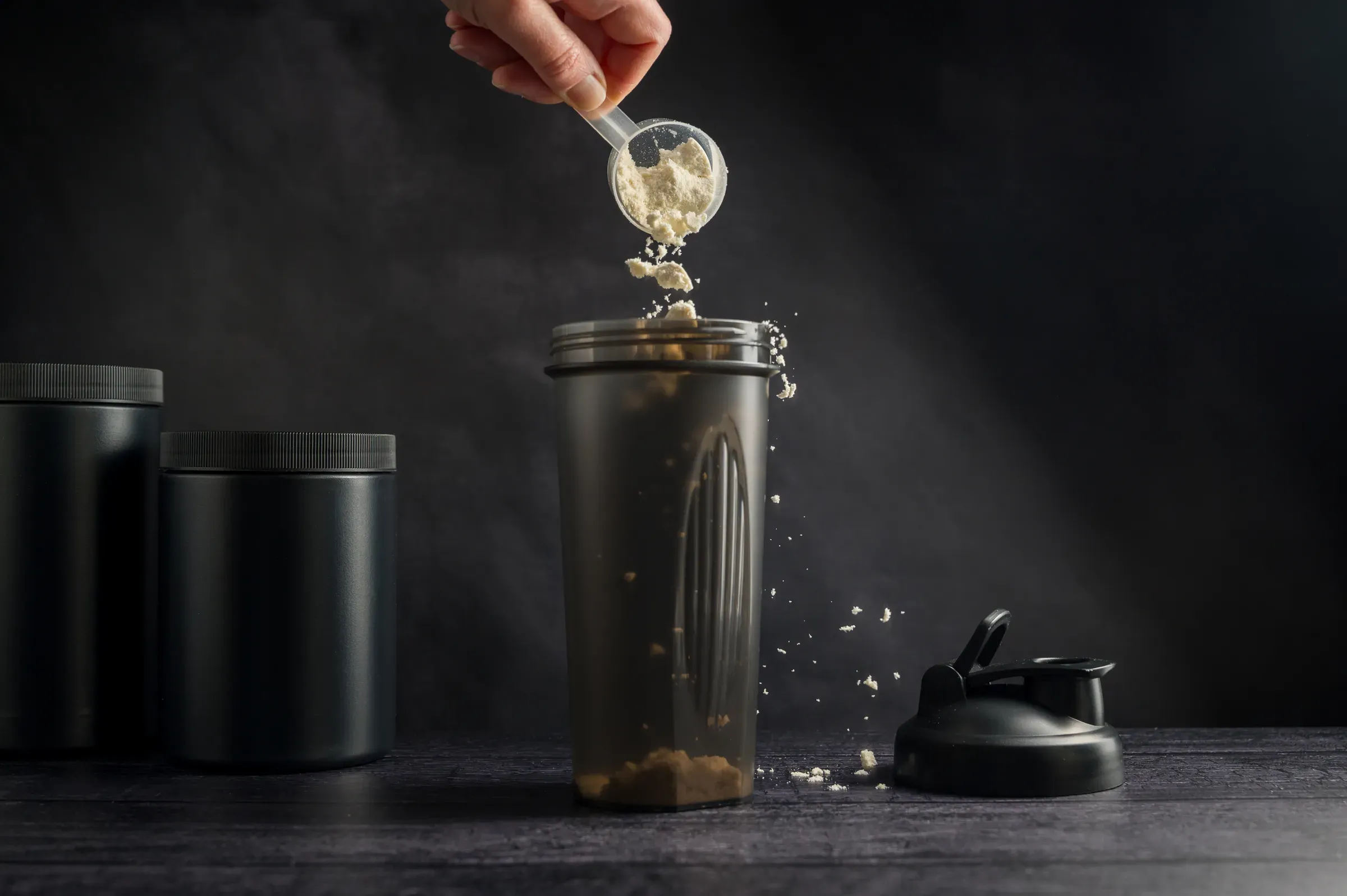
Protein drink. Hand pouring protein powder in a black shaker. Plastic tube on dark background. Body building,, sports nutrition & protein ecommerce
Sports nutrition & proteinGym members, endurance athletes and tested competitors who compare protein per serving, sugar per serving and the presence of an Informed Sport or NSF Certified for Sport mark, and who ask the mixability and taste question before anything else.

How sports nutrition & protein makes money

Four levers, and what limits each one here

Revenue is traffic times conversion rate times order value times purchase frequency. In this niche each lever has its own ceiling.

Traffic

Traffic: protein type, goal and flavour, in the order athletes search

Athletes search by product type and specification first: whey isolate, clear whey, vegan protein without stevia, creatine monohydrate powder, caffeine-free pre-workout. Flavour arrives at the end of the query and goal terms such as protein for muscle recovery sit alongside. The catalog has to mirror that: a collection per product type with real copy, a page per product that holds all flavours and sizes as variants, and ingredient pages for the components that get searched on their own. Most stores have one protein page per flavour and a grid of tubs, which creates duplicate pages and hides the product that should rank.

Conversion

Conversion: the sample pack beats the review count

The objection that stops a first order is taste. Reviews help, but a tub is a commitment and the shopper has been burned before. The conversion lever is a sample or trial pack sold at a price that covers itself, positioned on every full-size page as the low-risk path, and a flavour guide that describes each option honestly. The second objection is testing: competitive athletes need to see the banned-substance certification and the batch lookup, and everyone wants the amino acid profile and protein per serving as text. Mixability and the scoop size go on the page too, because they are the questions in the reviews.

Order value

Order value: stacks, tubs and the flavour bundle

Order value in sports nutrition comes from the stack. Protein plus creatine, pre-workout plus intra-workout, or a mass-gain pairing, sold as a set with a modest saving and a page of its own, raises the basket for a shopper who was going to buy the second product somewhere anyway. The larger tub does the same for a committed customer, and a two-flavour bundle solves the boredom that drives switching. Free shipping thresholds matter more here than in most categories because tubs are heavy and the shopper knows shipping is expensive, so the threshold sits just above the stack price.

Frequency

Frequency: the tub runs out on a schedule you can calculate

A 30-serving tub at one scoop a day is gone in a month; at two scoops it is gone in fifteen days. The store knows the size, the serving count and the order date, so the reorder date is arithmetic. Frequency work is building the reminder on that arithmetic, offering the subscription once the customer has finished the first tub rather than before, and rotating flavours inside the subscription so it does not get cancelled out of boredom. Training calendars matter too: a marathon runner buys gels in a block before a race and nothing after, and the flow should know that.

Search visibility

Ranking a sports nutrition catalog: variants, stacks and ingredient pages

The category queries are product-type and specification terms: whey protein isolate, plant protein powder, creatine monohydrate, pre-workout without caffeine, electrolyte tablets. Each needs a collection with copy that explains the differences the athlete cares about, protein per serving, sweetener, allergen and testing, plus a grid and internal links. Goal terms such as protein for weight training and recovery drink after running belong on guide pages that link into the collections.

Product pages hold every flavour and size as variants of one URL. That single decision fixes most sports nutrition SEO problems, because a store with a page per flavour has twelve near-identical pages competing for one query. The page carries the nutrition panel as text, the amino acid profile, the sweetener, the certification and a flavour guide.

Ingredient pages for creatine, beta-alanine, citrulline, caffeine and whey types carry the informational demand and link to the products that contain them. Stack pages need their own URLs with the component products linked. Technically, out-of-stock flavours should stay on the variant selector marked unavailable rather than vanish, and discontinued flavours redirect to the product, not the collection.

Queries that matter

  • whey isolate low sugar
  • vegan protein powder without stevia
  • creatine monohydrate powder informed sport
  • caffeine free pre workout
  • clear whey protein
  • protein powder for runners
  • best tasting chocolate protein

Product-type collections with real specification copy, single product URLs with all flavours as variants, and ingredient explainer pages rank. A page per flavour and a blog of workout tips do not.

AI answers

Assistants and the pre-workout question

Athletes ask assistants how much protein a scoop should have, whether a pre-workout is safe before a drug-tested event, which creatine form to take and which brands are certified. The store that gets named has protein per serving, sweetener, caffeine content and certification status as text on the page, a certification page that names the program and the batch lookup, and Product markup that agrees with the feed. We write the ingredient pages answer-first and check that every specification an assistant might quote is consistent across the page, the feed and the markup.

How much protein per scoop should a whey isolate have?
Is this pre-workout safe for drug-tested athletes?
Which creatine form is best for beginners?
Which protein powders are Informed Sport certified?

Questions shoppers put to assistants. A store gets named when its pages answer them in plain text.

Google Shopping and Merchant Center

Shopping feeds for protein and pre-workout: one item group per tub

Variant handling decides eligibility and performance here. Every flavour and size of a product shares an item_group_id, each variant carries its own GTIN where one is assigned, and the flavor and size attributes are populated rather than stuffed into the title. Titles still carry flavour and size at the end because shoppers type them, but the attribute fields are what let Shopping match a chocolate 2 kg query to the right variant. Unit pricing per serving or per hundred grams helps in a category where shoppers compare across tub sizes.

Policy is mostly about stimulants and claims. Ingredients on Google's unapproved substances list, including certain stimulants that appeared in older pre-workout formulas, make the listing ineligible and can affect the account. Muscle-gain and weight-loss claims that promise results fall under the healthcare and misrepresentation policies. Descriptions that state protein per serving, sweetener and certification stay clear of both.

Campaign structure follows margin and role: sample packs in an acquisition campaign, single tubs bid to margin by product type, stacks and large tubs in a campaign that accepts a lower return for a higher basket. Free listings are switched on and monitored separately.

Feed attributes that decide eligibility

  • item_group_id per product across flavours and sizes
  • flavor
  • size and unit_pricing_measure
  • gtin per variant
  • product_detail for protein per serving and certification
  • custom_label for sample versus full size

Disapprovals we see in this niche

  • Unapproved substance flags on pre-workouts with restricted stimulants
  • Availability mismatch when a flavour sells out faster than the feed updates
  • Misrepresentation for result claims in descriptions
  • Variant image mismatch when every flavour shares one tub photo

Meta and social ads

Meta creative for sports nutrition: athletes, mixability and the scoop

The policy lines here are body-transformation imagery, which Meta treats as before-and-after, and any ad implying the viewer needs to change their body. Weight management products require adult-only targeting. Inside those lines the creative is practical: the shake mixed on camera, the scoop shown against a tablespoon for scale, the nutrition panel read out, and athletes using the product during a real session with rights secured and their claims checked against what the label allows.

Athlete UGC is the strongest format in the niche and the most exposed, because a creator who says a product gets them shredded has made a claim the brand now owns. We brief creators on the allowed language, review before publishing, and keep the rights in writing. Audiences start with customers and engaged followers, then broad prospecting with product-type creative; interest targeting on fitness is crowded and expensive.

  • Mixability test on camera: shaker, water, thirty seconds
  • Flavour ranking by the team, with the honest loser included
  • The certification story for tested athletes
  • A real session with the product in use, rights secured
  • Protein per scoop versus the serving size, explained

Policy line

No body-transformation or before-and-after imagery, no implied need to change the viewer's body, adult-only targeting for weight management products, and no result claims in creator scripts.

Conversion and the store

Selling a 2 kg tub on a phone

The product page has to make a large untried purchase feel safe. That means the flavour selector with honest descriptions, the sample pack as the visible alternative, protein per serving and the panel as text, the certification mark linked to the lookup, and reviews filtered by flavour so the chocolate buyer reads about chocolate. The scoop size and the servings per tub belong above the fold because they decide value in the shopper's head.

The revenue template is the product page with the stack module beneath it. On mobile, the variant selector must show flavour and size without a scroll, the sticky bar must show the price for the selected variant, and the free shipping threshold must be visible with the amount remaining. Weight-based shipping surprises at checkout are the largest single abandonment cause in this niche, so shipping is stated on the product page.

Objections the page must answer

  • “Will I like the taste enough to finish the tub”
  • “How much protein is actually in a scoop”
  • “Is it tested for banned substances”
  • “Does it mix without clumping”
  • “What does shipping cost on something this heavy”

Email, SMS and retention

Retention for sports nutrition: flavour rotation and the refill date

The refill date is calculable, so the reminder is precise: servings in the tub divided by the customer's stated daily use, sent five days before the tub runs out. The first-use email on delivery covers mixing, timing around training and what to expect in the first week for creatine or pre-workout. A flavour feedback request at day ten catches the customers who did not like their choice and offers a different flavour before they leave.

The subscription offer arrives with the second tub, not the first, and includes flavour rotation as the headline benefit. Race-season and competition flows for endurance products are built around dates the customer gives you. SMS carries restock alerts for popular flavours, shipping updates and the refill nudge. Win-back names the flavour the customer bought and offers the sample pack of what is new.

  1. First-use and mixing guide

    On delivery

  2. Flavour feedback

    Day ten after delivery

  3. Refill reminder

    Five days before the tub runs out, calculated from servings and stated use

  4. Subscription with flavour rotation

    With the second tub order

  5. Race or competition block

    From the event date the customer provides

Where revenue leaks

The leaks we find in sports nutrition & protein stores

The Growth Analysis ranks these against your own numbers and says which to close first.

Get a Growth Analysis for your sports nutrition brand
  • A page per flavour

    Twelve near-identical URLs compete for one query, none ranks, and Shopping gets a feed without item groups.

  • Sold-out flavours still receiving ad spend

    The feed updates daily, the chocolate sells out at noon, and Shopping clicks land on an unavailable variant until the next fetch.

  • Shipping revealed at checkout

    A heavy tub with weight-based rates surprises the shopper at the last step, and the cart is abandoned at the highest-intent moment.

  • Creator claims the brand now owns

    An athlete's video promises a physique, the ad runs under the brand's account, and the rejection or the restriction lands on the brand.

Platform notes

Where the platform changes the work

Shopify

Flavours and sizes are variants of one product with per-variant GTINs and images; nutrition panels and certification data live in metafields and map to product_detail. Inventory syncs to Merchant Center through the channel so sold-out flavours update quickly, and selling plans carry the flavour-rotation subscription.

WooCommerce

Variable products with flavour and size attributes keep one URL per product; the feed plugin must emit item_group_id and per-variant GTINs, and stock status per variation has to reach the feed within the hour.

Headless

Variant selection state must render server-side so the product URL and the selected flavour are crawlable, and the feed is generated from the same product data as the storefront.

Questions

Sports nutrition & protein owners ask us

By CartKernel · Last reviewed

Should each flavour of our protein have its own product page?

No. One product URL with flavour and size as variants ranks better, feeds Shopping correctly through item_group_id, and lets reviews for all flavours strengthen one page. The exception is a flavour that has become a product in its own right with independent search demand, and even then it usually stays a variant with a dedicated landing page in paid.

Can we run Meta ads for pre-workout and fat-loss products?

Pre-workout, yes, with creative that avoids result claims and implied conditions. Products positioned for weight management need adult-only targeting and cannot use body-transformation imagery. We check ingredients against Google's unapproved substances list too, because a stimulant that Meta tolerates can still make the Shopping listing ineligible.

How do we get certified-for-sport status to actually sell?

By making it verifiable and specific. The mark links to the certifier's lookup for your product, the batch number appears on the page and the tub, and the collection for tested athletes filters to certified products only. Then the certification page ranks for the queries drug-tested athletes type, which is where that demand lives.

Is a sample pack worth the margin hit?

Usually, when it is priced to cover its own cost and followed by a flow that leads to the full tub. It removes the flavour objection that blocks first orders and gives the reorder flow a real signal about which flavour to recommend. We measure sample-to-tub conversion as its own line to check it is paying.

How do you handle heavy shipping costs for tubs in paid campaigns?

By showing the shipping cost or the free-shipping threshold on the product page and in the Shopping feed, so no shopper meets it for the first time at checkout. Campaign bids account for the shipping margin on single tubs versus stacks, and the threshold is set just above the stack price so the bundle becomes the obvious choice.

What do you report monthly for a sports nutrition store?

Revenue by product type and flavour, sample-to-tub conversion, refill rate on schedule, subscription retention by cohort month, shipping margin by order size, brand and non-brand paid revenue separated, and the flavours that sold out while ads were still running. Every figure reconciles to orders in the platform.

Grow your sports nutrition & protein store.

A free Growth Analysis ranks what your store should fix first, by revenue at stake, in about a week.