Skip to content

Jewelry · ecommerce growth

Birthstone jewelry marketing agency

Birthstone jewelry runs on a twelve month clock. Demand for each stone climbs in the weeks before that month's birthdays, the buyer is nearly always shopping for somebody else, and the question that decides the order is whether the color in the photograph is the color that will arrive. We build the store for that pattern: a page for every month and every stone, ready before its spike, honest treatment and hardness information, family piece builders that hold several stones at once, and flows that remember whose birthday it was.

The buyer, in brief

Consideration
A few days, squeezed shorter by a birthday that is already close
Purchase frequency
Two to four times a year in a household with several birthdays, plus a family piece that is added to as children arrive
Seasonality
Twelve overlapping curves, one per month, with Mother's Day and December carrying the two largest single peaks
Price band
Broad, from silver with created stones at accessible prices to natural sapphire and emerald at fine jewelry levels
Return risk
Moderate, driven by color that differs from the screen and by confusion between created and natural stones rather than by fit
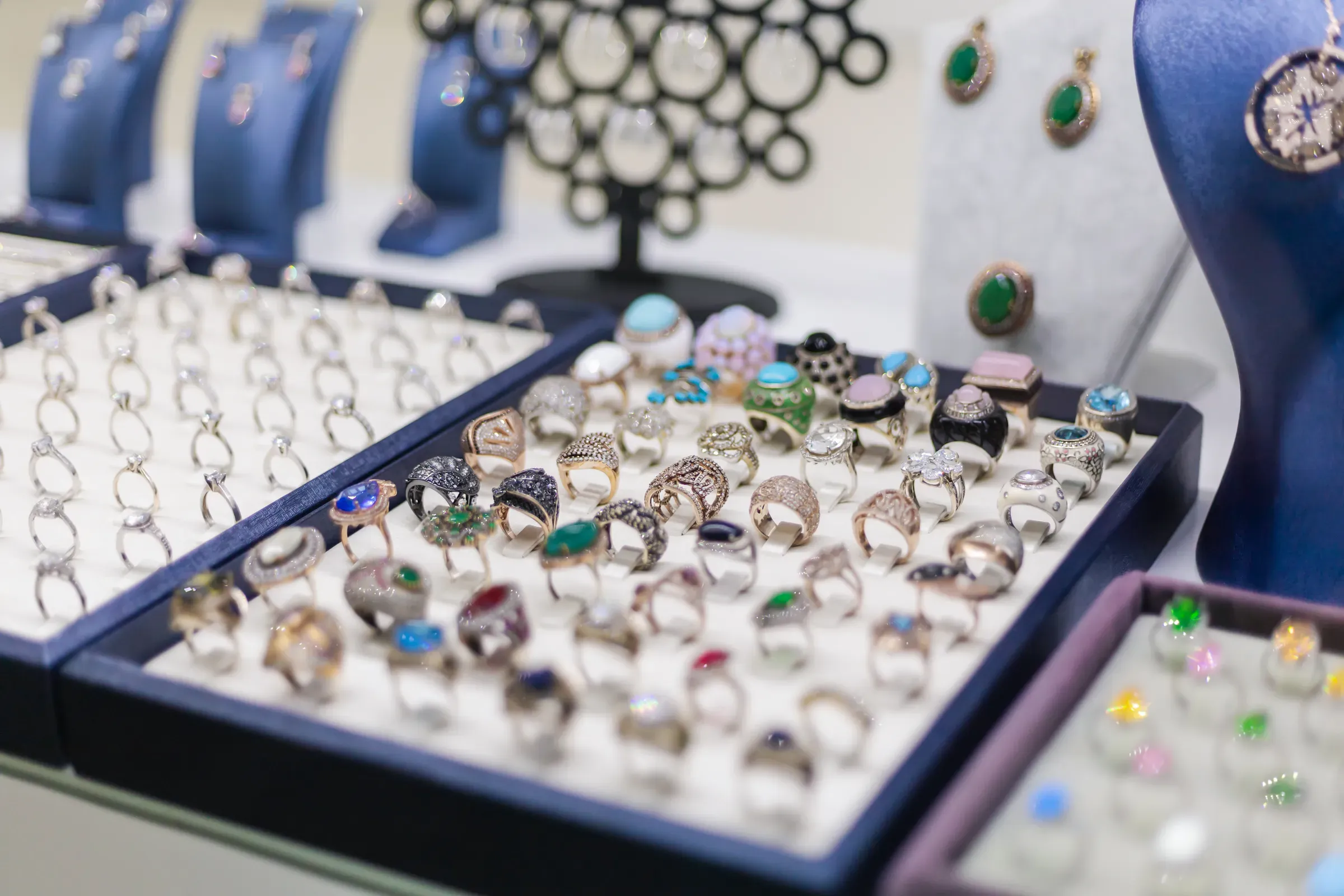
Numerous rings and earrings are arranged on display in a jewelry store. Each piece features unique designs,, gemstone & birthstone jewelry ecommerce
Gemstone & birthstone jewelryGift buyers shopping for a mother, a partner, a child or a grandchild, who look up the correct stone for a month, notice that traditional and modern lists disagree, and check whether the stone is natural, laboratory created or treated before they accept the price.

How gemstone & birthstone jewelry makes money

Four levers, and what limits each one here

Revenue is traffic times conversion rate times order value times purchase frequency. In this niche each lever has its own ceiling.

Traffic

Traffic: twelve months, two competing lists and a meaning page each

Search demand in this niche is a calendar. Each month has its own rising curve of searches for the stone, the meaning and the gift, and the store that has the page built and indexed months earlier is the one that catches it. Two complications make the work more interesting. Several months carry more than one accepted stone, and traditional and modern lists disagree, so a page that explains the difference calmly picks up the query and the trust at once. Second, the meaning searches are enormous and almost entirely served by content sites with nothing to sell. A month page that answers the meaning question properly and shows the jewelry underneath it captures demand a product grid never will.

Conversion

Conversion: color on a screen, and what the stone can survive

Two doubts stop this order. The first is color, because a gemstone photographed under a lamp is not the gemstone that arrives in daylight, and this buyer has almost certainly been disappointed by that before. Video in natural light, a note about the natural variation between stones and photographs of several examples of the same stone settle it. The second is durability, and it is rarely addressed at all. A shopper choosing an opal or an emerald for a ring that will be worn every day is making a decision they do not know they are making. A short hardness and care note on each stone page prevents an unhappy customer six months later and reads as expertise now.

Order value

Order value: the second stone, the family piece and the matched set

The structure of this niche pulls the basket upward on its own if the store lets it. A necklace that holds one stone will hold three, and a family piece with a stone for each child is a substantially larger order made by the same person on the same visit. Presenting that upgrade inside the product page, with a live preview of how three or four stones sit together, converts far better than a separate collection called Family Jewelry. Matched sets work the same way, since a birthstone pendant and studs make an obvious gift pairing. Metal upgrades from silver to gold sell most easily on family pieces, because a piece meant to be kept justifies the better metal.

Frequency

Frequency: birthdays repeat and families keep growing

This is one of the few jewelry niches with a genuinely predictable repeat cycle, and most stores waste it. The birthday that prompted the order happens again next year, and the buyer usually has several people on their list. Capturing the recipient's month at checkout, in a way that feels like personalization rather than data collection, turns a single order into an annual reminder that arrives with the right stone already selected. Family pieces add a second cycle, since a new grandchild means another stone on an existing necklace and a service the store can offer directly. Neither requires a discount to work, only a record of the date and a message that arrives early enough to matter.

Search visibility

Search: a page per month, a page per stone, and the meaning behind both

Build twelve month pages first and build them out of season. Each one answers what the birthstone for that month is, explains why some months carry an alternative, covers the meaning and history the searcher came for, and then shows the jewelry that uses the stone. These pages have a long lead time before they rank, which is exactly why they must be published well ahead of the month they serve rather than in the week the traffic arrives.

Stone pages sit alongside them and serve a different searcher, one who wants the gemstone rather than the date. A garnet page covers color range, typical treatments, hardness and what it suits, then lists the pieces. This is also where the honest work happens, because many gemstones on the market are heated, dyed, diffused or laboratory created, and disclosure is both a legal expectation and a competitive advantage when competitors stay vague.

The third layer is the family piece, which has its own search demand under names such as mothers ring and grandmother necklace. Give it a real landing page with a working preview rather than leaving it inside a customizer that search engines cannot enter. Technically, twelve stone options across several metals and sizes needs variant discipline so one design does not publish as a hundred pages, and the builder needs a crawlable entry point.

Queries that matter

  • october birthstone jewelry
  • mothers ring with 4 birthstones
  • what is the birthstone for august
  • emerald vs created emerald ring
  • birthstone necklace for grandma
  • june birthstone alexandrite meaning
  • is opal too soft for a ring

Month pages that answer the meaning question and sell the stone in the same place, stone pages covering treatment, hardness and care, and family piece pages with a live preview are what rank here. A single Birthstones collection listing twelve products does not.

AI answers

AI answers: which stone, is it real, and will it last

The questions put to assistants in this niche are factual and easy to get wrong: which stone belongs to a month, why November has two, whether a created sapphire is a real sapphire, which stones are hard enough for daily wear. Stores get cited when the month and stone pages answer those in complete sentences rather than in a chart image, when treatment and origin are disclosed in text an engine can read, and when the site is consistent about which birthstone list it uses. Vague pages that use words such as genuine without defining them tend to be passed over in favor of reference sites that simply state the facts.

What is the birthstone for November and why are there two?
Is a laboratory created sapphire a real sapphire?
Which birthstones are hard enough to wear every day?
What is a mothers ring and how many stones can it hold?
Do birthstones have both traditional and modern versions?

Questions shoppers put to assistants. A store gets named when its pages answer them in plain text.

Google Shopping and Merchant Center

Google Shopping for a catalog that multiplies by twelve

Every design in this niche exists in at least twelve versions, so the feed work starts with grouping. One pendant offered in twelve stones and three metals is one item group, not thirty six competing products, and the stone belongs in a dedicated attribute rather than only in the title. Titles read best as design, stone, metal and setting in that order, because the query is usually the stone plus the product type. Custom labels by birth month are what make seasonal bidding possible, and they are the single highest-value labeling decision here.

Disclosure is the policy issue that matters. Laboratory created and simulated stones must be named as such wherever the stone appears, and treatments that materially affect value or care should be disclosed rather than left out. Describing a created stone with the natural stone name invites a misrepresentation review and, more practically, produces returns. Made-to-order family pieces need handling times set honestly, because the delivery date shown to the shopper is calculated from them.

Seasonality should be expressed in the account rather than in a spreadsheet. Bids on each month's stone lift several weeks before the month begins and settle afterward, and Mother's Day is a separate planned event rather than a general uplift, because it concentrates family piece demand in a way no single birth month does.

Feed attributes that decide eligibility

  • material and the gemstone named as separate attributes
  • product_detail for stone origin, treatment and carat weight
  • item_group_id across the twelve stone options
  • size and size_system for rings
  • custom_label by birth month for seasonal bidding
  • min_handling_time for made-to-order family pieces
  • identifier_exists for pieces built to order

Disapprovals we see in this niche

  • Created or simulated stones listed under the natural stone name
  • Treatments left undisclosed where disclosure is expected
  • Missing handling time on made-to-order family pieces
  • Price mismatch when a Mother's Day promotion runs on site only

Meta and social ads

Meta and social ads: twelve colors and one family story

The strongest creative in this niche is the array. Twelve stones laid out in order, each with its month named on screen, works because the viewer immediately looks for their own and the people they buy for. The second strongest is the build, a family piece assembled stone by stone on screen until it holds a whole household, because it shows the upgrade rather than describing it. Both formats are cheap to produce and they age slowly.

The policy limits are specific. Gemstone marketing attracts claims about healing, protection and luck, and those cross into territory the ad platforms treat as health and wellbeing claims, so they stay out of the copy entirely. Created and simulated stones must be named as such in the ad, not only on the landing page. Gifting creative should avoid addressing the viewer by relationship, since copy that assumes the reader is a mother or a grandmother runs into personal attribute rules. Customer stories about family pieces are powerful and always need written permission.

  • Twelve stones laid out in order with the month named on each
  • A family ring built stone by stone on screen until it is full
  • The same stone filmed under a lamp and then in daylight
  • Created and natural shown side by side with the price of each
  • A recipient picking out her children's stones, used with permission

Policy line

No claims that a stone heals, protects or brings luck, created and simulated stones always named as such in the ad itself, and no personal attribute copy that addresses the viewer as a mother or a grandmother.

Conversion and the store

The store: the builder, the color and the list you are using

State which birthstone list the store follows and say so where the shopper is choosing. Half the confusion in this category comes from a customer who believes their month's stone is something other than what the site shows, and one sentence resolves it. Beside that, the stone selector needs real photographs of each stone in the actual setting rather than a color swatch, because a swatch is the fastest route to a return over color.

The family piece builder is where the money is and where the friction lives. It has to work on a phone, show the stones in the order they will be set, allow a name or a date where the design supports it, and hold its state when the shopper leaves and comes back. Setting order matters emotionally, so let them arrange it. Finally, put the production time and the delivery date in the builder rather than at checkout, because a birthday is a fixed deadline and a date discovered late is an abandoned cart.

Objections the page must answer

  • “Is this stone natural, laboratory created or simulated”
  • “Will the color match the photograph on my screen”
  • “Which birthstone list are you using, traditional or modern”
  • “Can I fit four stones in this setting and choose their order”
  • “Is this stone hard enough to be worn every day”

Email, SMS and retention

Email and SMS: capture the date, then arrive before it every year

The whole retention program depends on one field. Ask for the recipient's birth month at checkout or in the first post-purchase message, framed as a way to remind them next year rather than as a survey, and the store gains an annual trigger with the product already chosen. That single capture outperforms every promotional calendar this niche runs.

Around it, three flows do the rest. A care message matched to the stone bought goes out on delivery, and it is genuinely useful because an opal and a sapphire need different treatment. An add-a-stone flow follows family piece orders a few months later, when a new grandchild or a forgotten sibling is the reason to return. And the Mother's Day sequence runs with real order-by dates repeated in every message, because made-to-order pieces cannot be rescued by expedited shipping. SMS earns its place only for the final order-by reminders, where the deadline is genuine.

  1. Birth month capture

    At checkout, repeated in the first post-purchase email

  2. Care by stone

    On delivery, matched to the gemstone bought

  3. Month ahead reminder

    Three weeks before the recipient's birth month, yearly

  4. Add a stone

    Eight to twelve weeks after a family piece order

  5. Mother's Day order-by

    Three weeks, ten days and the final production date

Where revenue leaks

The leaks we find in gemstone & birthstone jewelry stores

The Growth Analysis ranks these against your own numbers and says which to close first.

Get a Growth Analysis for your birthstone jewelry brand
  • Month pages published in the month they are needed

    An October page put live in October has no ranking history when the demand arrives. The traffic goes to reference sites, and the store pays for the same visitors through ads instead.

  • Created stones described only as the stone

    A listing that says emerald when the stone is laboratory created loses the customer who finds out later and invites a misrepresentation review in the ad account.

  • A family builder search engines cannot enter

    The highest value product in the catalog lives behind a script with no crawlable landing page, so the terms people search for it by never reach the store.

  • Birth months collected and never used

    The date sits in a customer record nobody has connected to a flow, so the most predictable repeat purchase in jewelry is left to the customer to remember.

  • One photograph standing in for twelve colors

    A recolored swatch replaces a real image of each stone in the setting, and the difference between the swatch and the stone comes back as a return over color.

Platform notes

Where the platform changes the work

Shopify

Twelve stones across metals and sizes exceeds sensible variant counts quickly, so stone choice is usually a line item property with a preview rather than a variant, and metafields carry treatment, origin and hardness so they reach the page, the markup and product_detail together.

WooCommerce

Global attributes for stone and metal power both the filters and the indexable attribute archives that become stone pages, while a product add-on plugin handles multi-stone family pieces. The feed plugin needs to output the stone as its own attribute rather than only inside the title.

Headless

A custom family piece builder is the usual reason to go headless here, and the requirement that matters is a crawlable, indexable entry page for every configuration worth ranking, plus saved builder state so a shopper can return to a part-finished piece.

Questions

Gemstone & birthstone jewelry owners ask us

By CartKernel · Last reviewed

Which birthstone list should our store use?

Pick one, state it, and explain the alternatives where they exist. Several months carry more than one accepted stone and the traditional and modern lists disagree, which confuses shoppers who arrive certain of their own. A short note on each month page saying which list you follow and what the other option is settles the doubt and tends to pick up the comparison searches as well.

How should laboratory created gemstones be described?

By name, everywhere the stone appears. Created, laboratory grown and simulated all mean different things and should be used precisely in the title, the description, the feed and the ad copy. Being explicit costs nothing with the customer who wanted the created stone for the price, and it protects the store from misrepresentation problems and from returns opened by a customer who found out afterward.

When should month pages be built and published?

Months before the demand. These pages need time to earn rankings, so an October page published in August has already missed most of its first year. We build all twelve at once, out of season, then refresh each one shortly before its month with current inventory and any new pieces. That way the calendar works for you every year rather than only in the months you remembered.

Is a family piece builder worth the development cost?

It is when family pieces carry a meaningfully larger order value, which they usually do. The requirements are modest: a phone-first interface, real photographs of each stone in the setting, control over the order the stones sit in, saved state, and an indexable landing page. A builder hidden behind a script with no crawlable page earns none of the search demand attached to it.

How do we handle the seasonality of twelve different stones?

By putting the month into the feed as a custom label and letting the account read the calendar. Bids rise a few weeks before each month begins and ease afterward, with each month landing on its own page. Mother's Day is planned separately because it concentrates family piece demand, and the order-by dates for made-to-order pieces are set before any campaign starts.

Can we talk about the meaning of birthstones in ads?

History and tradition, yes. Effects, no. Copy that says a stone is traditionally associated with a month or a quality is fine, while copy saying it heals, protects or attracts anything crosses into claims the ad platforms treat as wellbeing promises. The safe version is usually more interesting anyway, because the history of these lists is genuinely good material.

Grow your gemstone & birthstone jewelry store.

A free Growth Analysis ranks what your store should fix first, by revenue at stake, in about a week.