Skip to content

Fashion & apparel · ecommerce growth

Streetwear marketing agency

A streetwear drop is decided before the collection goes live. The people who buy it already follow the brand, already know the piece from a teaser, and already have a size in mind when the countdown hits zero, which means the store's job on drop day is to not fall over and the marketing job is everything that happened in the two weeks before. We build the pre-launch capture, the launch-day store and the sold-out afterlife: waitlists and SMS reminders, pages that keep ranking after the stock is gone, and feeds that do not get disapproved every time availability flips.

The buyer, in brief

Consideration
Weeks of anticipation compressed into minutes at release; sizing and colourway are decided in advance
Purchase frequency
Tied to the drop calendar, typically every few weeks for an active brand, with core items restocked between capsules
Seasonality
Driven by the release schedule and collaborations rather than by weather, with a lift into holiday gifting and a slow patch in late summer
Price band
Mid to premium, from graphic tees at the entry to outerwear and collab pieces at the top
Return risk
Low on limited pieces, where many brands run final sale, but oversized and boxy fits produce size exchanges when the fit guide is vague
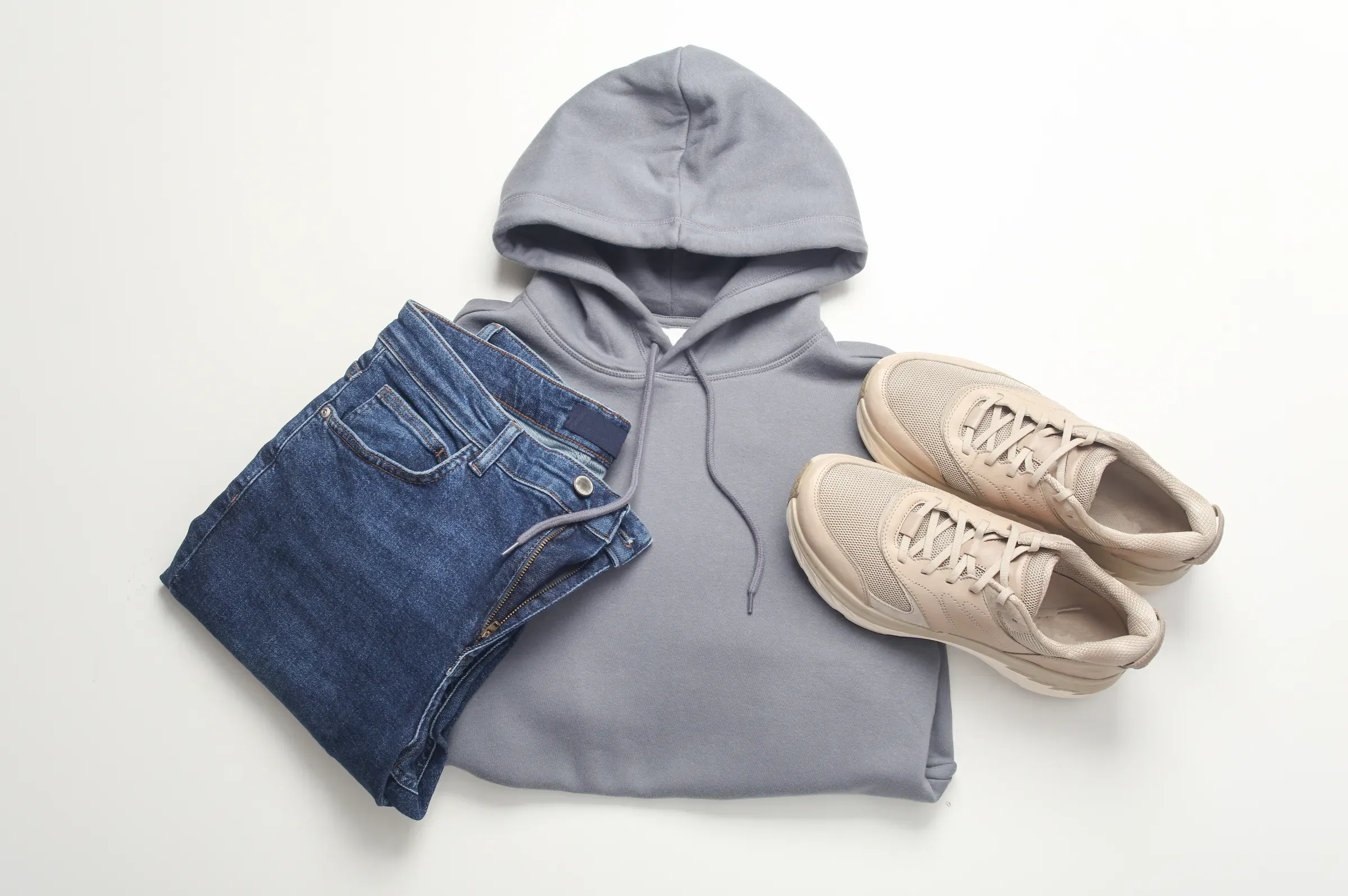
Men's youth clothing style. Jeans, sneakers and hoodie on a white background. Flat lay. Top view, streetwear ecommerce
StreetwearCulturally fluent buyers, mostly under thirty-five, who follow the brand on Instagram, Discord or TikTok, check the resale price of past drops before deciding a piece is worth buying, and judge legitimacy by the brand's consistency rather than by reviews.

How streetwear makes money

Four levers, and what limits each one here

Revenue is traffic times conversion rate times order value times purchase frequency. In this niche each lever has its own ceiling.

Traffic

Traffic: the drop calendar is the content calendar

Streetwear traffic arrives in spikes that the brand itself schedules, so the traffic lever is about making each spike bigger and catching what it leaves behind. Organic search in this niche is mostly navigational: the brand name, the name of a piece, a collab partner, and the word restock. Those searches go to whichever page exists, and too often it is a deleted product URL or a generic collection. We keep every released piece live at a stable URL with its archive, its fit notes and a waitlist, so the brand owns the search for its own drops, and we build lookbook and collection archive pages that rank for the season name and the collab name months after the release.

Conversion

Conversion: launch minute, not launch day

Conversion on a drop is decided in the first few minutes, when the store is under the heaviest load it will see all month and every buyer is racing every other buyer. The limits are technical and structural: a theme that renders slowly under load, a cart that lets one person hold ten units while others wait, a checkout that asks for an account, and a size chart that leaves oversized fits open to interpretation. We load-test the launch template, use the platform's bot protection and checkout throttling where it exists, pre-fill returning customers through accelerated checkout, and put a one-line fit guide with the model's size and height on every product before the countdown ends.

Order value

Order value: the full fit, not one tee

The average order on a drop rises when the pieces are released as a set that reads as one outfit and the store makes it easy to buy the hoodie, the pant and the cap together. What limits order value is a product grid that shows twelve items with no relationship between them and a cart that never suggests the matching piece. We merchandise drops as fits, add a complete-the-look block that respects live stock, and give core items such as blanks, socks and accessories a permanent place in the cart drawer so a limited piece carries a full-price basic with it.

Frequency

Frequency: the waitlist is the retention program

Frequency in streetwear is not replenishment, it is attendance: how many drops a customer shows up for. The brands that compound keep a list that hears about the next release first, and they treat a sold-out size as a lead rather than a loss. The limits are a waitlist that captures an email and never uses it, a back-in-stock notice that fires after the restock has sold out, and a customer file that cannot tell a three-drop regular from a one-time resale flipper. We build the early-access tier, the restock notice by size, and the segmentation that gives loyal buyers a head start without turning the brand into a discount list.

Search visibility

Search: product names, collab names and the restock query

Streetwear search is navigational first. The high-value queries are the brand name with a piece name, the brand name with a collab partner, the piece name with restock or resale, and the season or capsule name. These belong to product pages and archive pages that stay live permanently. Deleting a sold-out product URL throws away the links, the ranking and the demand, and hands the query to resale marketplaces. We keep sold-out products indexable with a waitlist, an archive note and links to the current release, and we build a season archive page for every capsule that lists the pieces, the release date and the story.

The second layer is category demand that the brand can borrow: oversized hoodie, heavyweight tee, cargo pant, and the fabric and weight terms the community uses, such as 400 gsm or garment-dyed. These need collections with copy that explains the cut, the fabric and the fit relative to a standard size, not a heading and a grid.

Technically, the catalog needs one URL per piece with colourways as variants, the fit guide as text rather than an image, Product and Offer markup that reports the real availability state, and a lookbook that links to products rather than sitting as an image gallery with no crawlable path.

Queries that matter

  • brand name plus hoodie name restock
  • oversized heavyweight hoodie 400 gsm
  • brand name collab release date
  • garment dyed boxy tee
  • is brand name true to size
  • cargo pants with adjustable hem

Permanent product pages with archive notes and fit guidance, season archive pages, and collection pages that explain cut and fabric rank here. Product URLs that vanish after each sellout, and lookbooks with no text, do not.

AI answers

AI answers: fit, restocks and whether a piece is legit

Assistants get asked how a specific hoodie fits, whether to size up for the boxy cut, when a piece last restocked and whether a listing on a resale site is real. The brands that get quoted answer those questions on their own pages in plain text: the fit guide describes the cut against a standard size, the product page states the release date and the restock history, and an authenticity page explains labels, tags and where the brand sells. We keep the sizing language consistent across the product page, the size guide and the Shopping feed, and make sure archive pages are reachable as static HTML so the crawlers behind the assistants can read the release history rather than a script-rendered gallery.

Should I size up in a boxy fit hoodie from this brand?
When did this piece last restock and will it come back?
How do I tell if a hoodie from this brand is authentic?
Which drops from this brand are still available at retail price?

Questions shoppers put to assistants. A store gets named when its pages answer them in plain text.

Google Shopping and Merchant Center

Google Shopping and Merchant Center when stock flips in minutes

Availability is the attribute that breaks streetwear feeds. When a drop sells out in minutes and a scheduled feed fetch runs once a day, Shopping keeps serving ads for pieces that are gone, the click lands on a sold-out page, and Merchant Center eventually flags availability mismatch. The fix is structural: an availability feed that updates through the API or a supplemental feed on a short interval, sold-out variants marked out_of_stock rather than deleted, and pre-orders marked with availability preorder and an availability_date so the listing is honest about when the piece ships.

The apparel attributes still apply. Every item needs age_group, color, gender and size, with item_group_id tying colourways and sizes to one product, and size_type set where the cut is oversized enough that the label size is misleading. Titles should carry the brand, the piece name, the cut and the colourway, because that is what the buyer types. Images must show the piece without text overlays, which rules out the drop poster as a product image.

Campaigns are split by role: core items that are always in stock run in a campaign bid to margin all month, drop pieces run in a short campaign that opens on release and closes on sellout, and free listings are kept live for the archive so the brand's own pages show for the piece name.

Feed attributes that decide eligibility

  • availability with a fast update path
  • availability_date for pre-orders
  • item_group_id across colourways
  • size_type for oversized cuts
  • age_group, color, gender, size
  • custom_label for core versus drop

Disapprovals we see in this niche

  • Availability mismatch after a drop sells through before the feed refreshes
  • Promotional text or drop graphics on the product image
  • Missing apparel attributes on a rushed launch upload
  • Price mismatch when a pre-order deposit differs from the listed price

Meta and social ads

Meta and social ads: the pre-drop sequence, not the post-drop ad

Paid social in streetwear works before the release and mostly fails after it. The pre-drop sequence runs teasers to the brand's own audiences, then a lookbook or a short film to broad prospecting, then a reminder to everyone who engaged, each landing on the waitlist or the countdown page. Once the drop is live, ads for a piece that will sell out in minutes waste budget; ads for the core range and for pieces with depth keep running. Catalog ads take over after launch for retargeting, which only works if the catalog reflects live availability.

Creative in this niche is the drop film, the flat lay with the fabric close enough to read, the fit shot on people the audience recognises as their own, and creator content with rights secured in writing. Policy is lighter than in beauty or lingerie, but text-heavy graphics, resale price references and any imagery that trades on another brand's marks will be rejected or will invite a trademark complaint.

  • Countdown teaser showing one detail of the piece
  • Fabric and weight close-up with the gsm on screen
  • Fit on three body types with the size each wears
  • The story behind the collab told by the collaborator
  • Creator wearing the previous drop, with rights in writing

Policy line

No other brand's logos or marks in creative, no resale or investment framing, no text-heavy images in catalog placements, and no imagery that implies a piece is a limited investment rather than clothing.

Conversion and the store

The store on drop day: sizing, speed and checkout

On drop day the product page has to answer three things faster than the stock disappears: what size do I take in this cut, will it ship now or later, and can I check out before it sells out. The fit block sits above the fold with the model's height and size and a one-line note on the cut, the shipping and pre-order status is stated on the button, and returning customers get an accelerated checkout that skips the form. A quick-add from the collection grid, with size selection inline, removes a page load between the buyer and the cart.

Between drops the same page has a different job. It has to keep the sold-out piece alive with a size-specific notify button, sell the core range at full price, and show the archive so a new visitor understands the brand. On mobile, the countdown page needs to load without a heavy video, the size selector needs to show what is left per size, and the cart should hold reservations for a limited time so a buyer who reaches checkout is not beaten by someone who did not.

Objections the page must answer

  • “Do I size up or down in this cut”
  • “Will this ship now or is it a pre-order”
  • “Can I actually check out before it sells out”
  • “Is this the real site or a reseller”
  • “If it does not fit, can I exchange a final-sale piece”

Email, SMS and retention

Email and SMS: the waitlist, the countdown and the restock

The list is the drop. The pre-launch sequence starts with the reveal to the full list, follows with an early-access window for repeat buyers, and ends with a countdown SMS in the hour before release to everyone who opted in. The opt-in is captured on the waitlist page and on the sold-out product pages, so every miss becomes a name for the next drop. After the release, a sellout message that links the pieces still available beats silence, and a restock notice segmented by the size the customer asked for beats a blast that sends everyone to a page with only extra small left.

Between drops, the flows that keep the brand in mind are the post-purchase story of the piece, the fit check that asks what size they took and whether it worked, and the archive email that shows what the brand has released before. Discounts are rare in this niche and are better spent as early access than as a code. SMS carries the countdown, the restock and the shipping update, and nothing else.

  1. Reveal and early access

    Seven to ten days before release, early access forty-eight hours before

  2. Countdown SMS

    One hour before the drop, to opted-in numbers only

  3. Sold-out redirect

    Within the hour after sellout, linking pieces still available

  4. Restock by size

    The moment a restock lands, segmented by the size requested

  5. Fit check

    Ten days after delivery

Where revenue leaks

The leaks we find in streetwear stores

The Growth Analysis ranks these against your own numbers and says which to close first.

Get a Growth Analysis for your streetwear brand
  • Deleted sold-out pages

    Each sellout removes the product URL, so the brand's own search for the piece lands on a 404 and resale sites take the query and the buyer.

  • Ads still running after the sellout

    Shopping and Meta keep serving the drop piece for hours after it is gone, buying clicks that land on a sold-out page and feeding an availability mismatch warning.

  • A waitlist that only collects

    Thousands of sizes requested, no segmentation, and a restock email that sends everyone to a page where only one size remains.

  • Checkout that loses the race

    Account creation, a slow theme under load and no cart reservation mean the fastest buyers are bots and the loyal ones arrive at an empty cart.

Platform notes

Where the platform changes the work

Shopify Plus

Launchpad schedules the release, bot protection and checkout throttling guard the first minutes, and Shopify Flow can tag repeat drop buyers for early access. Waitlist and back-in-stock by size run through a notify app tied to variant inventory.

Shopify

Standard plans can run drops with a scheduled theme publish and a pre-order app, but load and bot handling are thinner, so the launch template is kept light and the countdown page is static.

Headless

A headless front end handles launch traffic well when the product and inventory data are cached correctly, but availability has to be read live at add-to-cart or the cart fills with pieces that are already gone.

Questions

Streetwear owners ask us

By CartKernel · Last reviewed

Should we delete or hide product pages once a drop sells out?

Neither. Keep the page live and indexable, mark the variants out of stock, add a notify-me button per size and a short archive note, and link to the current release. The page keeps its ranking for the piece name, captures the demand the drop missed, and stays honest with Shopping and Meta about availability.

How do you stop bots from buying out a limited release?

With the platform's own bot protection, checkout throttling and a purchase limit per customer, plus a launch template that does not expose variant inventory through easily scraped endpoints. Early access for verified repeat buyers moves loyal customers ahead of the public window, which is the most reliable defence.

Is it worth running Shopping ads for a brand that sells out on its own?

For the drop pieces, usually not beyond the first minutes. For the core range, the restocks and the free listings that show your own page for a piece name, yes. We split the feed by role with a custom label so drop items can be switched off automatically at sellout while core items keep running.

What should the pre-launch email and SMS sequence look like?

A reveal to the full list about a week out, an early-access window for repeat buyers two days before, and a countdown SMS in the final hour to people who opted in. After the drop, a sellout message that points to what remains and a size-segmented restock notice when stock returns.

How do we handle fit questions for oversized and boxy cuts?

State the cut against a standard size on every product page, with the model's height and the size they wear, and add garment measurements for chest, length and sleeve. A fit-check email ten days after delivery collects the size taken and whether it worked, and that data goes back into the fit note.

Can you build the launch and waitlist mechanics inside our Shopify store?

Yes. Scheduled publishing, pre-order and waitlist by size, cart reservations, early-access tagging and the countdown page are all built inside the platform by our team, and the SMS and email sequences are wired to the same variant inventory so a restock notice never sends for a size that is already gone.

Grow your streetwear store.

A free Growth Analysis ranks what your store should fix first, by revenue at stake, in about a week.