Skip to content

Food & beverage · ecommerce growth

Chocolate brand marketing agency

Four dates decide a chocolate brand's year: Valentine's Day, Easter, Mother's Day and the December holidays, each with a shipping cutoff that cannot move and a summer in between when the product melts in a delivery van. The buyer is usually sending the box to someone else, wants to know it will arrive intact and on time, and reads the cacao percentage and the allergen line before anything else. We build chocolate stores that sell hard into those windows and keep selling through the heat: gifting pages that rank months ahead, a corporate order channel that does not clog the retail store, feeds whose shipping promises hold in July, and retention that brings last year's gift buyer back for the next occasion.

The buyer, in brief

Consideration
Fast for a gift with a deadline, slower for a self-purchase from a maker they are still learning about, weeks for a corporate order with approvals
Purchase frequency
Occasion-driven for gift buyers, monthly to quarterly for bar collectors, annual for corporate accounts with a repeat in the spring
Seasonality
Valentine's, Easter, Mother's Day and December carry most of the year; June to September is limited by heat, with shipping paused or insulated in many regions
Price band
Premium per gram for bean-to-bar and bonbons, with gift boxes and corporate assortments raising the ticket
Return risk
Not returnable as food; the real cost is replacement of melted or damaged arrivals, which a stated melt policy and ship-day rules keep low
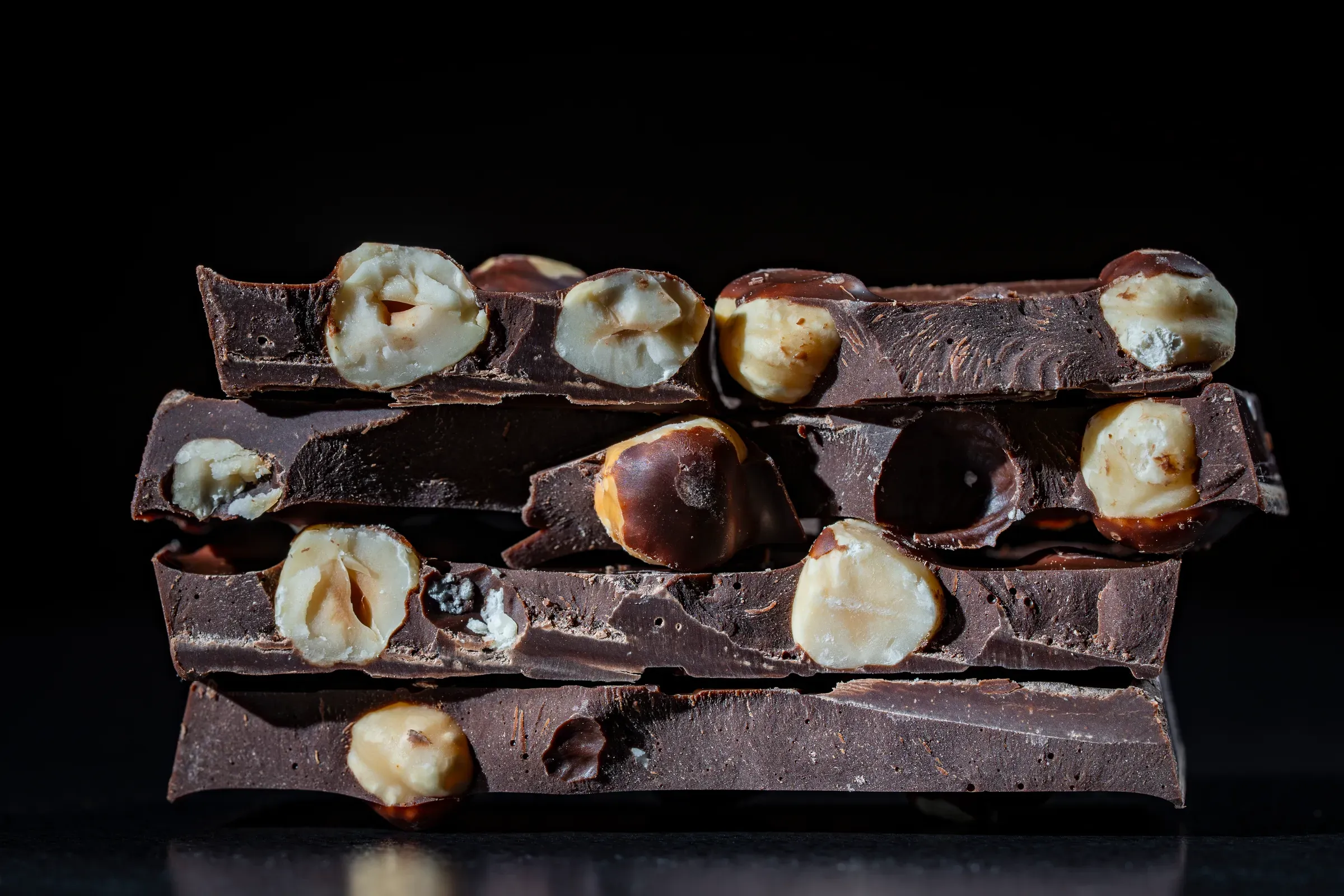
Stack of dark chocolate bars with whole hazelnuts on black background. Closeup of broken dark chocolate, chocolate & confectionery ecommerce
Chocolate & confectioneryGift senders shopping to a date, self-purchasers who follow bean-to-bar makers and read cacao percentages and origins, and office managers ordering fifty boxes with a logo sleeve. They check the delivery date promise, the melt policy, allergen statements and whether the box looks like a gift when it lands.

How chocolate & confectionery makes money

Four levers, and what limits each one here

Revenue is traffic times conversion rate times order value times purchase frequency. In this niche each lever has its own ceiling.

Traffic

Traffic: gifting queries peak early and origin queries never stop

Chocolate demand comes in two shapes. Gifting queries (chocolate gift box delivery, Easter chocolate online, corporate chocolate gifts) start rising four to six weeks before each occasion and the pages that rank in that window were built and indexed the previous season. Maker queries (single origin dark chocolate 70 percent, bean to bar Canada, vegan milk chocolate) run all year and belong to stores that explain origin, percentage and process. Most chocolate sites have a Shop All grid and a seasonal banner, so both shapes go to marketplaces. We build occasion pages that stay live year round with the next date on them, and origin, percentage and dietary collections with real copy underneath.

Conversion

Conversion: the delivery date and the melt policy are the sales copy

The gift buyer's question is not whether the chocolate is good; it is whether it will arrive on the date, intact, looking like a gift. The product page has to state the order-by date for the next occasion, the ship days, the insulated packaging and ice pack policy for warm weather, and what happens if a box arrives melted, all near the price. Allergen and ingredient statements must be visible without a tab, because a nut allergy ends the purchase silently if the answer is missing. A gift note field, hidden pricing on the packing slip and a recipient address separate from the buyer's are conversion features, not extras.

Order value

Order value: the assortment box and the corporate sleeve

A single bar does not cover its shipping, so the store has to make the box the default unit. Assortments, tasting flights of three to six bars with a printed guide, and gift boxes at two or three price points raise the ticket without discounting. Add a card, a second box to a second address, or a bag of drinking chocolate in the cart drawer and the average climbs again. The largest lever is corporate: a request form and a B2B price list for fifty to five hundred units with custom sleeves and a single invoice turns one December contact into the biggest order of the year. Keep it on its own pages so it does not slow the retail checkout.

Frequency

Frequency: the next occasion is already on the calendar

Chocolate repeat purchase is driven by the calendar rather than by consumption, which makes it predictable. A buyer who sent a Valentine's box is reminded before Mother's Day with the order-by date stated; a December gift buyer is invited back in February. Bar collectors and self-purchasers respond to new origin releases and limited batches, and a quarterly tasting subscription with a printed guide suits them better than a monthly one. Corporate buyers get a spring check-in and an early-order window before autumn. The summer gap is bridged with heat-stable products, local pickup and pre-orders for the September restart rather than silence.

Search visibility

Chocolate search: occasion pages built early, origin pages built deep

Chocolate SEO is a calendar exercise. Each occasion gets a permanent page (Valentine's chocolate gifts, Easter chocolate, Mother's Day chocolate, holiday chocolate gifts, corporate chocolate gifts) that stays live all year, is updated with the next order-by date and the current assortment, and accumulates links and history season after season. Stores that create a new Easter collection each spring and delete it in May start from zero every year and never rank in the window that matters.

The second layer is the maker's catalog. Percentage collections (70 percent dark, 85 percent and above), origin collections (Peruvian, Ecuadorian, Madagascan cacao), dietary collections (vegan, dairy-free, sugar-free, nut-free facility) and format collections (bars, bonbons, drinking chocolate, hot chocolate bombs) each need a page with editorial copy and real product data. Process content on bean-to-bar, conching and tempering earns links from food writers and gives the origin pages authority.

Technically, assortments and boxes need their own pages that link to every bar inside them, bar sizes are variants under one URL, and seasonal products that sell out are marked unavailable rather than removed. Shipping and melt policies belong on an indexable page that the product pages link to, because delivery questions are searched too.

Queries that matter

  • chocolate gift box delivery canada
  • bean to bar chocolate online
  • 70 percent dark chocolate single origin
  • corporate chocolate gifts with logo
  • vegan chocolate easter eggs
  • chocolate delivery in summer melting
  • hot chocolate bombs online

Permanent occasion pages with history, origin and percentage collections with real copy, and assortment pages that link to their contents rank in chocolate. Seasonal collections that are created and deleted each year, and a Shop All grid with a holiday banner, do not.

AI answers

Assistants and chocolate: delivery, melting, allergens and origin

The questions assistants field about chocolate are practical: will it melt in shipping in July, can a box arrive by Friday, is it made in a nut-free facility, what does 70 percent mean, which makers do single-origin bars in Canada. A store becomes citable when its policy page states the ship days, the insulated packaging and the warm-weather rules as plain sentences, when every product page carries the allergen statement and the cacao percentage as text, and when the About page says where the chocolate is made and from which cacao. We write the shipping and allergen pages as direct answers, keep percentage and origin consistent between page, feed and markup, and ensure the occasion pages state the order-by date in text an assistant can read.

Will chocolate ordered online melt if it ships in summer?
Can this chocolate gift box arrive before Valentine's Day if I order today?
Is this bar made in a nut-free facility?
Which bean-to-bar makers ship single-origin chocolate within Canada?
What does 70 percent cacao mean on a chocolate bar?

Questions shoppers put to assistants. A store gets named when its pages answer them in plain text.

Google Shopping and Merchant Center

Shopping and Merchant Center for chocolate: shipping promises that survive July

Chocolate feeds are decided by shipping settings before attributes. Merchant Center compares the delivery promise in the ad with what the checkout shows, so ship-day rules (orders leave Monday to Wednesday only in warm months), handling time and transit time must be configured with min_handling_time and max_handling_time and transit-time labels by region, and the insulated packaging surcharge, if any, must appear in the feed's shipping or in account-level rates. A summer shipping pause is handled by setting availability or by excluding regions for the period, never by leaving listings live that cannot be fulfilled.

Attributes carry the buying words: cacao percentage, origin and format in the title (72 percent dark chocolate bar, Peru, 70 g), allergen and dietary statements in product_detail, is_bundle on assortments and gift boxes, and item_group_id across bar sizes. Own-made bars usually lack a GTIN, so identifier_exists is set to false; if bars are barcoded for retail, the real codes go in. Sale prices for occasions use sale_price with effective dates so the page and the feed agree during the peak week.

Campaign structure follows the calendar and the margin: occasion gift boxes in a campaign whose budget rises six weeks before each date, bars and drinking chocolate bid to margin all year, and corporate assortments kept out of Shopping entirely since they are quoted, not listed.

Feed attributes that decide eligibility

  • min_handling_time and max_handling_time
  • shipping with region-level transit times
  • is_bundle for assortments and gift boxes
  • product_detail for allergens and dietary statements
  • item_group_id for bar sizes
  • sale_price_effective_date for occasion pricing

Disapprovals we see in this niche

  • Shipping cost or delivery time mismatch when warm-weather surcharges are not in the feed
  • Availability mismatch on listings left live during a summer shipping pause
  • Missing identifier warnings on bars without identifier_exists set
  • Price mismatch during an Easter promotion applied on the page only

Meta and social ads

Meta for chocolate brands: the unboxing, the pour and the ship-by date

Chocolate creative sells on sight. The temper snap, the pour into moulds, a bonbon cut in half, the box opened on a table: all of it works as short video with the occasion and the order-by date on screen. For gift buyers the packaging is the product, so it must be in frame and the delivery promise must be explicit. Maker content, with the founder explaining an origin or a percentage, builds the self-purchase audience that carries the quiet months. Reviews and customer photos of received gifts, with rights secured, answer the will-it-arrive-looking-good question better than studio shots.

Audiences begin with last year's gift buyers for each occasion, then lookalikes, then broad in the peak window. Policy is light for chocolate itself, but there are edges: anything alcoholic (liqueur truffles) triggers alcohol rules and age targeting, sugar-free and keto claims move into health review, and creative aimed at children is restricted. Summer creative should be honest about ship days and insulation rather than silent.

  • The temper snap and pour, filmed close, with the occasion date on screen
  • Box opened on a kitchen table exactly as a recipient would see it
  • The maker explaining one origin or one percentage
  • How we ship in warm weather, insulation and ice packs shown
  • Corporate sleeves being applied, for the office-manager audience

Policy line

Liqueur-filled or alcohol-infused products follow alcohol rules and need age targeting; sugar-free, keto and functional claims move ads into health review; creative must not target children; delivery promises in ads must match what checkout can actually deliver.

Conversion and the store

Chocolate store pages: date, arrival condition and the gift checkout

The gift box page carries the revenue in chocolate and its job is to remove three doubts: will it arrive by the date, will it arrive intact, and will it look like a gift. The order-by date for the next occasion sits beside the price and updates itself. The warm-weather shipping policy is a short block, not a link. Allergen and ingredient statements are visible. Photography shows the open box and the outer packaging. The self-purchase bar page is different: percentage, origin, tasting notes and process matter there, and a tasting flight is the upsell.

Checkout must support a gift note, a recipient address without an account, a hidden-price packing slip and a choice of delivery date where the carrier allows it. On mobile, the delivery promise has to be visible above the fold and the ship-day rule shown before the shipping step, because discovering a Monday-only ship rule at checkout is a common abandonment cause in the summer months. The corporate form lives on its own page with quantity tiers and a sleeve preview, separate from the cart entirely.

Objections the page must answer

  • “Will it get there by the date I need”
  • “Will it melt or arrive broken”
  • “Does it contain nuts, dairy or gluten, and is the facility shared”
  • “Can I send it to them directly without the price showing”
  • “Can we get fifty of these with our logo, and who do I talk to”

Email, SMS and retention

Email and SMS for chocolate: the four dates, the melt season and the corporate window

Chocolate email runs on the calendar. Each occasion gets a sequence that starts six weeks out with the assortment and the order-by date, tightens to a last-call as the cutoff nears, and ends with a local-pickup or e-gift option for people who missed it. Last year's buyers for that occasion are the first segment, then everyone else. The post-purchase flow for a gift order confirms the delivery date, explains how the box is packed for the weather and asks the sender to tell us if the recipient has an allergy we should know for next time.

Self-purchasers get release notes when a new origin or batch lands and a tasting-flight offer after their second bar order. The summer is not silent: a heat-season email explains the ship-day rules and promotes heat-stable products, local pickup and September pre-orders. Corporate accounts get a spring check-in and an early-order window in September with a single email. SMS is reserved for the order-by cutoff reminder and delivery updates for people who opted in.

  1. Occasion sequence

    Six weeks before each of the four dates, ending at the shipping cutoff

  2. Gift delivery confirmation

    On shipment of any order sent to a different address

  3. Tasting flight offer

    After a second bar order from a self-purchaser

  4. Heat season notice

    At the start of the warm-weather ship rules, with restart pre-orders in late summer

  5. Corporate early-order window

    September, to past corporate accounts and request-form leads

Where revenue leaks

The leaks we find in chocolate & confectionery stores

The Growth Analysis ranks these against your own numbers and says which to close first.

Get a Growth Analysis for your chocolate brand
  • Occasion collections deleted after the date

    The Easter page that ranked in April is removed in May, so next March a fresh page competes from nothing while retailers with a ten-year-old URL take the traffic.

  • Listings live during the summer shipping pause

    Shopping ads keep spending on gift boxes that cannot be shipped for three weeks, orders queue up, buyers cancel and Merchant Center logs the mismatch.

  • Corporate leads answered like retail tickets

    A request for two hundred logo boxes arrives through the contact form, waits behind shipping questions and is placed with a supplier that replied the same day.

  • Ship-day rules discovered at checkout

    A Friday buyer learns at the shipping step that chocolate ships Monday to Wednesday only, so the gift will be late and the cart is abandoned.

Platform notes

Where the platform changes the work

Shopify

Cacao percentage, origin and allergen statements live in metafields that render in a fixed block and feed product_detail. A delivery-date app or checkout customization handles ship-day rules and gift notes; Shopify Plus checkout extensibility can surface the melt policy and ship-day rule before the shipping step. Corporate orders belong in B2B or on a form with draft orders, kept out of the retail flow.

WooCommerce

Shipping-zone rules with day-of-week restrictions and a warm-weather surcharge need a shipping plugin configured to match what Merchant Center is told, and composite products handle assortments so bars draw down stock.

BigCommerce

Native customer groups give corporate buyers their own pricing and a quantity-tiered catalog without a second store, and the shipping rules must be mirrored in the Merchant Center account rather than assumed.

Questions

Chocolate & confectionery owners ask us

By CartKernel · Last reviewed

How should a chocolate brand handle summer when shipping is risky?

Decide the rule, then publish it everywhere. Ship-day restrictions, insulated packaging, ice packs, any surcharge and the replacement policy go on a shipping page, on every product page and into Merchant Center's shipping settings. Listings that cannot ship in a pause are marked unavailable or region-excluded. The summer is then used for heat-stable products, local pickup and pre-orders for the restart rather than for silence.

When should we start marketing for Valentine's Day, Easter and the holidays?

The pages should exist all year. Paid budgets and email sequences start five to six weeks before each date and end at the shipping cutoff, because that is when the searches happen. Anything started two weeks before the date competes at peak prices for people who have already decided. We schedule the budgets to the curve and pause spend the day the cutoff passes.

Can corporate gifting run through our normal online store?

Through the same platform, on its own pages and flow. A request form with quantity tiers, a sleeve or card preview, a price list and invoicing by draft order or a B2B channel keeps large orders from clogging retail checkout and from distorting your average order value and ad attribution. Corporate assortments stay out of the Shopping feed since they are quoted rather than listed.

Do bean-to-bar makers need GTINs to sell through Google Shopping?

Not for bars they make and sell themselves. Setting identifier_exists to false on those products satisfies Merchant Center. If your bars carry retail barcodes because they are stocked in shops, use the real GTINs, and never reuse one across sizes or flavours. Assortments and gift boxes are marked as bundles with their own price and no borrowed barcode.

What can a chocolate ad say about allergens and dietary claims?

It can state facts that the label supports: vegan, dairy-free, made in a nut-free facility, no added sugar. What it should not do is imply a health outcome or a suitability for a medical condition, and keto or sugar-free framing gets reviewed under health policies. We keep the allergen statement identical on the label, the page, the feed and the ad so a reviewer finds no contradiction.

Is a chocolate subscription worth building?

For bar collectors, yes, at a quarterly or bimonthly cadence with a printed tasting guide and a new origin each box; for gift buyers, no, since their repeat is driven by dates. We build the subscription for the self-purchase audience, keep it paused through the warm months where shipping is restricted, and let the occasion sequences carry the gift buyers back.

Grow your chocolate & confectionery store.

A free Growth Analysis ranks what your store should fix first, by revenue at stake, in about a week.