Skip to content

Fashion & apparel · ecommerce growth

Workwear brand marketing agency

Workwear is bought twice: once by a tradesperson replacing trousers that gave out, and once by an office manager kitting out fourteen new starters with a logo on the chest. The first wants durability, pocket layout and a size that fits over boots. The second wants a quote, a size run, a decoration proof and an invoice on terms. We build stores that serve both without confusing either: standards and trade pages that rank, a bulk path with real quoting, feeds that survive decorated and made-to-order items, and reorder flows tied to how crews actually turn over.

The buyer, in brief

Consideration
Minutes for a replacement, two to six weeks for a company order with quotes and samples
Purchase frequency
Individuals every few months as garments wear out, companies on hiring cycles and annual kit refreshes
Seasonality
Hi-vis and insulated layers rise in autumn, lighter and cooling garments in spring, with a bump when a new fiscal year releases budget
Price band
Value to mid on single garments, with company orders reaching several thousand dollars in one basket
Return risk
Low on plain stock and near zero on decorated items, which makes the size sample kit the thing that prevents the problem
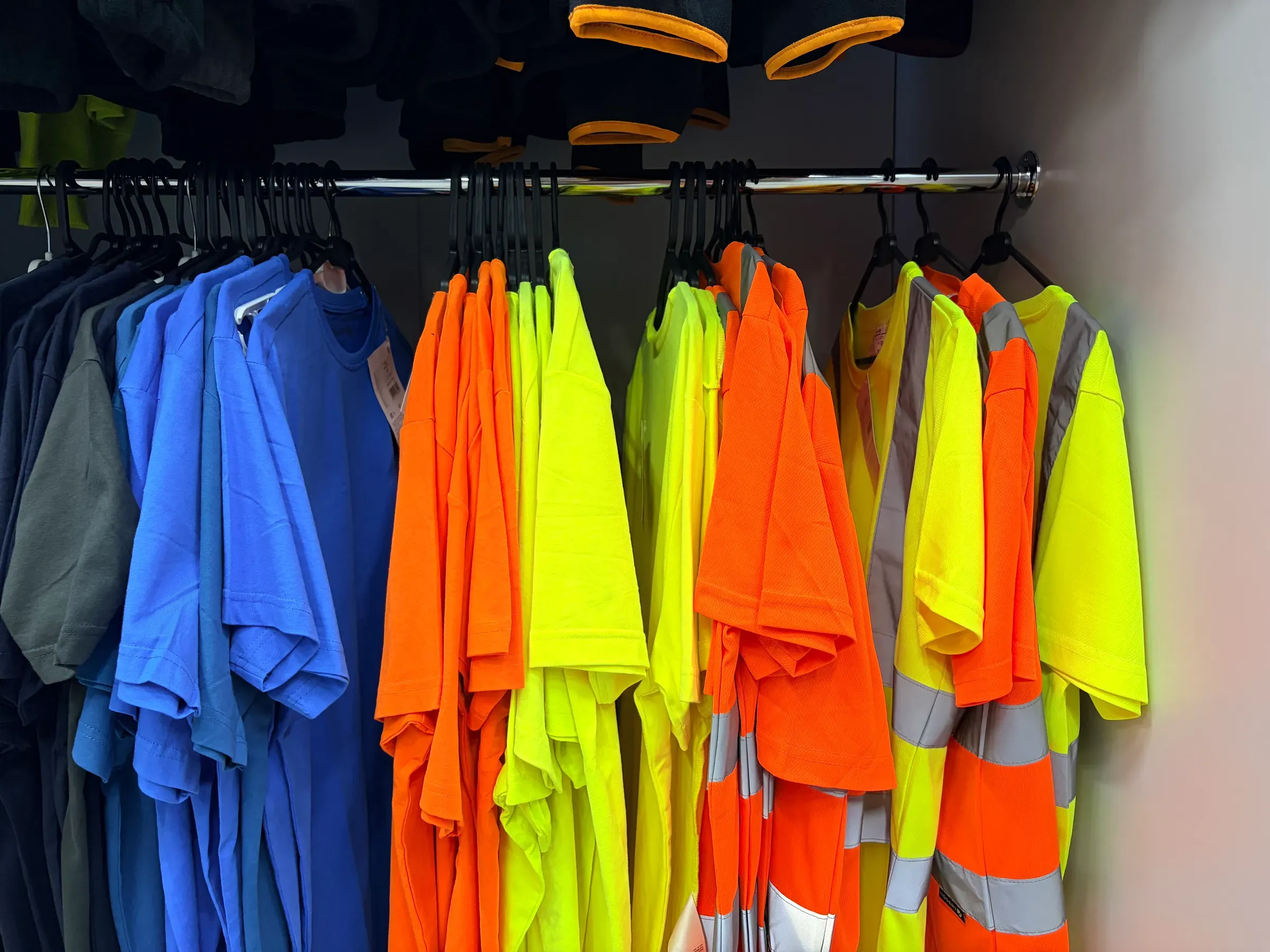
Rack of colorful workwear including high-visibility safety vests and t-shirts in a closet, workwear & uniforms ecommerce
Workwear & uniformsTwo buyers on one site: tradespeople replacing worn kit who know their size and their standard, and office, safety and procurement managers ordering size runs with a logo, who check lead time, decoration proof and payment terms first.

How workwear & uniforms makes money

Four levers, and what limits each one here

Revenue is traffic times conversion rate times order value times purchase frequency. In this niche each lever has its own ceiling.

Traffic

Traffic: the standard, the trade and the task are the query

People in this category search with precision. They type a standard, a trade or a task: class 2 hi-vis shirt, arc rated coveralls, ripstop work pants with knee pad pockets, embroidered polo shirts bulk. Most workwear catalogs answer that with a shop by brand menu and one generic collection, so the specific demand goes to the large distributors. The traffic lever is a catalog structured by standard, trade and feature, with real copy explaining what each standard requires and which garments meet it, plus a separate set of pages for bulk and decoration queries, which are a different search entirely and convert to a quote rather than a cart.

Conversion

Conversion: two paths through one store

The individual buyer and the procurement buyer need different journeys, and most workwear sites build one and lose the other. The individual needs fit over boots, the pocket layout, the fabric weight, the standard on the label and stock in a size that is often tall or big. The company buyer needs a quote form that captures quantities by size, a decoration proof, a lead time, and a way to pay that is not a personal card. Building a logged-in account path with company pricing, saved size runs and payment terms alongside the ordinary cart is usually the single largest conversion change available in this niche.

Order value

Order value: the kit, the size run and the decoration

Baskets grow here through completeness rather than upsell. A trade buying trousers needs the matching jacket, knee pads that fit the pockets and a second pair so one can be in the wash. A company kitting out a crew needs shirts, outer layers and hi-vis in one order, with decoration priced per position. Presenting kit bundles by trade, showing decoration pricing openly instead of on request, and offering quantity breaks that are visible before the quote all lift the average order. Sample and size kits that can be credited against the eventual order remove the last hesitation on a large first purchase.

Frequency

Frequency: garments wear out and crews turn over

Repeat revenue in workwear is predictable if the store records what was bought. A trade who bought two pairs of trousers is due again within months, and a company that ordered fourteen shirts in March will hire again. The mechanics are a reorder page that repeats the last order with the same sizes and decoration, an account that stores the logo file and the size run so a repeat takes a minute, and a prompt tied to the customer's own hiring or seasonal pattern rather than to a newsletter calendar. Wear-out reminders on consumable items such as gloves and socks do the same job for individuals.

Search visibility

Search: standards, trades and the bulk enquiry, kept apart

Workwear search splits cleanly into kinds of demand and each needs its own page type. Standard queries name a specification, and the page has to explain what the class or rating means before it lists garments that meet it. Trade queries name the job, and the page has to read like it was written by someone who has done it, with the garments a mechanic, welder, nurse or line cook actually needs. Feature queries name the detail: knee pad pockets, ripstop, flame resistant, stretch waistband, tall sizes.

Bulk and decoration queries behave differently again. Someone searching for embroidered polo shirts for a company is looking for a supplier, not a product page, so the landing page carries minimums, decoration options, artwork requirements, lead times and a quote form rather than an add-to-cart button. Keeping these pages separate from retail collections stops the two intents from cannibalising each other and lets each one be measured properly.

Technically, extended sizing is the trap. Tall, big and short versions belong on one product with size variants and one canonical URL, and filtered views by size or colour should not enter the index. Decorated versions of a garment should never become duplicate products, or the catalog multiplies and the feed follows it.

Queries that matter

  • class 2 hi vis shirt
  • flame resistant coveralls
  • work pants with knee pad pockets
  • embroidered polo shirts bulk
  • tall work trousers 36 inseam
  • nursing scrubs with pockets
  • what does ansi class 3 mean

Pages that explain a standard or a trade and then list qualifying garments rank in this category, as do bulk and decoration landing pages built for the enquiry. Brand-listing menus and a single workwear collection do not.

AI answers

AI answers: specification questions with a right answer

Assistants get asked precise questions here: which hi-vis class a roadside worker needs, whether a garment is arc rated or only flame resistant, what the difference between two fabric weights means in practice, and which supplier will decorate twenty shirts within a fortnight. These have correct answers, so a store is cited when its pages state the standard, the rating, the fabric weight and the certification in plain text, when the specification on the page matches the label and the feed, and when the bulk page states minimums and lead times as facts rather than as an invitation to call. We write the standards pages answer first and keep specification wording identical across page, feed and structured data.

Which hi-vis class do I need for working near traffic?
What is the difference between flame resistant and arc rated clothing?
Where can I get twenty polo shirts embroidered with a company logo?
Do these work trousers come in a 36 inch inseam?

Questions shoppers put to assistants. A store gets named when its pages answer them in plain text.

Google Shopping and Merchant Center

Google Shopping and Merchant Center for stock, sizes and decorated goods

The four apparel attributes still apply, and workwear leans hard on size_type. Tall, big and short garments have to declare it, or Google reads a 36 waist as one thing when there are three different garments behind it. Size_system says whether the number is a waist in inches or an alpha size. Material and pattern describe fabric weight and construction, and product_detail is where the standard, the rating, the pocket count and the fabric weight belong so listings show for specification queries.

Decorated and made-to-order items are the policy problem. A garment whose price changes with the logo cannot carry a single fixed price honestly, so custom items either stay out of the feed or list at a clearly stated base price with decoration priced separately on the page. Availability has to reflect real lead times rather than the retail default, and stock counts on branded distributor lines need a feed that refreshes often enough to keep up with a supplier file.

Campaigns split by buyer. Retail replacement lines are bid to margin, bulk-intent terms are better served by search campaigns pointing at the quote page than by Shopping, and free listings carry the long tail of size and standard combinations.

Feed attributes that decide eligibility

  • size_type for tall, big and short
  • size_system for waist and alpha sizing
  • material and fabric weight
  • product_detail for standards and ratings
  • item_group_id across colours and sizes
  • gtin on branded distributor lines

Disapprovals we see in this niche

  • Price mismatch on decorated items priced from a base
  • Availability mismatch when made-to-order lead times are not reflected
  • Missing size_type so extended sizes collide with regular ones
  • Feed fetch failures when a distributor stock file changes shape

Meta and social ads

Meta and social ads: the job site, not the studio

Creative in workwear is judged by people who will spot a fake immediately. Garments worn on a real site, filmed in the weather they are made for, with the pocket layout, the reinforcement and the reflective tape shown at working distance, outperform studio flat lays. Demonstrations do well: a fabric abrasion test, a jacket after a season, two fabric weights side by side. Decoration content travels too, because seeing a logo stitched onto a garment is the proof a company buyer wants before enquiring.

Audiences work best as broad prospecting with strong creative plus retargeting from the site, since job title and employer targeting are limited and unreliable. For the company buyer, lead forms that ask for headcount, garments and timing qualify better than a discount offer. Any protection claim in an ad has to match the certification on the label, because this is the category where a customer will check the label.

  • A garment worn on a working site in the weather it was made for
  • Fabric abrasion and tear demonstrated on camera
  • The same jacket new and after a season of wear
  • Logo decoration filmed from artwork to finished garment
  • Pocket and tool layout explained by someone who uses it

Policy line

Safety and protection claims must match the garment's actual certification, and workplace injury imagery or fear-based framing is not the angle to use here.

Conversion and the store

The store: a quote path beside the cart

The product page has to answer the practical questions first: fabric weight and composition, the standard on the label, the pocket and tool layout, whether it fits over boots or a base layer, and which extended sizes exist. Garment measurements per size matter more than a generic chart, because people buy this to wear over other clothing. Reviews are far more useful when the reviewer states their trade and their usual size, so the review request should ask for both.

The larger opportunity is the second path. A quote request that captures garments, quantities by size, decoration positions and a needed-by date, an account that stores the logo artwork and the last size run, company pricing behind a login, and payment terms for approved accounts turn a browsing procurement manager into a repeat account. Sample and size kits, credited against the order, remove the risk from a first bulk purchase.

Objections the page must answer

  • “Will it fit over boots and a base layer”
  • “Does it actually meet the standard printed on the label”
  • “How heavy is the fabric and how will it wear”
  • “Can you decorate it, at what price and how quickly”
  • “Do you offer size runs, samples and payment terms”
  • “What happens if two of the fourteen shirts are the wrong size”

Email, SMS and retention

Email and SMS: reorders, quotes that stalled and the season change

The highest-return flow in workwear is the reorder. A one-click repeat of the last order with the same sizes, decoration and delivery address, sent when the garment is due to be worn out or when the customer's own cycle says a new intake is coming, beats any promotional send. For company accounts the prompt is tied to hiring and the annual kit refresh rather than to a calendar month.

Quote follow-up is the second flow. A quote that goes quiet needs a short, useful sequence: the proof, the lead time, an answer to the question that usually stops the order, and a named person to reply to. Beyond that, seasonal changeover emails for insulated and hi-vis layers, consumable reminders for gloves and socks, and artwork approval updates by SMS for decorated orders in progress cover most of the value.

  1. One-click reorder

    Three to six months after a garment order, by category

  2. Quote follow-up

    Day two, day five and day twelve after a quote is sent

  3. Artwork and proof updates

    At proof, at approval and at dispatch, by SMS

  4. Seasonal layer changeover

    Six weeks before the weather turns, by region

  5. New intake reminder for company accounts

    On the account's own hiring cycle

Where revenue leaks

The leaks we find in workwear & uniforms stores

The Growth Analysis ranks these against your own numbers and says which to close first.

Get a Growth Analysis for your workwear brand
  • One cart for two buyers

    A procurement manager needing fourteen shirts in three sizes with a logo is handed the same checkout as someone buying one pair of trousers, so the order goes to a supplier with a quote form.

  • Decoration priced on request

    Hiding embroidery and print pricing behind an enquiry loses the buyers who are comparing three suppliers in one afternoon and will not wait until tomorrow for a reply.

  • Extended sizes without size_type

    Tall and big garments compete with regular ones inside the same listing, so the shoppers who need them cannot find them and the ones who order get the wrong length.

  • Logo files retyped every time

    A repeat company order starts from scratch because the artwork and size run were never saved to the account, so a five-minute reorder becomes a week of email.

Platform notes

Where the platform changes the work

Shopify

Shopify B2B on Plus carries company profiles, price lists, payment terms and saved size runs alongside the retail store, so one catalog serves both buyers. Decoration is built as product options with clear base pricing so the feed price stays truthful.

WooCommerce

Wholesale roles and tiered pricing give company accounts their own prices and terms, while global attributes for standard, fabric weight and size type power both the filters and the indexable archive pages.

BigCommerce

Native customer groups and price lists handle company pricing, and quote workflows connect to the same catalog so a bulk enquiry does not turn into a spreadsheet outside the store.

Questions

Workwear & uniforms owners ask us

By CartKernel · Last reviewed

Should our retail store and our company accounts sit on the same site?

Usually yes, with two paths through it. One catalog keeps stock, product data and the feed in one place, while a logged-in company path adds price lists, saved size runs, quotes and payment terms. Splitting into two sites doubles the catalog work and divides the search authority. The decision hinges on how different the pricing and the assortment really are.

How do we handle decorated garments in a Google Shopping feed?

By listing the base garment at the price a shopper can actually pay for it undecorated, and pricing decoration separately on the page, or by keeping made-to-order items out of the feed entirely. A feed price that assumes decoration will not match the landing page and the item gets flagged. Lead times also need reflecting in availability rather than left at the default.

Can we say a garment is safety certified in ads and product titles?

You can state the certification the garment actually holds, in the words the standard uses, with the class or rating named. What causes problems is generalised protection language the label does not support, or applying a certification held by one style across a whole range. We keep the specification wording identical on the label, the page, the feed and the ad.

What is the fastest way to raise the average order value on a workwear site?

Make the kit visible. Group garments by trade so a buyer sees the full set rather than one item, show quantity breaks before the quote rather than after it, and price decoration openly. Sample and size kits credited against a later order also raise the eventual basket, because they turn a cautious first company purchase into a full size run.

How do you market to procurement managers who ignore consumer tactics?

By removing the friction they actually feel. Search campaigns aimed at bulk and decoration language, landing pages that state minimums, lead times and artwork requirements, a quote form that captures sizes and dates, and a short follow-up sequence with a named contact. Discount codes and urgency banners do very little; a proof turned around the same day does a great deal.

Do reorder reminders work when we do not know when a garment wears out?

They work well enough using what the store already knows. The category, the quantity bought and the time since the order give a reasonable window, and the customer's own reply corrects it. For company accounts, hiring cycles and the annual kit refresh are better signals than any wear estimate, and both can be recorded on the account after the first order.

Grow your workwear & uniforms store.

A free Growth Analysis ranks what your store should fix first, by revenue at stake, in about a week.