Skip to content

Jewelry · ecommerce growth

Piercing jewelry marketing agency

Piercing jewelry is bought in millimeters. The order fails when the gauge is wrong, the post is too short after the swelling has gone down, or the threading does not match the labret already in the ear. This buyer asks what the metal is certified as before asking what it costs. We build the store for that precision: gauge, length and threading as ordering attributes rather than words in a title, material pages that answer the implant-grade question, placement and healing content that ranks, and a wholesale path for studios.

The buyer, in brief

Consideration
Minutes for a repeat buyer who knows their sizes, days for a first order that needs measuring
Purchase frequency
Several times a year while an ear is being curated, plus replacements for lost ends and backs
Seasonality
Steadier than the rest of jewelry, with a rise from late spring into summer when ears are on show and a gifting lift in December
Price band
Very wide, from titanium ends at accessory prices to solid gold pieces priced like fine jewelry
Return risk
Body jewelry is usually final sale for hygiene reasons, so wrong sizes arrive as complaints, remakes and support tickets rather than as returns
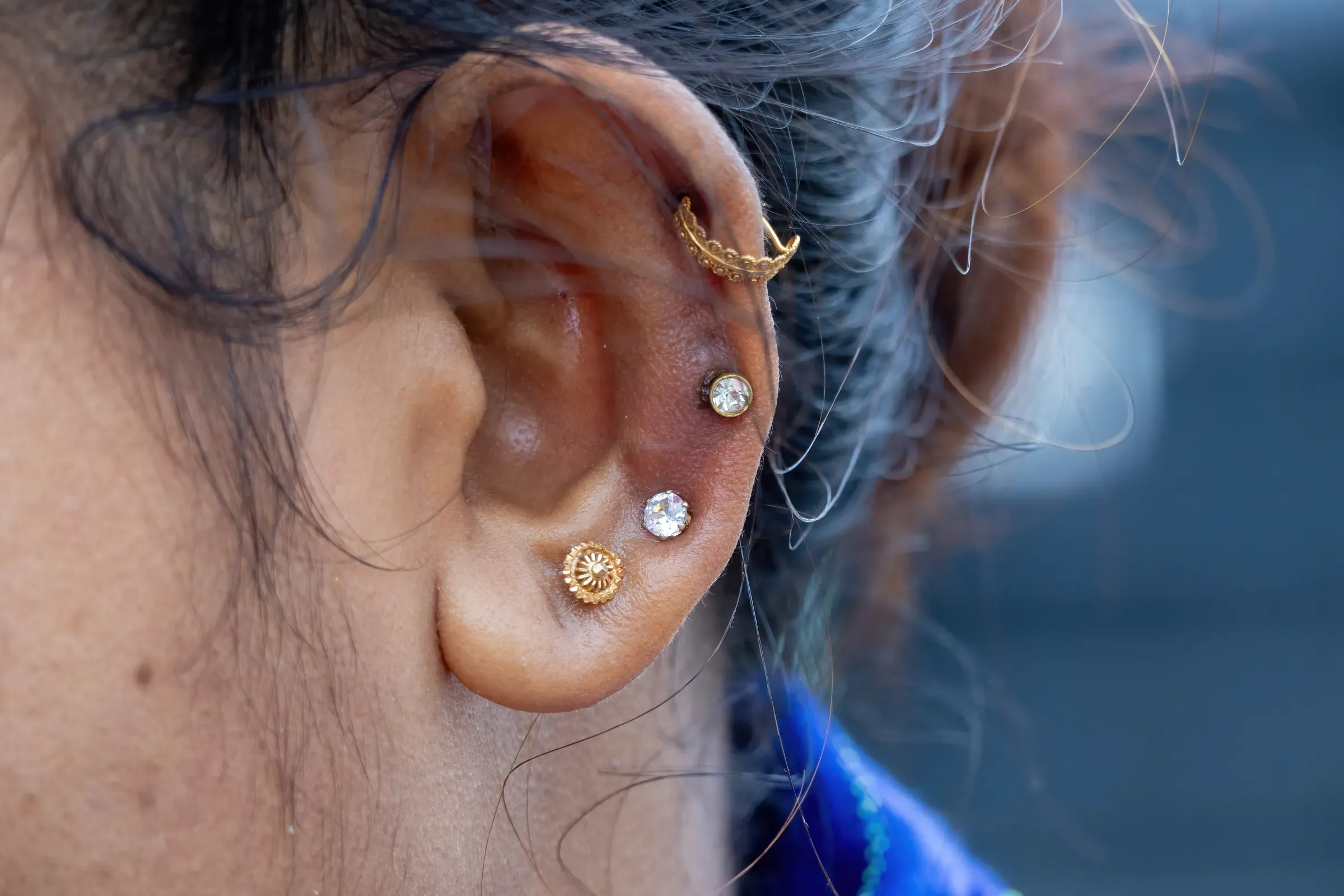
Macro shot of multiple ear piercings including gold studs and a helix hoop on a woman's ear, body & piercing jewelry ecommerce
Body & piercing jewelryPierced customers curating an ear over months, who check gauge, post length, threading style and the exact material specification before ordering, alongside studio owners buying trays at wholesale for clients whose piercings are still healing.

How body & piercing jewelry makes money

Four levers, and what limits each one here

Revenue is traffic times conversion rate times order value times purchase frequency. In this niche each lever has its own ceiling.

Traffic

Traffic: placement, size and material are three separate vocabularies

People searching for body jewelry use one of three languages and a catalog has to speak all of them. Placement is the first: daith, conch, helix, tragus, rook, septum, navel, nostril. Size is the second, written the way the jewelry is ordered, such as a 16 gauge labret at eight millimeters. Material is the third, and it is where the trust sits, because the query is often written as implant grade titanium or nickel free rather than as a metal name. Most stores organize by product shape instead, with collections called Studs and Hoops, which matches none of those searches. Building a page for every placement, every gauge and length combination that sells, and every material standard puts the catalog where the demand already is.

Conversion

Conversion: the measurement problem and the threading match

The single largest conversion blocker in this niche is that the shopper does not know their own numbers. They know they have a helix piercing, not that it is sixteen gauge and needs a seven millimeter post now that the swelling has settled. The store that wins gives them a way to find out: photographs of gauges at actual scale, a printable measuring strip, an explanation of how to read the length of a labret they already own, and a plain comparison of threadless, internally threaded and externally threaded fittings so a top they buy will actually attach to the post in their ear. Adding those to the product page and the collection page moves add-to-cart rate more than any change to photography.

Order value

Order value: the curated ear, the pack and the spare end

Body jewelry is a low unit price with an unusually natural path to a larger basket. Curated ear sets, built as a group of pieces designed to sit together across three or four placements, sell as one decision instead of four. Threadless tops need posts, and a store that pairs them automatically avoids both a smaller order and a support ticket from someone holding a piece that will not attach. Multipacks of backs, ends and o-rings sell because they get lost. Anodized color sets sell because the same titanium end in six finishes is a collection rather than a repeat. None of that needs a discount, only a product page that understands how the pieces fit together.

Frequency

Frequency: healing has stages and ends get lost

Repeat purchase in this niche is built into the way a piercing heals. A new piercing is fitted with a longer post to allow for swelling, and it is downsized weeks later, which is a purchase almost nobody remembers to plan for. Once healed, the first jewelry change is the moment a customer moves from functional titanium to something decorative, and often to gold. After that the pattern is replacement and expansion: an end lost down a drain, a new placement added to the curation, a seasonal color change. A store that knows the date of the first order can meet each of those moments with a message rather than waiting to be remembered.

Search visibility

Search: placement pages, size pages and the material standard

The first build is a page for every placement the catalog serves. A daith page explains what fits a daith, which shapes clear the anatomy, what gauge is typical and what to expect while it heals, then lists the jewelry. That page answers an informational query and a commercial one in the same place, which is why it ranks and why it converts. Placement pages also give the product pages a sensible internal link structure, which a flat catalog of hoops and studs never has.

The second build is size. Gauge and length are how this product is ordered, so they belong in the URL structure and in indexable collections, not only in a filter. A page for sixteen gauge labrets, another for eighteen gauge, another for the common lengths, each with an explanation of who needs that size, catches a query that converts immediately because the searcher already knows exactly what they want.

The third is material, and it is worth writing carefully. Explain what implant grade means, name the specifications the jewelry is made to, and describe what nickel free can and cannot promise. Product pages should carry gauge, length, threading, material and finish as structured data rather than as a sentence, and variants should be grouped so one design does not appear as forty competing pages.

Queries that matter

  • 16g titanium labret stud
  • implant grade titanium earrings for sensitive ears
  • daith piercing jewelry
  • threadless vs internally threaded
  • conch hoop 8mm
  • how to measure piercing jewelry gauge
  • nickel free helix earring

Placement pages that explain what fits and why, gauge and length guides with real measuring help, and material pages naming the actual specification are what rank in body jewelry. A Body Jewelry collection sorted by price, with sizes hidden in a dropdown, does not.

AI answers

AI answers: what fits a healing piercing and what the metal really is

The questions assistants field here are specific and safety-adjacent: what gauge a standard helix is, whether surgical steel and implant grade mean the same thing, when jewelry can first be changed, what threadless actually is. A store becomes quotable when it answers those in plain sentences on pages that are not gated behind a filter, when the material specifications are written out rather than implied by a marketing word, and when aftercare content is framed as general information with a clear pointer back to the piercer rather than as instruction. Consistency matters too, since the gauge on the page, in the markup and in the feed all have to agree.

What gauge is a standard helix piercing?
Is implant grade titanium the same thing as surgical steel?
When can I change the jewelry in a new piercing?
What is the difference between threadless and internally threaded jewelry?
What jewelry can I wear if I react to nickel?

Questions shoppers put to assistants. A store gets named when its pages answer them in plain text.

Google Shopping and Merchant Center

Google Shopping for a catalog measured in millimeters

The feed has to carry the numbers. Gauge and post length belong in the size attribute with a size system, not stitched into the title where no filter can read them, and the title itself should read as a shopper would search: material, placement, gauge, length, finish. Product_detail carries threading style, end fitting, anodized color and the material specification. Item group ids tie every gauge, length and finish of one design together, which stops forty variants competing as forty products.

Policy problems here are mostly about wording and imagery. Surgical steel and implant grade are not interchangeable, and using them as though they were is the kind of claim that draws a misrepresentation review. Images of fresh or irritated piercings fail image policy and can trip adult content review for body placements. Wholesale pricing tiers must be kept out of the retail feed, because a trade price appearing beside a retail page price is a straightforward price mismatch.

Structure campaigns by margin rather than by category. Titanium basics carry volume at thin margin and belong in their own campaign with a modest target. Gold ends carry the contribution and deserve separate bidding, separate custom labels and their own asset groups, because they are bought by a customer who has already healed a piercing and is upgrading.

Feed attributes that decide eligibility

  • size carrying gauge and post length with a size_system
  • material naming the specification, such as ASTM F136 titanium
  • product_detail for threading style and end fitting
  • item_group_id across gauges, lengths and finishes
  • color for gold tone and anodized finish
  • identifier_exists for ends manufactured in house
  • custom_label separating titanium basics from gold

Disapprovals we see in this niche

  • Surgical steel and implant grade used interchangeably in titles
  • Images showing a fresh, healing or irritated piercing
  • Sizes written only in the title with no size attribute submitted
  • Wholesale tier pricing leaking into the retail feed
  • Adult content review triggered by body placement imagery

Meta and social ads

Meta and social ads: the curated ear, and the ruler

The creative that carries this niche is close, slow and technical. A curated ear built piece by piece with each placement named on screen sells the idea of the whole project rather than one stud. A hand holding a threadless top beside an internally threaded one settles a question that costs the store orders every week. A ten second clip showing how to measure the labret already in your ear is both an ad and the answer to the top support question. Product on a tray, filmed under daylight, works because the colors of anodized titanium are the actual product.

Policy is tighter here than most jewelry categories. Fresh, healing or irritated piercings are not usable in creative, and body placements need to be shot in a way that keeps them clear of nudity review. Aftercare should be framed as general information pointing back to a professional piercer, never as treatment. Creator content needs written rights and a check that the creator has not claimed a material standard the product does not meet.

  • A curated ear built piece by piece with each placement named on screen
  • Threadless and internally threaded held side by side in one hand
  • How to measure the labret already in your ear, in fifteen seconds
  • A piercer explaining why downsizing matters, filmed in the studio
  • One titanium end anodized in six colors, laid out on a tray

Policy line

No images of fresh, healing or irritated piercings, no aftercare presented as medical treatment, body placements shot to stay clear of nudity review, and material specifications written exactly as the standard names them.

Conversion and the store

The store: a product page that gives the shopper their own numbers

Assume the shopper does not know their size and design the page to fix that in place, not to send them away to find out. That means gauge and length selectors with a visual scale beside them, a printable measuring strip, a short explanation of how to measure an existing piece, and a threading compatibility note on every top and every post. It also means saying plainly when a piece is not suitable for a healing piercing, because the alternative is a customer who blames the store for a problem the product never claimed to solve.

The second job is the final sale policy. Hygiene rules make most body jewelry non-returnable, and hiding that in the footer produces angry tickets rather than fewer of them. Say it on the product page, next to the sizing help that makes it fair, and offer a low-cost sizing exchange on unworn items where the business can carry it. Mobile matters more than usual here because much of the traffic arrives from social, so the size selector, the price and the compatibility note all need to sit above the fold.

Objections the page must answer

  • “What gauge and length do I actually need”
  • “Will this attach to the post already in my ear”
  • “Is this genuinely implant grade or just called surgical steel”
  • “Can I wear this while the piercing is still healing”
  • “What happens if I order the wrong size and cannot return it”

Email, SMS and retention

Email and SMS: measure, downsize, curate, restock

The first flow is educational because the first order is usually a guess. A short measuring guide sent immediately after the first purchase reduces the wrong-size complaint that would otherwise arrive a week later, and it teaches the customer the vocabulary that makes every future order faster. The downsizing reminder follows at the point a new piercing has usually settled, and it is one of the few genuinely useful automated messages in jewelry, because the customer needs the product and does not know it yet.

After healing, the program turns to curation. A message that shows what sits well beside the piece already bought, with the placements named, is the natural second order. Spare ends and backs go out later because they get lost. Wholesale runs on its own schedule with restock timing based on the size of the last tray order, and it should never receive the retail promotional calendar. SMS is worth using for restocks of popular gold ends, which sell out quickly and drive the most disappointed inbox replies.

  1. How to measure

    Immediately after a first order

  2. Downsizing reminder

    Six to eight weeks after a first piercing purchase

  3. Curate the ear

    Three to five weeks after the first order

  4. Spare ends and backs

    Twelve weeks after any threadless purchase

  5. Wholesale restock

    Six weeks after a studio tray order

Where revenue leaks

The leaks we find in body & piercing jewelry stores

The Growth Analysis ranks these against your own numbers and says which to close first.

Get a Growth Analysis for your body jewelry brand
  • Sizes trapped inside the product title

    Gauge and length exist as words in a heading rather than as attributes, so shoppers cannot filter, the feed cannot report them and Shopping shows the product for far fewer of the queries it should win.

  • Surgical steel used as a synonym for implant grade

    The two describe different specifications. Using them interchangeably loses the customer who came looking specifically because of a reaction, and it invites a misrepresentation review in the ad account.

  • Tops sold without the post they need

    A threadless top arrives with nothing to attach it to. The order is smaller than it should have been and the support ticket costs more than the margin on the piece.

  • Studios checking out at retail prices

    There is no trade application, no customer group and no wholesale landing page, so professional buyers either pay retail once and leave, or place their standing order somewhere that made it easy.

  • No measuring help before the first order

    The store expects a shopper to know their own gauge. Most do not, so they either guess and complain, or leave to find a chart on a forum and buy from whoever published it.

Platform notes

Where the platform changes the work

Shopify

Gauge, length and finish as three variant options reaches the platform's variant ceiling quickly, so designs are split into families and tied together with metafields and item group ids rather than piled into one product. Trade pricing runs through a separate B2B catalog so wholesale rates never reach the retail feed.

WooCommerce

Global attributes for gauge, length, threading and material power the filters and the attribute archives that can be set to index, which is how the size pages get built. A role-based pricing plugin handles studio accounts, and the feed plugin has to be told to map size attributes rather than concatenating them into the title.

BigCommerce

Variant rules handle price differences between gauges without duplicating products, customer groups carry studio pricing, and faceted search needs canonical rules so gauge and length combinations do not flood the index.

Questions

Body & piercing jewelry owners ask us

By CartKernel · Last reviewed

How should gauge and length be handled in the catalog and the feed?

As structured size data on every product, with a size system set, and as variants of one design rather than separate products. That lets shoppers filter to what fits, lets Shopping match exact size queries, and keeps one design from appearing as dozens of near-identical listings. Sizes written only into the title are invisible to every system that matters.

Can body jewelry be advertised without images causing problems?

Yes, with discipline about what is shown. Fully healed piercings photographed cleanly are fine. Fresh, irritated or bleeding piercings are not, and body placements need framing that keeps the creative clear of nudity review. Feed images should be the jewelry on plain white with no overlays, with lifestyle shots kept for the product page and social.

Should we sell wholesale to piercing studios through the same store?

Usually the same store with a separate trade path: an application form, a customer group with trade pricing, its own landing pages and its own conversion action. Studios buy in trays on a restock cycle and should never be judged against a retail return target. Keeping trade pricing out of the retail feed avoids price mismatch problems in Merchant Center.

How do we talk about materials without overclaiming?

Name the specification the jewelry is actually made to and explain what it means in a sentence. If a piece is titanium made to a recognized implant specification, say which one. If it is steel, call it steel. Avoid nickel free as a blanket promise unless the material genuinely supports it, and keep the same wording on the page, in the feed and in the ads.

Is aftercare content worth publishing on a body jewelry store?

It is, as general information rather than instruction. Healing timelines, what downsizing is and why swelling changes the post length you need are all searched heavily and they sell the right product at the right moment. Write them plainly, point the reader back to their piercer for anything specific to their own healing, and never frame the content as treatment advice.

What does repeat purchase look like for a piercing jewelry brand?

It follows the healing timeline. A first order is functional and usually oversized, a downsize follows weeks later, the first decorative change comes once healed, and curation continues from there with new placements and replacement ends. Timing flows to those stages produces far more repeat revenue than a promotional calendar, because each message meets a need the customer already has.

Grow your body & piercing jewelry store.

A free Growth Analysis ranks what your store should fix first, by revenue at stake, in about a week.